


Medial temporal theta state before an event predicts episodic encoding success in humans
- PMID: 19289818
- PMCID: PMC2663999
- DOI: 10.1073/pnas.0900289106
Medial temporal theta state before an event predicts episodic encoding success in humans
Abstract
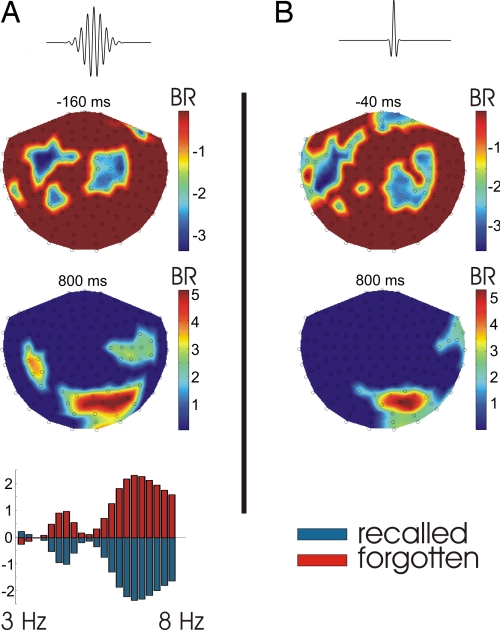
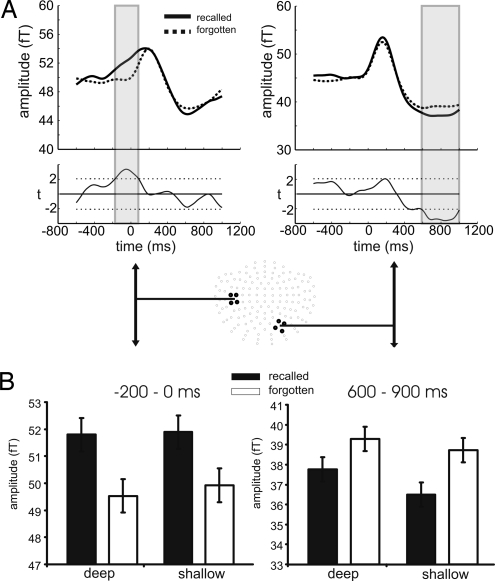
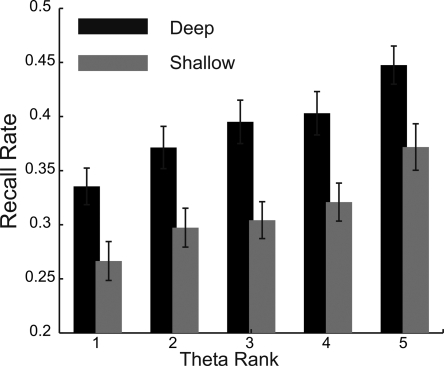
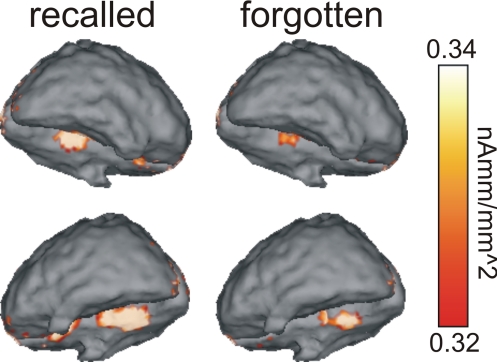
We report a human electrophysiological brain state that predicts successful memory for events before they occur. Using magnetoencephalographic recordings of brain activity during episodic memory encoding, we show that amplitudes of theta oscillations shortly preceding the onsets of words were higher for later-recalled than for later-forgotten words. Furthermore, single-trial analyses revealed that recall rate in all 24 participants tested increased as a function of increasing prestimulus theta amplitude. This positive correlation was independent of whether participants were preparing for semantic or phonemic stimulus processing, thus likely signifying a memory-related theta state rather than a preparatory task set. Source analysis located this theta state to the medial temporal lobe, a region known to be critical for encoding and recall. These findings provide insight into state-related aspects of memory formation in humans, and open a perspective for improving memory through theta-related brain states.
Conflict of interest statement
The authors declare no conflict of interest.
Figures
References
-
- Fernandez G, et al. Real-time tracking of memory formation in the human rhinal cortex and hippocampus. Science. 1999;285:1582–1585. - PubMed
-
- Paller KA, Kutas M, Mayes AR. Neural correlates of encoding in an incidental learning paradigm. Electroencephalogr Clin Neurophysiol. 1987;67:360–371. - PubMed
-
- Schott B, Richardson-Klavehn A, Heinze HJ, Duzel E. Perceptual priming versus explicit memory: Dissociable neural correlates at encoding. J Cogn Neurosci. 2002;14:578–592. - PubMed
-
- Brewer JB, Zhao Z, Desmond JE, Glover GH, Gabrieli JD. Making memories: Brain activity that predicts how well visual experience will be remembered. Science. 1998;281:1185–1187. - PubMed
-
- Buckner RL, Logan J, Donaldson DI, Wheeler ME. Cognitive neuroscience of episodic memory encoding. Acta Psychol (Amst) 2000;105:127–139. - PubMed
Publication types
MeSH terms
LinkOut - more resources
Full Text Sources
Other Literature Sources
Medical
