. 2009 Mar 31;106(13):5424-9.
doi: 10.1073/pnas.0812729106. Epub 2009 Mar 16.

Cyclophilin 40 is required for microRNA activity in Arabidopsis

Affiliations

Cyclophilin 40 is required for microRNA activity in Arabidopsis

Michael R Smith et al. Proc Natl Acad Sci U S A. .

Abstract

Loss-of-function mutations of SQUINT (SQN)-which encodes the Arabidopsis orthologue of cyclophilin 40 (CyP40)-cause the precocious expression of adult vegetative traits, an increase in carpel number, and produce abnormal spacing of flowers in the inflorescence. Here we show that the vegetative phenotype of sqn is attributable to the elevated expression of miR156-regulated members of the SPL family of transcription factors and provide evidence that this defect is a consequence of a reduction in the activity of ARGONAUTE1 (AGO1). Support for this latter conclusion was provided by the phenotypic similarity between hypomorphic alleles of AGO1 and null alleles of SQN and by the genetic interaction between sqn and these alleles. Our results suggest that AGO1, or an AGO1-interacting protein, is a major client of CyP40 and that miR156 and its targets play a central role in the regulation of vegetative phase change in Arabidopsis.


Conflict of interest statement

The authors declare no conflict of interest.

Figures
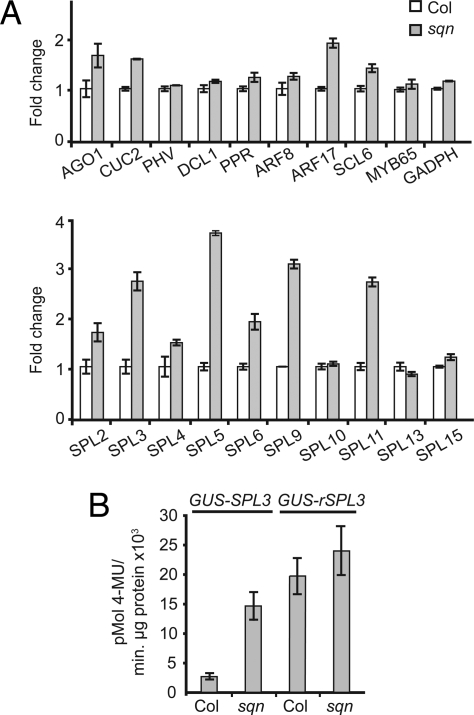
Fig. 1.
Fig. 1.
sqn interferes with miRNA-mediated silencing. (A) Quantitative RT-PCR analysis of miRNA-targeted transcripts in 12- (top graph) and 18-day-old (bottom graph) sqn seedlings, relative to wild-type Col. GADPH was used as a nontarget control. Values were normalized to actin-2, then to the value of wild-type Col plants, which was fixed to 1. Average of 3 replicates (±SEM). (B) GUS activity in extracts of 30 primary transformants of wild-type Col and sqn plants transformed with miR156-sensitive (35S::rSPL3) or miR156-resistant (35S::rSPL3) reporter genes (±SEM).
Fig. 2.
Fig. 2.
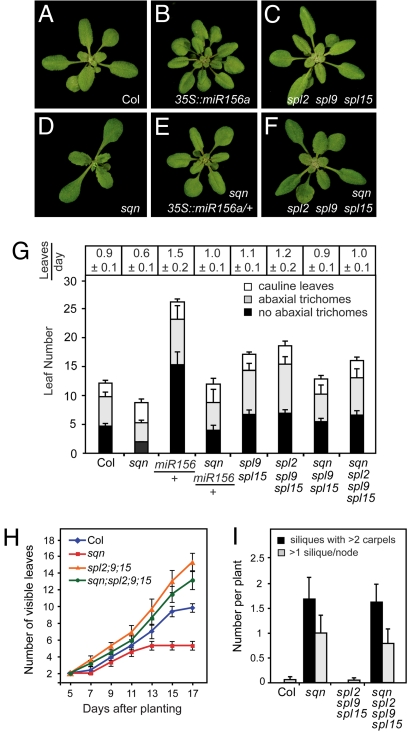
The vegetative phenotype of sqn is attributable to the overexpression of genes normally repressed by miR156. (A–F) 21-day-old rosettes. (A) Wild-type Col, (B) 35S::miR156, (C) spl2–1 spl9–4 spl15–1, (D) sqn, (E) sqn 35S::miR156a/+, (F) sqn, spl2–1 spl9–4 spl15–1. (G) Rate of leaf initiation and number of juvenile (abaxial trichomes), adult (no abaxial trichomes), and cauline leaves in various genotypes (±SEM). (H) The rate of leaf initiation in wild-type Col, sqn, spl2–1 spl9–4 spl15–1, and sqn spl2–1 spl9–4, spl15–1 (±SEM). (I) spl2–1 spl9–4 spl15–1 does not rescue the effect of sqn on carpel number or silique spacing.
Fig. 3.
Fig. 3.
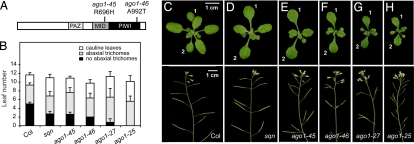
Weak alleles of AGO1 resemble sqn. (A) ago1–45 and ago1–46 are missense mutations in the MID and PIWI domains of AGO1. (B) sqn and ago1 mutations reduce the number of juvenile leaves (leaves with no abaxial trichomes), have little or no effect on the number of adult leaves (leaves with abaxial trichomes), and increase the number of cauline leaves (±SEM). (C–H) Eighteen-day-old rosettes and immature inflorescences of (C) wild-type Col, (D) sqn, (E) ago1–45, (F) ago1–46, (G) ago1–27, and (H) ago1–25. Leaves 1 and 2 are indicated. Rosettes are at the same magnification, as are the inflorescences.
Fig. 4.
Fig. 4.
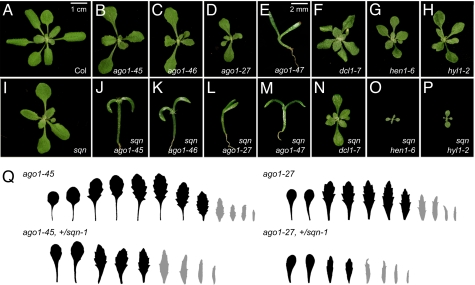
sqn interacts synergistically with genes in the miRNA pathway. (A–P) Two-week-old wild-type Col (A), and plants singly and doubly mutant for sqn (I) and ago1–45 (B and J), ago1–46 (C and K), ago1–27 (D and L), ago1–47 (E and M), dcl1–7 (F and N), hen1–6 (G and O), and hyl1–2 (H and P). sqn ago1 double mutants have the same severe phenotype as the ago1 null allele, ago1–47. Double mutants between sqn and dcl1–7, hen1–6, and hyl1–2 were smaller, grew more slowly, displayed earlier onset of abaxial trichomes, and had more severe floral defects and lower fertility than the single mutants. A–D, F–I, and N–P are at the magnification indicated in A. E and J–M are at the magnification indicated in E. (Q) Successive rosette (black) and cauline (gray) leaves of an ago1–45 and ago1–27 plant, and plants homozygous for ago1–45 or ago1–27 and heterozygous for sqn. sqn dominantly enhances the phenotype of these ago1 mutations.
Fig. 5.
Fig. 5.
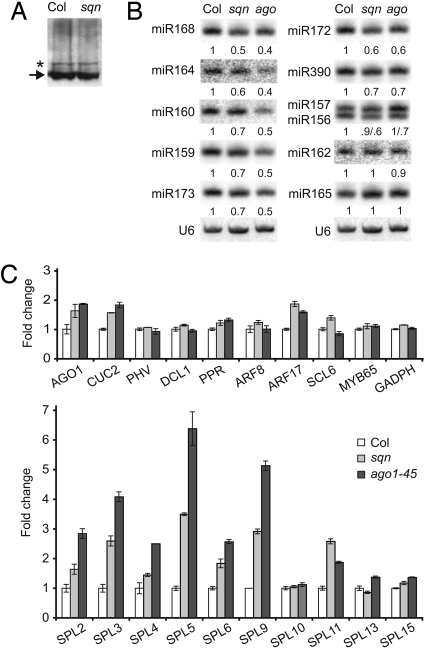
sqn and ago1–45 have similar effects on gene expression. (A) Western blot of protein isolated from Col and sqn seedlings probed with an antibody to AGO1; the background band indicated by the asterisk served as a loading control. (B) Northern blot of low-molecular-weight RNA isolated from floral buds of wild-type, sqn, and ago1–45 plants and hybridized sequentially with oligonucleotides complementary to the functional strand of the indicated miRNA. U6 was used as a loading control. (C) The abundance of miRNA-regulated transcripts in ago1–45 and sqn, relative to wild type. The values for sqn are the same as those in Fig. 2 and are presented here again for comparison. Quantitative RT-PCR was performed on RNA isolated from 12- (top graph) and 18-day-old (bottom graph) seedlings using primers specific for each gene. GADPH was used as a nontarget control. Values were normalized to actin-2, then to the value of wild-type Col plants, which was fixed to 1. Average of 3 replicates (±SEM).

References

    1. Berardini TZ, Bollman K, Sun H, Poethig RS. Regulation of vegetative phase change in Arabidopsis thaliana by cyclophilin 40. Science. 2001;291:2405–2407. - PubMed
    1. Galat A. Peptidylproline cis-trans-isomerases: Immunophilins. Eur J Biochem. 1993;216:689–707. - PubMed
    1. He Z, Li L, Luan S. Immunophilins and parvulins. Superfamily of peptidyl prolyl isomerases in Arabidopsis. Plant Physiol. 2004;134:1248–1267. - PMC - PubMed
    1. Harrar Y, Bellini C, Faure JD. FKBPs: At the crossroads of folding and transduction. Trends Plants Sci. 2001;6:426–431. - PubMed
    1. Vittorioso P, Cowling R, Faure JD, Caboche M, Bellini C. Mutation in the Arabidopsis PASTICCINO1 gene, which encodes a new FK506-binding protein-like protein, has a dramatic effect on plant development. Mol Cell Biol. 1998;18:3034–3043. - PMC - PubMed

Publication types

LinkOut - more resources