


Multi-stimuli sensitive amphiphilic block copolymer assemblies
- PMID: 19290632
- PMCID: PMC2693022
- DOI: 10.1021/ja809475a
Multi-stimuli sensitive amphiphilic block copolymer assemblies
Abstract
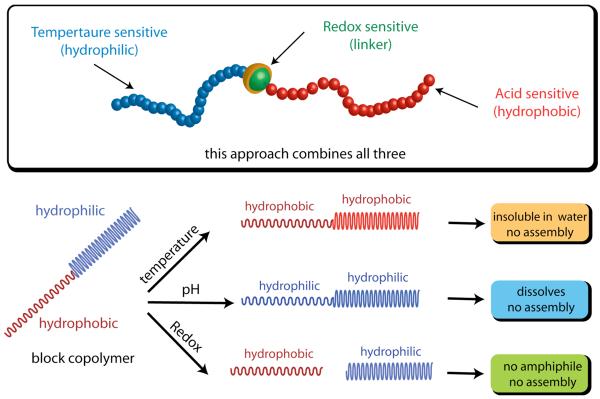
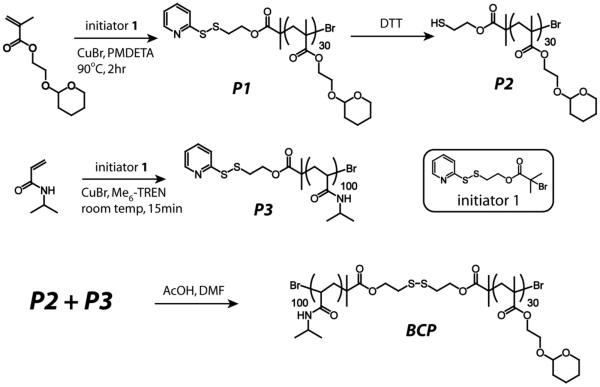
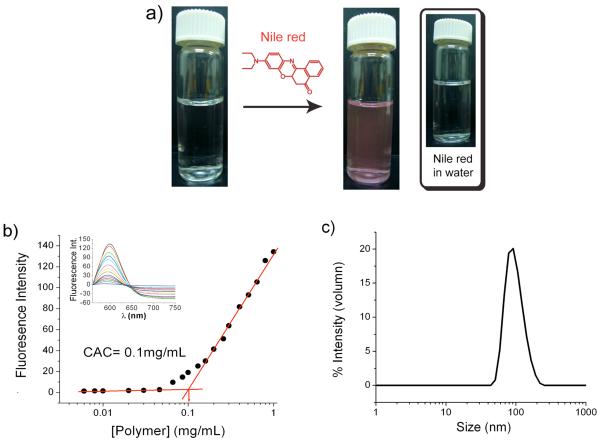
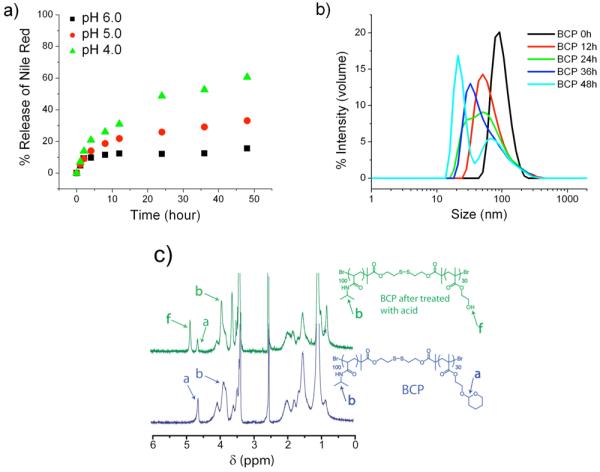
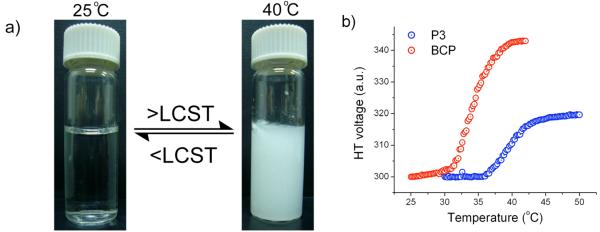
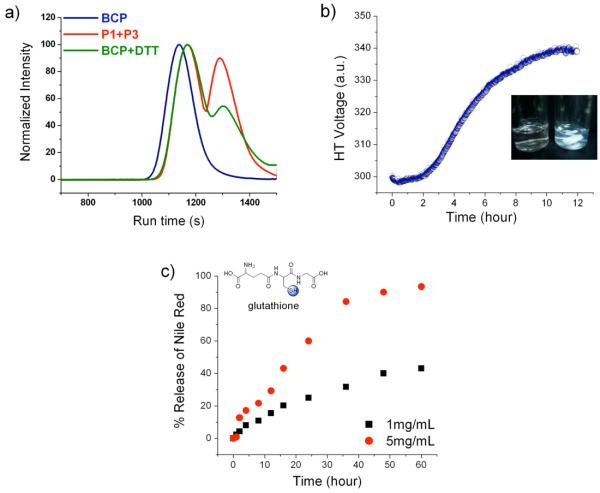
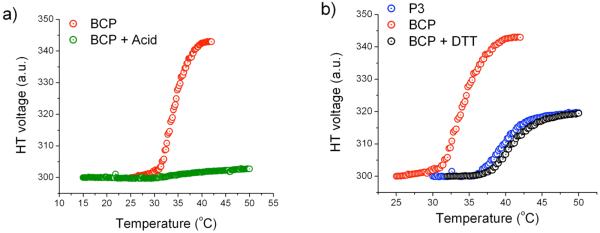
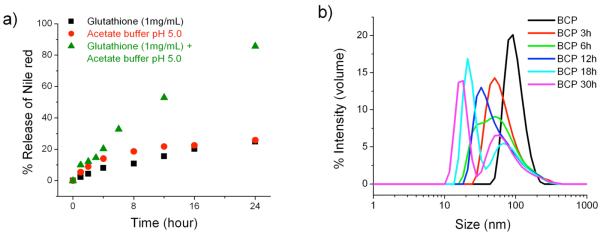
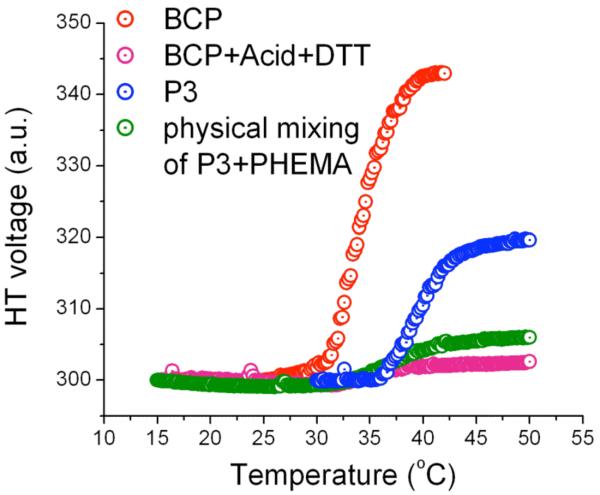
Stimuli-responsive polymers are arguably the most widely considered systems for a variety of applications in biomedical arena. We report here a novel triple stimuli sensitive block copolymer assembly that responds to changes in temperature, pH and redox potential. Our block copolymer design constitutes an acid-sensitive THP-protected HEMA as the hydrophobic part and a temperature-sensitive PNIPAM as the hydrophilic part with an intervening disulfide bond. The micellar properties and the release kinetics of the encapsulated guest molecule in response to one stimulus as well as combinations of stimuli have been evaluated. Responsiveness to combination of stimuli not only allows for fine-tuning the guest molecule release kinetics, but also provides the possibility of achieving location-specific delivery.
Figures
References
-
- Astruc D, Chardac F. Chem. Rev. 2001;101:2991–3024. - PubMed
- Persigehl P, Jordan R, Nuyken O. Macromolecules. 2000;33:6977–6981.
- Vriezema DM, Comellas Aragones M, Elemans JAAW, Cornelissen JJLM, Rowan AE, Nolte RJM. Chem. Rev. 2005;105:1445–1490. - PubMed
- Jung HM, Price KE, McQuade DT. J. Am. Chem. Soc. 2003;125:5351–5355. - PubMed
-
- Tew GN, Pralle MU, Stupp SI. Angew. Chem., Int. Ed. 2000;39:517–521. - PubMed
- Lee M, Cho B-K, Zin W-C. Chem. Rev. 2001;101:3869–3892. - PubMed
- Fuhrhop J-H, Wang T. Chem. Rev. 2004;104:2901–2937. - PubMed
- Brunsveld L, Folmer BJB, Meijer EW, Sijbesma RP. Chem. Rev. 2001;101:4071–4098. - PubMed
- Estroff LA, Hamilton AD. Chem. Rev. 2004;104:1201–1218. - PubMed
-
- Okano T, Bae YH, Jacobs H, Kim SW. J. Controlled Release. 1990;11:255–265.
- Hoffman AS. J. Controlled Release. 1987;6:297–305.
- Brønsdsted H, Kopecek J. Biomaterials. 1991;12:584–592. - PubMed
- Yeh P, Kopečková P, Kopeček J. J. Polym. Sci., Polym. Chem. 1994;32:1627–1637.
- Ganta S, Devalapally H, Shahiwala A, Amiji M. J. Controlled Release. 2008;126:187–204. - PubMed
- Kataoka K, Harada A, Nagasaki Y. Adv. Drug Delivery Rev. 2001;47:113–131. - PubMed
- Rapoport N. Prog. Polym. Sci. 2007;32:962–990.
-
- Zhang L, Yu K, Eisenberg A. Science. 1996;272:1777–1779. - PubMed
- Zhang L, Eisenberg A. J. Am. Chem. Soc. 1996;118:3168–3181.
- Discher DE, Eisenberg A. Science. 2002;297:967–973. - PubMed
- Zhou Z, Li Z, Ren Y, Hillmyer MA, Lodge TP. J. Am. Chem. Soc. 2003;125:10182–10183. - PubMed
- Sanji T, Kitayama F, Sakurai H. Macromolecules. 1999;32:5718–5720.
- Neiser MW, Muth S, Kolb U, Harris JR, Okuda J, Schmidt M. Angew. Chem., Int. Ed. 2004;43:3192–3195. - PubMed
-
- Goodwin AP, Mynar JL, Ma Y, Fleming GR, Frechet JMJ. J. Am. Chem. Soc. 2005;127:9952–9953. - PubMed
- Jiang J, Tong X, Zhao Y. J. Am. Chem. Soc. 2005;127:8290–8291. - PubMed
- Anderson VC, Thompson DH. Biochim. Biophys. Acta. 1992;1109:33–42. - PubMed
- Nishiyama N, Iriyama A, Jang WD, Miyata K, Itaka K, Inoue Y, Takahashi H, Yanagi Y, Tamaki Y, Koyama H, Kataoka K. Nat. Mater. 2005;4:934–941. - PubMed
Publication types
MeSH terms
Substances
Grants and funding
LinkOut - more resources
Full Text Sources
Other Literature Sources
