


Review
doi: 10.1186/gb-2009-10-3-213.
Epub 2009 Mar 6.
Rac and Rho driving tumor invasion: who's at the wheel?
Affiliations
- PMID: 19291272
- PMCID: PMC2690992
- DOI: 10.1186/gb-2009-10-3-213
Item in Clipboard
Review
Rac and Rho driving tumor invasion: who's at the wheel?
Genome Biol.
2009.
Abstract
Genome-wide analysis of regulators of Rho-family small GTPases has identified critical elements that control the morphology and invasive behavior of melanoma cells.
Figures
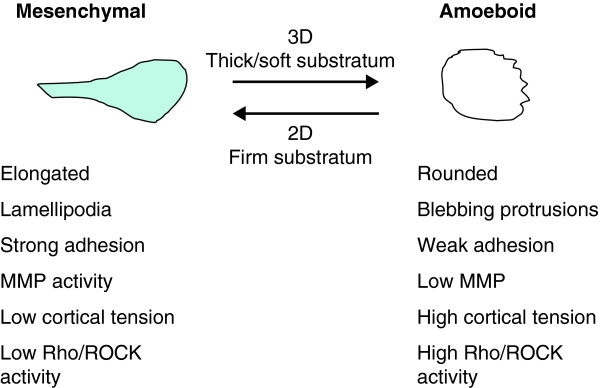
Characteristics of the mesenchymal and amoeboid cell phenotypes.
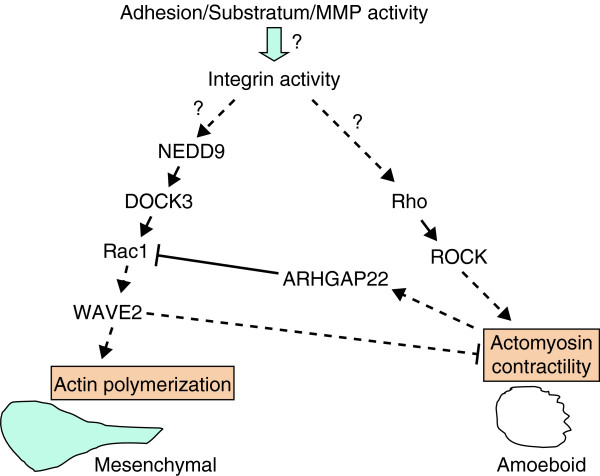
Signaling control of mesenchymal and amoeboid cell phenotypes. The reciprocal inhibitory relationship between Rac and Rho signaling cascades establishes a bistable switch that controls the mesenchymal and amoeboid phenotypes. Mesenchymal morphology is controlled by a pathway that activates Rac1 via the adaptor protein NEDD9 and the Rac-specific GEF DOCK3. Rac1 activation results in actin polymerization mediated by the actin-nucleation protein WAVE2, which promotes cell elongation. WAVE2 somehow also suppresses actomyosin contractility and, consequently, amoeboid behavior. On the other hand, Rho/ROCK activation stimulates actomysoin contractility, thereby promoting the amoeboid phenotype, and inhibits Rac by activating the Rac-specific GAP, ARHGAP22. Presumably both Rac1 and Rho activation are ultimately controlled by integrin activity, but precisely how the extracellular environment favors either Rac or Rho signaling remains to be resolved. Solid arrows, direct connections; dashed arrows, indirect connections.
References
-
- Wolf K, Mazo I, Leung H, Engelke K, von Andrian UH, Deryugina EI, Strongin AY, Brocker EB, Friedl P. Compensation mechanism in tumor cell migration: mesenchymalamoeboid transition after blocking of pericellular proteolysis. J Cell Biol. 2003;160:267–277. doi: 10.1083/jcb.200209006. - DOI - PMC - PubMed
Publication types
MeSH terms
Substances
Grants and funding
LinkOut - more resources
Full Text Sources
Miscellaneous
