


Prognostic factors for 5-year survival after local excision of rectal cancer
- PMID: 19291825
- PMCID: PMC2658846
- DOI: 10.3748/wjg.15.1242
Prognostic factors for 5-year survival after local excision of rectal cancer
Abstract
Aim: To evaluate the prognostic factors for 5-year survival after local excision of rectal cancer, and to examine the therapeutic efficacy and surgical indications for this procedure.
Methods: Clinical data, obtained from 106 local rectal cancer excisions performed between January 1980 and December 2005, were retrospectively analyzed. Survival analysis was performed using the Kaplan-Meier method, statistical comparisons were performed using the log-rank test, and multivariate analysis was performed using the Cox proportional hazards model.
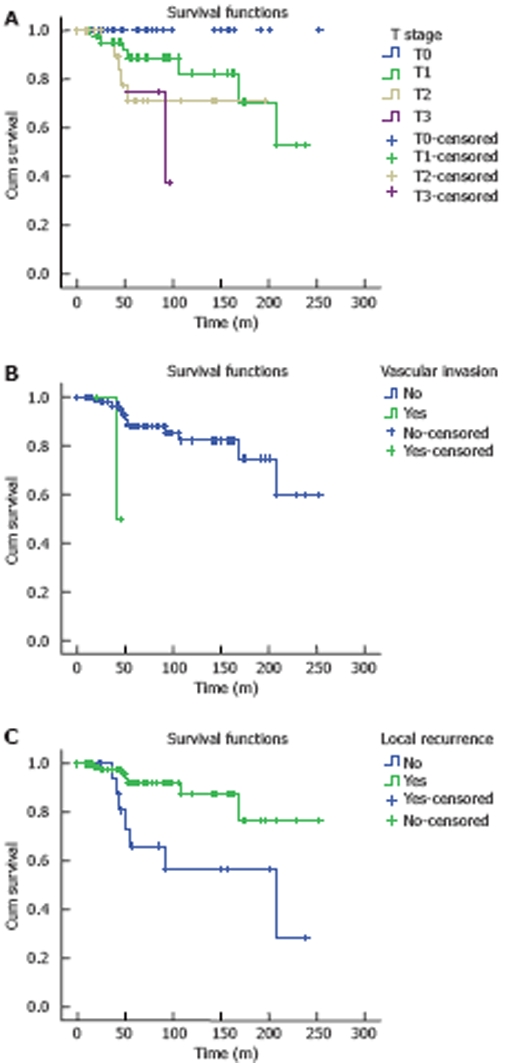
Results: Transanal, transsacral, and transvaginal excisions were performed in 92, 12, and 2 cases, respectively. The rate of complication, local recurrence, and 5-year survival was 6.6%, 17.0%, and 86.7%, respectively. Univariate analysis showed that T stage, vascular invasion, and local recurrence were related to the prognosis of the cases (P < 0.05). Multivariate analysis showed that T stage [P = 0.011, 95% confidence interval (CI) = 1.194-3.878] and local recurrence (P = 0.022, 95% CI = 1.194-10.160) were the major prognostic factors for 5-year survival of cases after local excision of rectal cancer.
Conclusion: Local rectal cancer excision is associated with few complications, and suitable for stages Tis and T1 rectal cancer. Prevention of local recurrence, active postoperative follow-up, and administration of salvage therapy are the effective methods to increase the efficacy of local excision of rectal cancer.
Figures
References
-
- Heintz A, Mörschel M, Junginger T. Comparison of results after transanal endoscopic microsurgery and radical resection for T1 carcinoma of the rectum. Surg Endosc. 1998;12:1145–1148. - PubMed
-
- Willett CG, Compton CC, Shellito PC, Efird JT. Selection factors for local excision or abdominoperineal resection of early stage rectal cancer. Cancer. 1994;73:2716–2720. - PubMed
-
- Mellgren A, Sirivongs P, Rothenberger DA, Madoff RD, García-Aguilar J. Is local excision adequate therapy for early rectal cancer? Dis Colon Rectum. 2000;43:1064–1071; discussion 1071-1074. - PubMed
-
- Sengupta S, Tjandra JJ. Local excision of rectal cancer: what is the evidence? Dis Colon Rectum. 2001;44:1345–1361. - PubMed
-
- Blair S, Ellenhorn JD. Transanal excision for low rectal cancers is curative in early-stage disease with favorable histology. Am Surg. 2000;66:817–820. - PubMed
MeSH terms
LinkOut - more resources
Full Text Sources
