Monophyletic origin of domestic bactrian camel (Camelus bactrianus) and its evolutionary relationship with the extant wild camel (Camelus bactrianus ferus)
- PMID: 19292708
- PMCID: PMC2721964
- DOI: 10.1111/j.1365-2052.2008.01848.x
Monophyletic origin of domestic bactrian camel (Camelus bactrianus) and its evolutionary relationship with the extant wild camel (Camelus bactrianus ferus)
Abstract
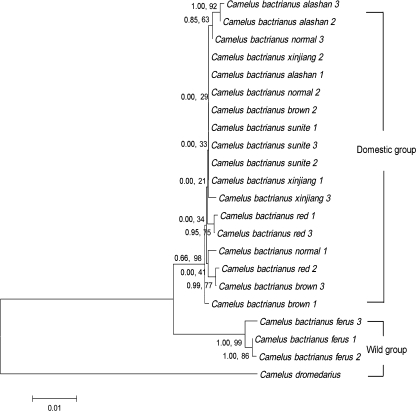
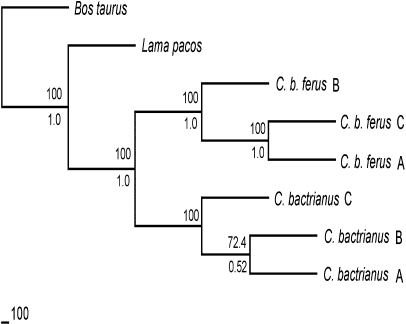
The evolutionary relationship between the domestic bactrian camel and the extant wild two-humped camel and the factual origin of the domestic bactrian camel remain elusive. We determined the sequence of mitochondrial cytb gene from 21 camel samples, including 18 domestic camels (three Camelus bactrianus xinjiang, three Camelus bactrianus sunite, three Camelus bactrianus alashan, three Camelus bactrianus red, three Camelus bactrianus brown and three Camelus bactrianus normal) and three wild camels (Camelus bactrianus ferus). Our phylogenetic analyses revealed that the extant wild two-humped camel may not share a common ancestor with the domestic bactrian camel and they are not the same subspecies at least in their maternal origins. Molecular clock analysis based on complete mitochondrial genome sequences indicated that the sub-speciation of the two lineages had begun in the early Pleistocene, about 0.7 million years ago. According to the archaeological dating of the earliest known two-humped camel domestication (5000-6000 years ago), we could conclude that the extant wild camel is a separate lineage but not the direct progenitor of the domestic bactrian camel. Further phylogenetic analysis suggested that the bactrian camel appeared monophyletic in evolutionary origin and that the domestic bactrian camel could originate from a single wild population. The data presented here show how conservation strategies should be implemented to protect the critically endangered wild camel, as it is the last extant form of the wild tribe Camelina.
Figures
References
-
- Bannikov AG. Wild camels of the Gobi. Wildlife. 1976;18:398–403.
-
- Beja-Pereira A, England PR, Ferrand N, Jordan S, Bakhiet AO, Abdalla MA, Mashkour M, Jordana J, Taberlet P, Luikart G. African origins of the domestic donkey. Science. 2004;304:1781. - PubMed
-
- Ewing B, Green P. Base-calling of automated sequencer traces using phred. II. Error probabilities. Genome Research. 1998;8:186–94. - PubMed
Publication types
MeSH terms
LinkOut - more resources
Full Text Sources