


Electrophysiological correlates of high-level perception during spatial navigation
- PMID: 19293100
- PMCID: PMC2704578
- DOI: 10.3758/PBR.16.2.313
Electrophysiological correlates of high-level perception during spatial navigation
Abstract
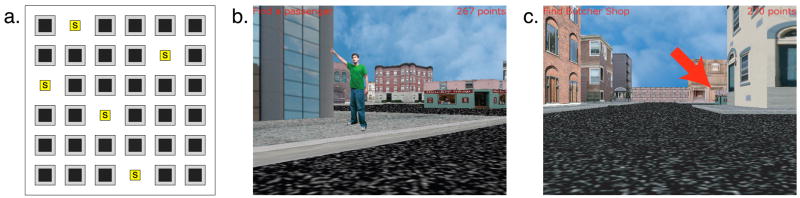
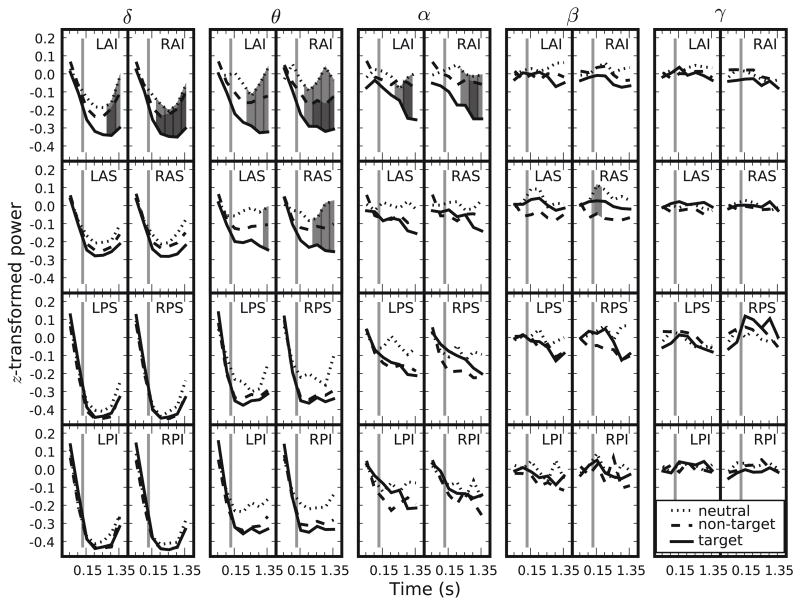
We studied the electrophysiological basis of object recognition by recording scalp electroencephalograms while participants played a virtual-reality taxi driver game. Participants searched for passengers and stores during virtual navigation in simulated towns. We compared oscillatory brain activity in response to store views that were targets or nontargets (during store search) or neutral (during passenger search). Even though store category was solely defined by task context (rather than by sensory cues), frontal electrophysiological activity in the low frequency bands (primarily in the [4-8 Hz] band) reliably distinguished between the target, nontarget, and neutral store views. These results implicate low-frequency oscillatory brain activity in frontal regions as an important variable in the study of the cognitive processes involved in object recognition, categorization, and other forms of high-level perception.
Figures
References
-
- Chun MM. Types and tokens in visual processing: A double dissociation between the attentional blink and repetition blindness. Journal of Experimental Psychology: Human Perception and Performance. 1997;23:738–755. - PubMed
-
- Curran T. Effects of attention and confidence on the hypothesized ERP correlated of recollection and familiarity. Memory & Cognition. 2004;42:1088–1106. - PubMed
-
- Curran T, DeBuse C, Lenynes PA. Conflict and criterion setting in recognition memory. Journal of Experimental Psychology: Learning, Memory, and Cognition. 2007;33:2–17. - PubMed
Publication types
MeSH terms
Grants and funding
LinkOut - more resources
Full Text Sources