SLC45A3-ELK4 is a novel and frequent erythroblast transformation-specific fusion transcript in prostate cancer
- PMID: 19293179
- PMCID: PMC4063441
- DOI: 10.1158/0008-5472.CAN-08-4926
SLC45A3-ELK4 is a novel and frequent erythroblast transformation-specific fusion transcript in prostate cancer
Abstract
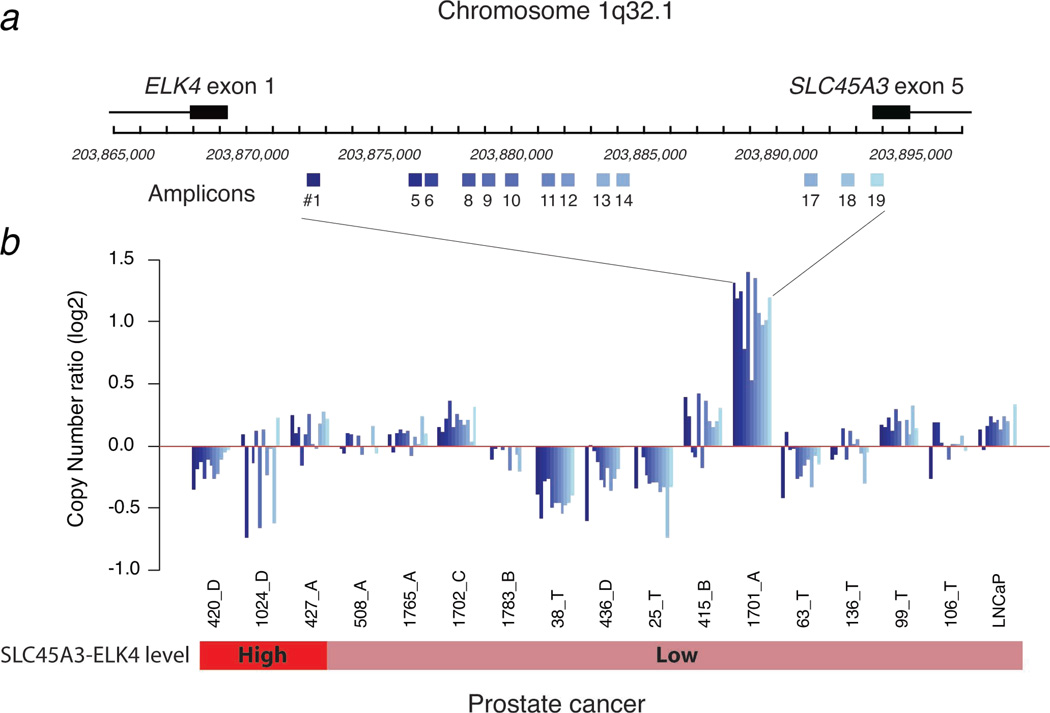
Chromosomal rearrangements account for all erythroblast transformation-specific (ETS) family member gene fusions that have been reported in prostate cancer and have clinical, diagnostic, and prognostic implications. Androgen-regulated genes account for the majority of the 5' genomic regulatory promoter elements fused with ETS genes. TMPRSS2-ERG, TMPRSS2-ETV1, and SLC45A3-ERG rearrangements account for roughly 90% of ETS fusion prostate cancer. ELK4, another ETS family member, is androgen regulated, involved in promoting cell growth, and highly expressed in a subset of prostate cancer, yet the mechanism of ELK4 overexpression is unknown. In this study, we identified a novel ETS family fusion transcript, SLC45A3-ELK4, and found it to be expressed in both benign prostate tissue and prostate cancer. We found high levels of SLC45A3-ELK4 mRNA restricted to a subset of prostate cancer samples. SLC45A3-ELK4 transcript can be detected at high levels in urine samples from men at risk for prostate cancer. Characterization of the fusion mRNA revealed a major variant in which SLC45A3 exon 1 is fused to ELK4 exon 2. Based on quantitative PCR analyses of DNA, unlike other ETS fusions described in prostate cancer, the expression of SLC45A3-ELK4 mRNA is not exclusive to cases harboring a chromosomal rearrangement. Treatment of LNCaP cancer cells with a synthetic androgen (R1881) revealed that SLC45A3-ELK4, and not endogenous ELK4, mRNA expression is androgen regulated. Altogether, our findings show that SLC45A3-ELK4 mRNA expression is heterogeneous, highly induced in a subset of prostate cancers, androgen regulated, and most commonly occurs through a mechanism other than chromosomal rearrangement (e.g., trans-splicing).
Figures



References
-
- Mosquera JM, Perner S, Demichelis F, et al. Morphological features of TMPRSS2-ERG gene fusion prostate cancer. J Pathol. 2007;212:91–101. - PubMed
-
- Demichelis F, Fall K, Perner S, et al. TMPRSS2:ERG gene fusion associated with lethal prostate cancer in a watchful waiting cohort. Oncogene. 2007;26:4596–4599. - PubMed
Publication types
MeSH terms
Substances
Grants and funding
LinkOut - more resources
Full Text Sources
Other Literature Sources
Medical
Molecular Biology Databases