


Effects of modafinil on dopamine and dopamine transporters in the male human brain: clinical implications
- PMID: 19293415
- PMCID: PMC2696807
- DOI: 10.1001/jama.2009.351
Effects of modafinil on dopamine and dopamine transporters in the male human brain: clinical implications
Abstract
Context: Modafinil, a wake-promoting drug used to treat narcolepsy, is increasingly being used as a cognitive enhancer. Although initially launched as distinct from stimulants that increase extracellular dopamine by targeting dopamine transporters, recent preclinical studies suggest otherwise.
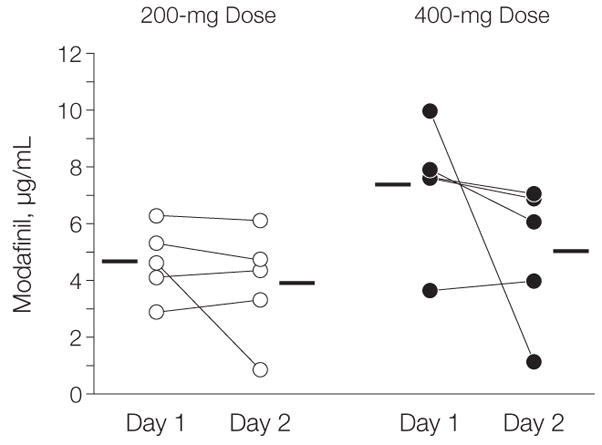
Objective: To measure the acute effects of modafinil at doses used therapeutically (200 mg and 400 mg given orally) on extracellular dopamine and on dopamine transporters in the male human brain.
Design, setting, and participants: Positron emission tomography with [(11)C]raclopride (D(2)/D(3) radioligand sensitive to changes in endogenous dopamine) and [(11)C]cocaine (dopamine transporter radioligand) was used to measure the effects of modafinil on extracellular dopamine and on dopamine transporters in 10 healthy male participants. The study took place over an 8-month period (2007-2008) at Brookhaven National Laboratory.
Main outcome measures: Primary outcomes were changes in dopamine D(2)/D(3) receptor and dopamine transporter availability (measured by changes in binding potential) after modafinil when compared with after placebo.
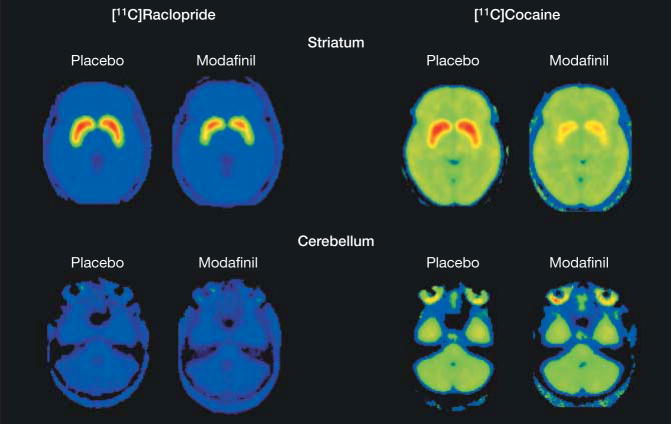
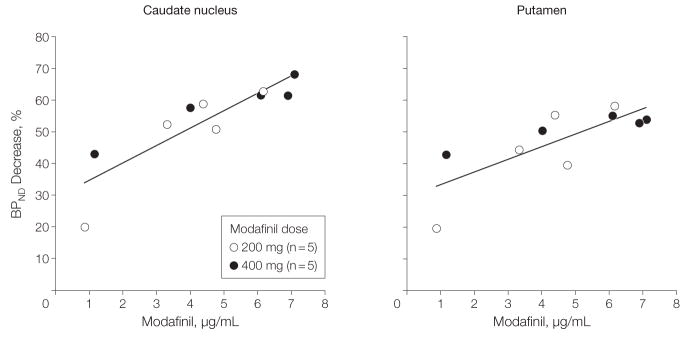
Results: Modafinil decreased mean (SD) [(11)C]raclopride binding potential in caudate (6.1% [6.5%]; 95% confidence interval [CI], 1.5% to 10.8%; P = .02), putamen (6.7% [4.9%]; 95% CI, 3.2% to 10.3%; P = .002), and nucleus accumbens (19.4% [20%]; 95% CI, 5% to 35%; P = .02), reflecting increases in extracellular dopamine. Modafinil also decreased [(11)C]cocaine binding potential in caudate (53.8% [13.8%]; 95% CI, 43.9% to 63.6%; P < .001), putamen (47.2% [11.4%]; 95% CI, 39.1% to 55.4%; P < .001), and nucleus accumbens (39.3% [10%]; 95% CI, 30% to 49%; P = .001), reflecting occupancy of dopamine transporters.
Conclusions: In this pilot study, modafinil blocked dopamine transporters and increased dopamine in the human brain (including the nucleus accumbens). Because drugs that increase dopamine in the nucleus accumbens have the potential for abuse, and considering the increasing use of modafinil, these results highlight the need for heightened awareness for potential abuse of and dependence on modafinil in vulnerable populations.
Figures
References
-
- Minzenberg MJ, Carter CS. Modafinil: a review of neurochemical actions and effects on cognition. Neuropsychopharmacology. 2008;33(7):1477–1502. - PubMed
-
- Enhancing not cheating. Nature. 2007;450 (7168):320. - PubMed
-
- Provigil (modafinil) Physicians’ Desk Reference. 60. Montvale, NJ: Thompson PDR; 2006. pp. 1002–1007.
-
- Kruszewski SP, Klotz SG. Modafinil: mischaracterization. J Clin Psychiatry. 2007;68(6):970–971. - PubMed
-
- Kruszewski SP. Euphorigenic and abusive properties of modafinil. Am J Psychiatry. 2006;163(3):549. - PubMed
Publication types
MeSH terms
Substances
Grants and funding
LinkOut - more resources
Full Text Sources
Other Literature Sources
Medical
