


Risk factors associated with major cerebrovascular complications after intracranial stenting
- PMID: 19299309
- PMCID: PMC2837590
- DOI: 10.1212/01.wnl.0b013e3181a1863c
Risk factors associated with major cerebrovascular complications after intracranial stenting
Abstract
Background: There are limited data on the relationship between patient and site characteristics and clinical outcomes after intracranial stenting.
Methods: We performed a multivariable analysis that correlated patient and site characteristics with the occurrence of the primary endpoint (any stroke or death within 30 days of stenting or stroke in the territory of the stented artery beyond 30 days) in 160 patients enrolled in this stenting registry. All patients presented with an ischemic stroke, TIA, or other cerebral ischemic event (e.g., vertebrobasilar insufficiency) in the territory of a suspected 50-99% stenosis of a major intracranial artery while on antithrombotic therapy.
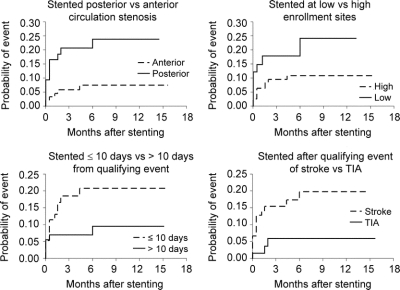
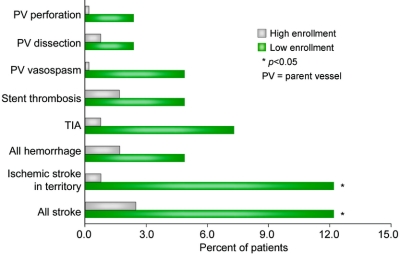
Results: Cerebral angiography confirmed that 99% (158/160) of patients had a 50-99% stenosis. In multivariable analysis, the primary endpoint was associated with posterior circulation stenosis (vs anterior circulation) (hazard ratio [HR] 3.4, 95% confidence interval [CI] 1.2-9.3, p = 0.018), stenting at low enrollment sites (< 10 patients each) (vs high enrollment site) (HR 2.8, 95% CI 1.1-7.6, p = 0.038), < or = 10 days from qualifying event to stenting (vs > or = 10 days) (HR 2.7, 95% CI 1.0-7.8, p = 0.058), and stroke as a qualifying event (vs TIA/other) (HR 3.2, 95% CI 0.9-11.2, p = 0.064). There was no significant difference in the primary endpoint based on age, gender, race, or percent stenosis (50-69% vs 70-99%).
Conclusions: Major cerebrovascular complications after intracranial stenting may be associated with posterior circulation stenosis, low volume sites, stenting soon after a qualifying event, and stroke as the qualifying event. These factors will need to be monitored in future trials of intracranial stenting.
Figures
Comment in
-
The learning curve for neuroendovascular procedures: how important is it?Neurology. 2009 Jun 9;72(23):1974-5. doi: 10.1212/WNL.0b013e3181a92c6f. Epub 2009 Apr 29. Neurology. 2009. PMID: 19403883 No abstract available.
References
-
- Sacco RL, Kargman DE, Gu Q, et al. Race-ethnicity and determinants of intracranial atherosclerotic cerebral infarction. Stroke 1995;26:14–20. - PubMed
-
- Broderick J, Brott T, Kothari R, et al. The Greater Cincinnati/Northern Kentucky Stroke Study: preliminary first-ever and total incidence rates of stroke among blacks. Stroke 1998;29:415–421. - PubMed
-
- Wityk RJ, Lehman D, Klag M, et al. Race and sex differences in the distribution of cerebral atherosclerosis. Stroke 1996;27:1974–1980. - PubMed
-
- Wong KS, Huang YN, Gao S, et al. Intracranial stenosis in Chinese patients with acute stroke. Neurology 1998;50:812–813. - PubMed
-
- Kasner SE, Chimowitz MI, Lynn MJ, et al. Predictors of ischemic stroke in the territory of a symptomatic intracranial arterial stenosis. Circulation 2006;113:555–563. - PubMed
Publication types
MeSH terms
Substances
Grants and funding
LinkOut - more resources
Full Text Sources
Medical
