. 2009 Jul;150(7):3214-20.
doi: 10.1210/en.2008-1733. Epub 2009 Mar 19.

Postnatal development of an estradiol-kisspeptin positive feedback mechanism implicated in puberty onset

Affiliations

Postnatal development of an estradiol-kisspeptin positive feedback mechanism implicated in puberty onset

Jenny Clarkson et al. Endocrinology. 2009 Jul.

Abstract

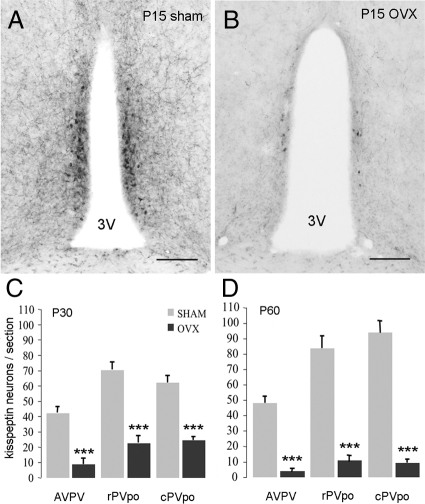
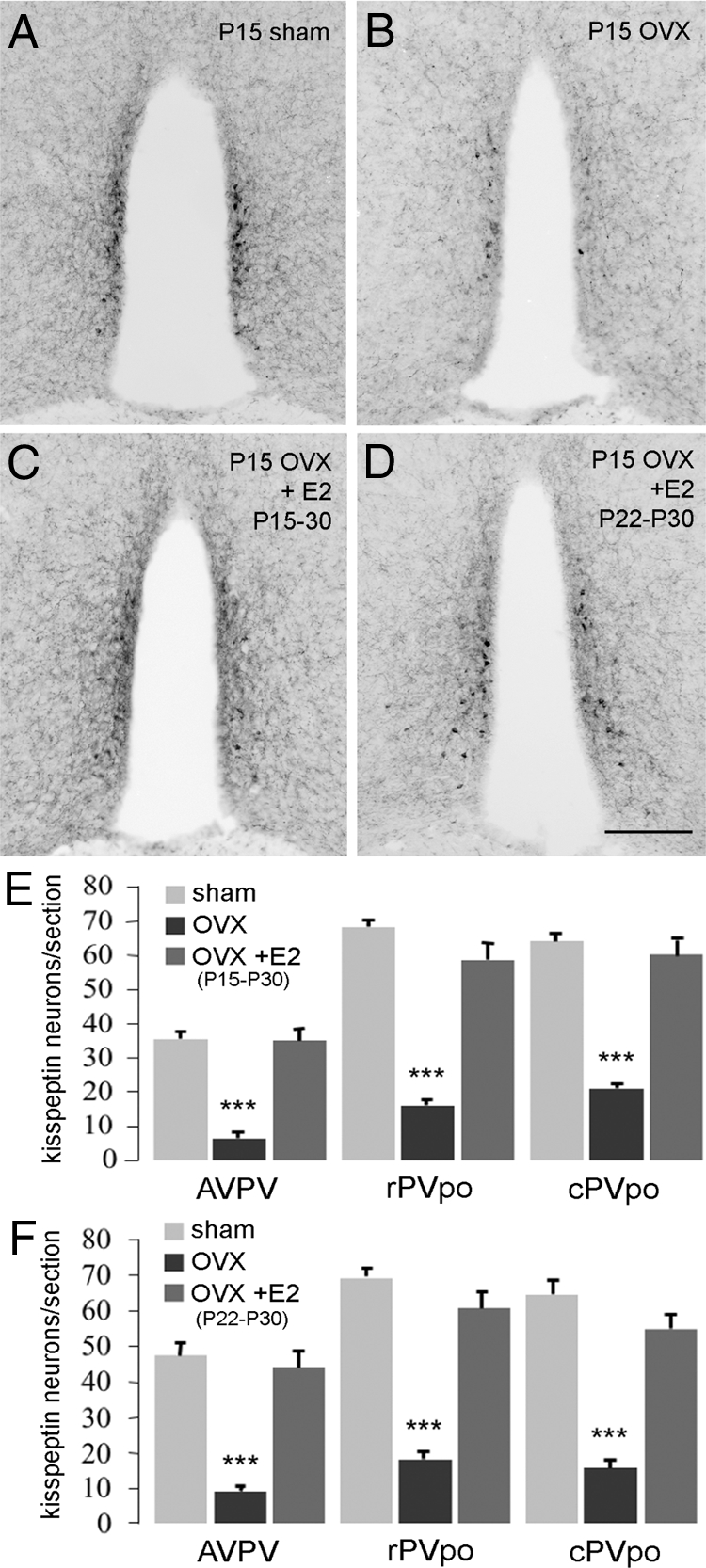
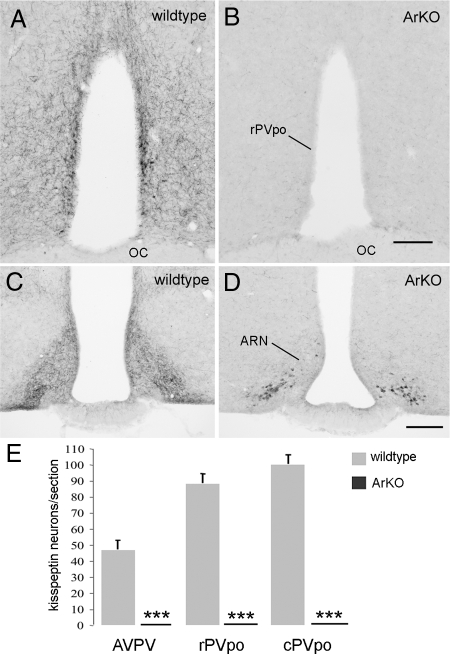
The regulation of GnRH neurons by kisspeptin is critical for normal puberty onset in mammals. In the rodent the kisspeptin neurons innervating GnRH neurons are thought to reside in the rostral periventricular area of the third ventricle (RP3V). Using kisspeptin immunocytochemistry we show that kisspeptin peptide expression in the RP3V of female mice begins around postnatal d 15 (P15) and rapidly increases to achieve adult-like levels by P30, the time of puberty onset. Ovariectomy of female pups at P15 resulted in a 70-90% reduction (P < 0.01) in kisspeptin peptide expression within the RP3V of P30 or P60 mice. Replacement of 17-beta-estradiol (E2) in P15-ovariectomized mice from P15-30 or P22-30 resulted in a complete restoration of kisspeptin peptide expression in the RP3V (P < 0.01). Kisspeptin-immunoreactive fibers throughout the hypothalamus, including the arcuate nucleus, followed the same pattern of estrogen-dependent expression. To test the absolute necessity of estrogen for kisspeptin expression in the RP3V, aromatase knockout mice were examined. Kisspeptin-immunoreactive cells were detected in the arcuate nucleus, but there was a complete absence of kisspeptin peptide in RP3V neurons of aromatase knockout adult females. These results demonstrate that E2 is essential for the prepubertal development of kisspeptin peptide within RP3V neurons and suggest that an E2-kisspeptin positive feedback mechanism exists before puberty. This implies that RP3V kisspeptin neurons are E2-dependent amplifiers of GnRH neuron activity in the prepubertal period.


Figures
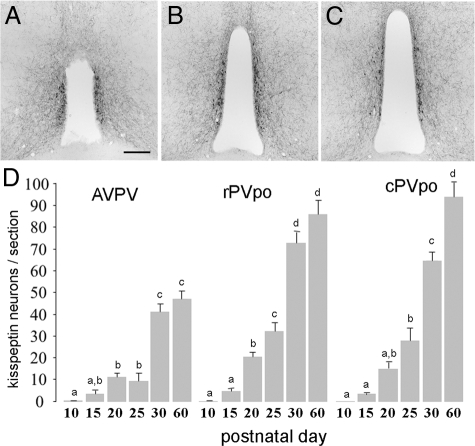
Figure 1
Figure 1
Development of kisspeptin-10 immunoreactivity in the AVPV, rPVpo, and cPVpo of P10, P15, P20, P25, P30, and P60 female mice. A–C, Representative sections of kisspeptin immunoreactivity in the AVPV, rPVpo, and cPVpo. D, Histogram shows the mean (+sem) number of kisspeptin cell bodies per section at the three levels of the RP3V across postnatal development. Bars with different letters are significantly different from one another (P < 0.05; ANOVA with Student-Newman-Keuls post hoc test). Scale bar in A–C is 200 μm.
Figure 2
Figure 2
Ovarian steroids control the developmental increase in kisspeptin immunoreactivity in the RP3V. A and B, Kisspeptin-10 immunoreactivity in the rPVpo of sham (A) and P15 OVX (B) mice killed at P30. C and D, Quantitative analysis of kisspeptin immunoreactive cell bodies in the AVPV, rPVpo, and cPVpo of the RP3V given as the mean (+sem) number of immunoreactive cell bodies detected per section in P15 OVX and sham-treated mice killed at P30 (n = 4 per group) (C) and P60 (n = 6 per group) (D). ***, P < 0.001 compared with respective sham. Scale bars, 100 μm. 3V, Third ventricle.
Figure 3
Figure 3
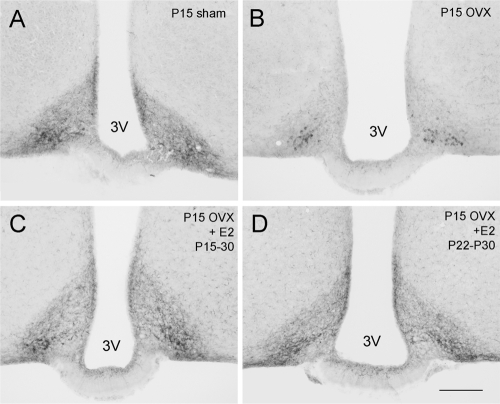
Effects of P15 OVX and E2 replacement on kisspeptin immunoreactivity in the ARN. Kisspeptin immunoreactivity in the ARN at P30 in sham (A), P15 OVX (B), P15 OVX with E2 replacement from P15–30 (C), and P15 OVX with E2 replacement from P22–30 (D). Scale bar, 200 μm. 3V, Third ventricle.
Figure 4
Figure 4
E2 involvement in the developmental increase in kisspeptin expression in the RP3V. A–D, Representative coronal sections through the rPVpo of P30 mice showing kisspeptin immunoreactivity in sham (A), P15 OVX plus vehicle capsule (B), P15 OVX plus E2 capsule from P15–30 (C), and P15 OVX plus E2 capsule from P22–30 (D) animals. E, Quantitative analysis of kisspeptin immunoreactivity in the AVPV, rPVpo, and cPVpo given as the mean (+sem) number of cell bodies detected per section in sham, P15 OVX, and P15 OVX plus E2 capsule from P15–30-treated mice. F, Same data from the experiment in which P15 OVX mice were given the E2 capsule for only the last 7 d (P22–30). ***, P < 0.001 compared with respective sham and E2-treated group.
Figure 5
Figure 5
Complete absence of RP3V kisspeptin expression in ArKO mice. A–D, Representative coronal sections throughout the rPVpo (A and B) and ARN (C and D) showing kisspeptin immunoreactivity in wild-type littermates (A and C) and ArKO (B and D) adult female mice. E, Quantitative analysis of kisspeptin immunoreactive cell bodies in the AVPV, rPVpo, and cPVpo given as the mean (+sem) number of cells detected per section in wild-type littermates and ArKO mice (n = 6 per group). ***, P < 0.001 compared with wild-type. Scale bars, 200 μm. OC, Optic chiasm.
Figure 6
Figure 6
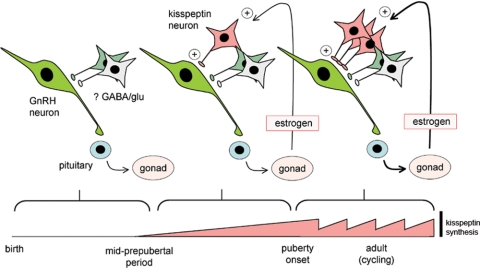
Schematic diagram showing proposed activation of RP3V kisspeptin neurons by E2 from birth. In the initial phase up until the mid-prepubertal period, there is no kisspeptin expression (represented by pink bar at bottom). With increasing exposure to E2, kisspeptin expression begins and facilitates GnRH neuron activation. By puberty onset, the kisspeptin expression is fully developed and functioning to amplify GnRH neuron activity. After puberty, kisspeptin expression in the RP3V fluctuates with cyclical E2 levels where it facilitates the generation of the preovulatory GnRH/LH surge in each cycle. GABA, γ-Aminobutyric acid; glu, glutamate.

References

    1. Plant TM 2008 Hypothalamic control of the pituitary-gonadal axis in higher primates: key advances over the last two decades. J Neuroendocrinol 20:719–726 - PubMed
    1. Plant TM, Witchel SF 2006 Puberty in nonhuman primates and humans. In: Neill JD, ed. Knobil and Neill’s physiology of reproduction. 3rd ed. Amsterdam: Elsevier; 2177–2230
    1. Terasawa E, Fernandez DL 2001 Neurobiological mechanisms of the onset of puberty in primates. Endocr Rev 22:111–151 - PubMed
    1. Ojeda SR, Lomniczi A, Sandau US 2008 Glial-gonadotrophin hormone (GnRH) neurone interactions in the median eminence and the control of GnRH secretion. J Neuroendocrinol 20:732–742 - PubMed
    1. Seminara SB, Messager S, Chatzidaki EE, Thresher RR, Acierno Jr JS, Shagoury JK, Bo-Abbas Y, Kuohung W, Schwinof KM, Hendrick AG, Zahn D, Dixon J, Kaiser UB, Slaugenhaupt SA, Gusella JF, O'Rahilly S, Carlton MB, Crowley Jr WF, Aparicio SA, Colledge WH 2003 The GPR54 gene as a regulator of puberty. N Engl J Med 349:1614–1627 - PubMed

Publication types