. 2009 Mar 15;23(6):681-93.
doi: 10.1101/gad.1773109.

Cooperative NCoR/SMRT interactions establish a corepressor-based strategy for integration of inflammatory and anti-inflammatory signaling pathways

Affiliations

Cooperative NCoR/SMRT interactions establish a corepressor-based strategy for integration of inflammatory and anti-inflammatory signaling pathways

Serena Ghisletti et al. Genes Dev. .

Abstract

Innate immune responses to bacterial or viral infection require rapid transition of large cohorts of inflammatory response genes from poised/repressed to actively transcribed states, but the underlying repression/derepression mechanisms remain poorly understood. Here, we report that, while the nuclear receptor corepressor (NCoR) and silencing mediator of retinoic acid and thyroid hormone receptor (SMRT) corepressors establish repression checkpoints on broad sets of inflammatory response genes in macrophages and are required for nearly all of the transrepression activities of liver X receptors (LXRs), they can be selectively recruited via c-Jun or the Ets repressor Tel, respectively, establishing NCoR-specific, SMRT-specific, and NCoR/SMRT-dependent promoters. Unexpectedly, the binding of NCoR and SMRT to NCoR/SMRT-dependent promoters is frequently mutually dependent, establishing a requirement for both proteins for LXR transrepression and enabling inflammatory signaling pathways that selectively target NCoR or SMRT to also derepress/activate NCoR/SMRT-dependent genes. These findings reveal a combinatorial, corepressor-based strategy for integration of inflammatory and anti-inflammatory signals that play essential roles in immunity and homeostasis.


Figures
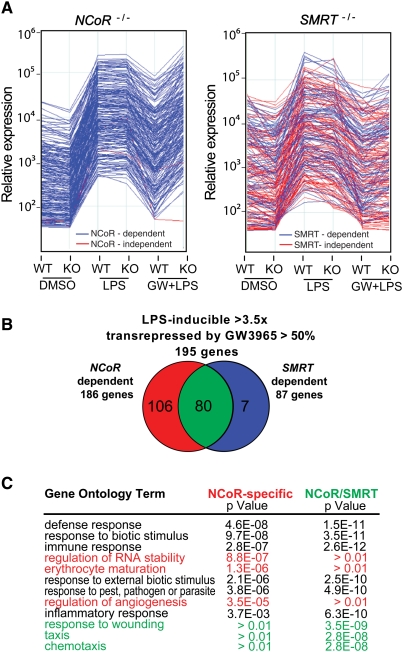
Figure 1.
Figure 1.
NCoR and SMRT are globally required for LXR transrepression. (A) Relative expression of the 200 most highly LPS-inducible, GW3965-sensitive genes in macrophages derived from fetal livers of wild-type (WT), NCoR−/− (KO), and SMRT−/− (KO) embryos under control conditions and after 6 h of LPS treatment in the absence or presence of LXR ligand (GW3965, GW 1 μM). Wild-type littermate embryos were used to derive control macrophages for each genotype. The NCoR-dependent or SMRT-dependent genes are color-coded in blue in each experiment. The NCoR-independent or SMRT-independent genes are color-coded in red in each experiment. (B) Venn diagram indicating relationships between LPS-inducible, GW3965-sensitive genes with respect to NCoR and SMRT dependence. The red sector respresents NCoR-specific genes, the blue sector SMRT-specific genes, and the green sector NCoR/SMRT-dependent genes. (C) GO analysis of the NCoR-specific and NCoR/SMRT-dependent sets of genes for selected biological process annotations.
Figure 2.
Figure 2.
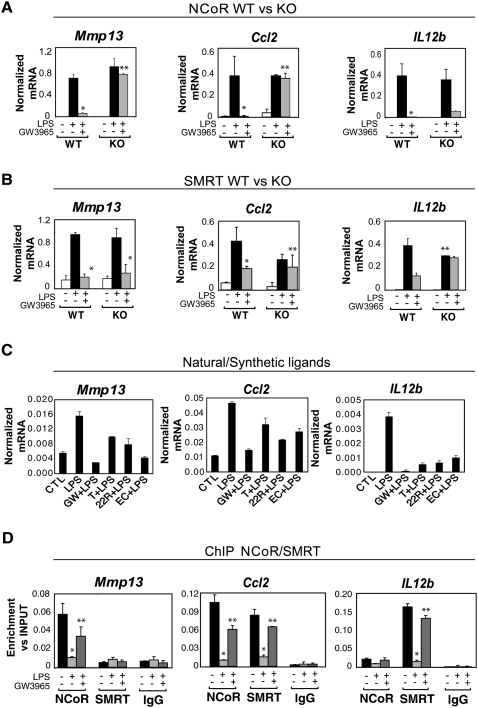
Expression profiles and promoter occupancy of NCoR- and SMRT-dependent target genes. (A,B) Expression profiles of NCoR-specific (Mmp13), SMRT-specific (Il12b), and NCoR/SMRT-dependent genes (Ccl2) analyzed by Q-PCR in wild-type, NCoR−/−, or SMRT−/− macrophages. Cells were treated with DMSO (white bars) or with LPS (1 μg/mL) for 6 h in the absence (black bars) or presence of LXR ligand (GW3965, 1 μM, gray bars) in wild-type versus NCoR−/− (A) or wild-type versus SMRT−/− macrophages (B). (*) P < 0.05 versus LPS; (**) P < 0.05 versus GW3965 + LPS wild type. (C) Effects of natural and synthetic LXR ligands (1 μM GW3965, 1 μM T1317, 5 μM 22R hydroxycholesterol, and 5 μM 24,25 epoxycholesterol) on LPS responses. (D) Promoter occupancy of the target genes described in A and B as evaluated by ChIP analysis. Primary macrophages were untreated (black bars) or treated with LPS (1 μg/mL) or GW3965 + LPS as indicated for 1 h. ChIP assays were performed with an antibody against NCoR or SMRT or control IgG. Immunoprecipitated DNA was analyzed by real-time PCR using primers specific for the indicated promoters. (*) P < 0.01 versus control; (**) P < 0.05 versus LPS. Results are expressed as the average of three independent experiments. Error bars represent standard deviations.
Figure 3.
Figure 3.
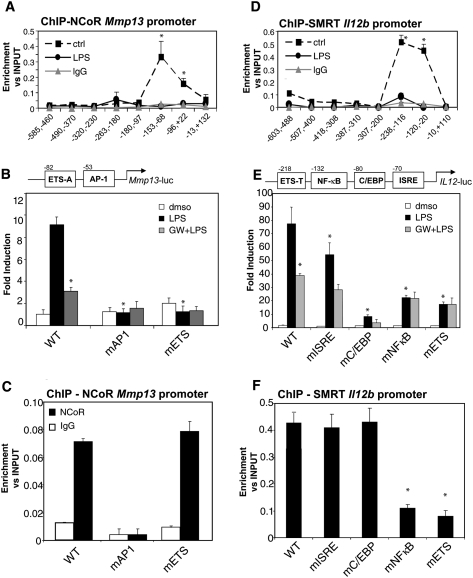
NCoR is recruited to an AP-1 site in the Mmp13 promoter, and SMRT is recruited to an ETS site in the Il12b promoter. (A). NCoR occupancy of the Mmp13 proximal promoter region evaluated by ChIP assay. Primary macrophages were untreated (solid square) or treated with LPS (1 μg/mL, solid circles) for 1 h. ChIP assays were performed with an antibody against NCoR and control IgG. Immunoprecipitated DNA was analyzed by real-time PCR using primers that amplified the indicated regions of the Mmp13 promoter. (B) AP1 and ETS mutations abolished LPS induction of the Mmp13 promoter. RAW264.7 cells were transfected with luciferase reporter genes driven by the wild-type (WT) Mmp13 promoter or Mmp13 promoters with mutant AP1 or ETS sites. Twenty-four hours after transfection, cells were treated with DMSO (white bars) or with LPS (1 μg/mL) for 12 h in the absence (black bars) or presence of LXR ligand (GW3965, 1 μM, gray bars). (*) P < 0.05 versus LPS wild type. (C) The AP1 site is necessary for NCoR recruitment on the Mmp13 promoter. RAW cells were transfected with the wild-type or indicated mutant Mmp13-luciferase vectors. ChIP assays were performed with an antibody against NCoR and control IgG. Immunoprecipitated DNA was analyzed by real-time PCR using primers designed to amplify a region across the junction of the luciferase reporter coding region and the Mmp13 promoter. (*) P < 0.01 versus wild type. (D) SMRT occupancy of the Il12b proximal promoter region evaluated by ChIP assay. Primary macrophages were untreated (solid square) or treated with LPS (1 μg/mL, solid circles). ChIP assay was performed with an antibody against SMRT and control IgG. Immunoprecipitated DNA was analyzed by real-time PCR using primers that amplified the indicated regions of the Il12b proximal region. (*) P < 0.05 versus LPS. (E) LXR transrepression is impaired by ETS and NFκB mutations of the Il12b promoter. RAW264.7 cells were transfected with luciferase reporter genes driven by the wild-type (WT) Il12b promoter or Il12b promoters in which the ETS, NFκB, C/EBP, or ISRE sites were mutated. Twenty-four hours after transfection, cells were treated with DMSO (white bars) or with LPS (1 μg/mL) for 12 h in the absence (black bars) or presence of LXR ligand (GW3965, 1 μM, gray bars). (*) P < 0.05 versus LPS wild type. (F) The κB and ETS sites are necessary for SMRT recruitment to the Il12b promoter. RAW cells were transfected with the indicated wild-type or mutant Il12b-promoter/luciferase vectors, and ChIP assays were performed with an antibody against SMRT and control IgG. Immunoprecipitated DNA was analyzed by real-time PCR using primers designed to amplify a region between the luciferase and the proximal promoter region. (*) P < 0.05 versus wild type. Results are expressed as average of three independent experiments. Error bars represent standard deviations.
Figure 4.
Figure 4.
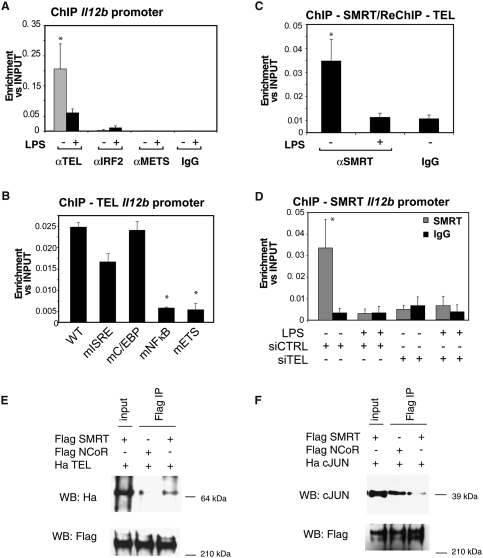
SMRT is recruited to the Il12b promoter through TEL (A) TEL binds specifically to the Il12b promoter. ChIP analysis for binding of TEL, IRF2, and METS to the Il12b promoter was performed with untreated (gray bars) and LPS-treated (black bars) primary macrophages using TEL, IRF2, and METS antibodies or control IgG (*) P < 0.05 versus IgG. (B) The κB and Ets sites are necessary for TEL binding to the Il12b promoter. RAW cells were transfected with the indicated wild-type and mutant Il12b-luciferase reporter plasmids. ChIP assay was performed with antibody against TEL and control IgG. Immunoprecipitated DNA was analyzed by real-time PCR using primers designed to amplify a region between the luciferase and the proximal promoter region. (*) P < 0.01 versus wild-type. (C) TEL and SMRT are present in the same complex on Il12b promoter as shown by ReChIP assay done in primary macrophages. (*) P < 0.05 versus IgG. (D) TEL is the beacon for the recruitment of SMRT on Il12b promoter. Primary macrophages were transfected with siRNA control and siRNA against TEL. ChIP assays were performed using antibodies against SMRT (top panel, gray bars) or control IgG (black bars, top and bottom panels). (*) P < 0.05 versus IgG. Results are expressed as average of three independent experiments. Error bars represent standard deviations. (E) Preferential co-IP of HA-TEL by Flag-SMRT. (F) Preferential co-IP of c-Jun by Flag-NCoR.
Figure 5.
Figure 5.
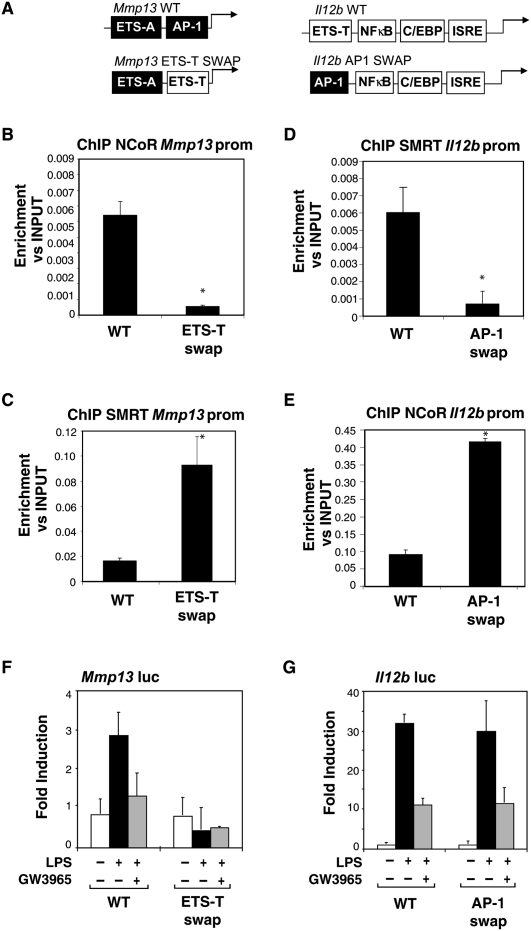
cJun and TEL sites are sufficient to confer NCoR and SMRT binding to the Il12b and Mmp13 promoters, respectively. (A) Schematic diagram of the wild-type and mutant Mmp13 and Il12b promoters indicating the swapped AP1 and ETS sites. ETS-T is the TEL-binding site in the Il12b promoter. ETS-A is a binding site for ETS activators in the Mmp13 promoter. AP-1 is the cJun-binding site in the Mmp13 promoter. (B,C) Replacing the ETS-A site in the Mmp13 promoter with the ETS-T site from Il12b inhibits the recruitment of NCoR and promotes SMRT binding to the Mmp13 promoter as shown by ChIP assays performed in RAW cells transfected with the plasmids shown in A. (D,E) NCoR is recruited to the Il12b promoter upon a swap of the AP1 Mmp13 site into the ETS-T on the ETS site as shown by ChIP assays. (*) P < 0.05 versus wild type. Results are expressed as the average of three independent experiments. Error bars represent standard deviations. (F,G) Functional analysis of the indicated wild-type and mutant Mmp13 and Il12b promoters in RAW264.7 cells.
Figure 6.
Figure 6.
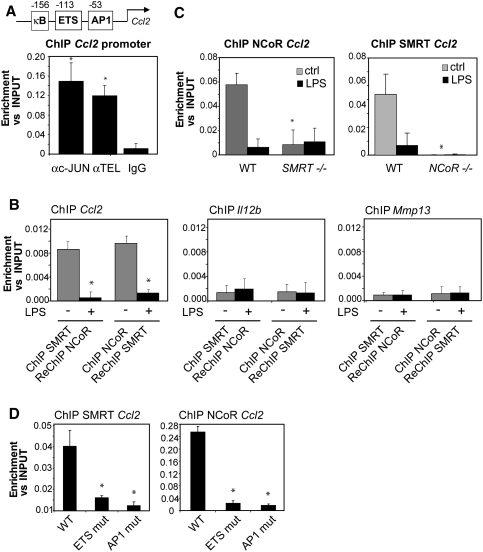
NCoR and SMRT bind interdependently to the Ccl2 promoter. (A) c-Jun and TEL occupy the Ccl2 promoter as shown by ChIP in primary macrophages. (*) P < 0.05 versus IgG. (B) NCoR and SMRT are present in the same complex as shown by ReChIP assays in unstimulated primary macrophages (gray bars). Immunoprecipitated DNA was analyzed by real-time PCR primers specific for the Ccl2 promoter. The Il12b and Mmp13 promoters were used as negative controls (*) P < 0.01 versus control. (C) SMRT and NCoR are mutually required for binding to the Ccl2 promoter, as shown by ChIP assay using liver-derived macrophages from wild-type, NCoR−/−, and SMRT−/− embryos. Cells were untreated (gray bars) or treated with LPS (black bars) for 1 h. (*) P < 0.05 versus wild-type control. (D) Mutations in the ETS and AP-1 sites of the Ccl2 promoter each lead to loss of NCoR and SMRT occupancy. RAW cells were transfected with luciferase reporter genes under the control of the wild-type Ccl2 promoter or Ccl2 promoters mutated at the AP1 or ETS sites. ChIP assays were performed using antibodies against NCoR, SMRT, and control IgG. Immunoprecipitated DNA was analyzed by real-time PCR using primers amplifying a region corresponding to the junction between the Ccl2 promoter and the luciferase reporter coding region. (*) P < 0.05 versus wild type. Results are expressed as the average of three independent experiments. Error bars represent standard deviations.
Figure 7.
Figure 7.
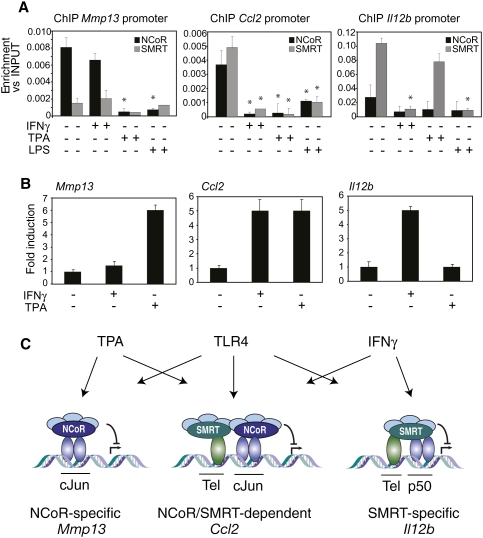
NCoR and SMRT function as integrators of multiple signals. (A) IFNγ and TPA induce SMRT and NCoR clearance, respectively, on Il12b, Ccl2, and Mmp13 promoters. Primary macrophages were treated with IFNγ (10 U/mL), TPA (100 ng/mL), or LPS (1 μg/mL) for 1 h, and ChIP assay was performed using antibodies against NCoR, SMRT, and control IgG. Immunoprecipitated DNA was analyzed by real-time PCR using primers for Mmp13, Ccl2, and Il12b promoters. (*) P < 0.05 versus control. (B) Mmp13, Ccl2, and Il12b expression analysis by Q-PCR of primary macrophages treated for 6 h with IFNγ (10 U/mL), TPA (100 ng/mL), or LPS (1 μg/mL). (C) Model depicting differential recruitment of NCoR and SMRT on target promoters by c-Jun, Tel, and p50, and differential clearance by TPA, LPS, and IFNγ. See the text for discussion.

References

    1. Akira S., Takeda K. Toll-like receptor signalling. Nat. Rev. Immunol. 2004;4:499–511. - PubMed
    1. Angel P., Imagawa M., Chiu R., Stein B., Imbra R.J., Rahmsdorf H.J., Jonat C., Herrlich P., Karin M. Phorbol ester-inducible genes contain a common cis element recognized by a TPA-modulated trans-acting factor. Cell. 1987;49:729–739. - PubMed
    1. Baek S.H., Ohgi K.A., Rose D.W., Koo E.H., Glass C.K., Rosenfeld M.G. Exchange of N-CoR corepressor and Tip60 coactivator complexes links gene expression by NF-κB and β-amyloid precursor protein. Cell. 2002;110:55–67. - PubMed
    1. Blaschke F., Takata Y., Caglayan E., Collins A., Tontonoz P., Hsueh W.A., Tangirala R.K. A nuclear receptor corepressor-dependent pathway mediates suppression of cytokine-induced C-reactive protein gene expression by liver X receptor. Circ. Res. 2006;99:e88–e99. doi: 10.1161/01.RES.0000252878.34269.06. - DOI - PubMed
    1. Bradley M.N., Zhou L., Smale S.T. C/EBPβ regulation in lipopolysaccharide-stimulated macrophages. Mol. Cell Biol. 2003;23:4841–4858. - PMC - PubMed

Publication types

MeSH terms