The apolipoprotein L family of programmed cell death and immunity genes rapidly evolved in primates at discrete sites of host-pathogen interactions
- PMID: 19299565
- PMCID: PMC2675973
- DOI: 10.1101/gr.085647.108
The apolipoprotein L family of programmed cell death and immunity genes rapidly evolved in primates at discrete sites of host-pathogen interactions
Abstract
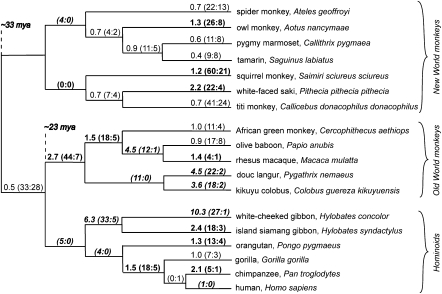
Apolipoprotein L1 (APOL1) is a human protein that confers immunity to Trypanosoma brucei infections but can be countered by a trypanosome-encoded antagonist SRA. APOL1 belongs to a family of programmed cell death genes whose proteins can initiate host apoptosis or autophagic death. We report here that all six members of the APOL gene family (APOL1-6) present in humans have rapidly evolved in simian primates. APOL6, furthermore, shows evidence of an adaptive sweep during recent human evolution. In each APOL gene tested, we found rapidly evolving codons in or adjacent to the SRA-interacting protein domain (SID), which is the domain of APOL1 that interacts with SRA. In APOL6, we also found a rapidly changing 13-amino-acid cluster in the membrane-addressing domain (MAD), which putatively functions as a pH sensor and regulator of cell death. We predict that APOL genes are antagonized by pathogens by at least two distinct mechanisms: SID antagonists, which include SRA, that interact with the SID of various APOL proteins, and MAD antagonists that interact with the MAD hinge base of APOL6. These antagonists either block or prematurely cause APOL-mediated programmed cell death of host cells to benefit the infecting pathogen. These putative interactions must occur inside host cells, in contrast to secreted APOL1 that trafficks to the trypanosome lysosome. Hence, the dynamic APOL gene family appears to be an important link between programmed cell death of host cells and immunity to pathogens.
Figures




References
-
- Ahn W.S., Bae S.M., Lee J.M., Namkoong S.E., Han S.J., Cho Y.L., Nam G.H., Seo J.S., Kim C.K., Kim Y.W. Searching for pathogenic gene functions to cervical cancer. Gynecol. Oncol. 2004;93:41–48. - PubMed
-
- Bennett-Lovsey R.M., Herbert A.D., Sternberg M.J., Kelley L.A. Exploring the extremes of sequence/structure space with ensemble fold recognition in the program Phyre. Proteins. 2008;70:611–625. - PubMed
-
- Campillo N., Carrington M. The origin of the serum resistance associated (SRA) gene and a model of the structure of the SRA polypeptide from Trypanosoma brucei rhodesiense. Mol. Biochem. Parasitol. 2003;127:79–84. - PubMed
Publication types
MeSH terms
Substances
Associated data
- Actions
- Actions
- Actions
- Actions
- Actions
- Actions
- Actions
- Actions
- Actions
- Actions
- Actions
- Actions
- Actions
- Actions
- Actions
- Actions
- Actions
- Actions
- Actions
- Actions
- Actions
- Actions
- Actions
- Actions
- Actions
- Actions
- Actions
- Actions
- Actions
- Actions
- Actions
- Actions
- Actions
- Actions
LinkOut - more resources
Full Text Sources
Other Literature Sources
Miscellaneous