


Death in heart failure: a community perspective
- PMID: 19300532
- PMCID: PMC2657718
- DOI: 10.1161/CIRCHEARTFAILURE.107.743146
Death in heart failure: a community perspective
Abstract
Background: Mortality in heart failure (HF) remains high but causes of death are incompletely defined. As HF is heterogeneous syndrome categorized according to ejection fraction (EF), the association between EF and causes of death is important, yet elusive.
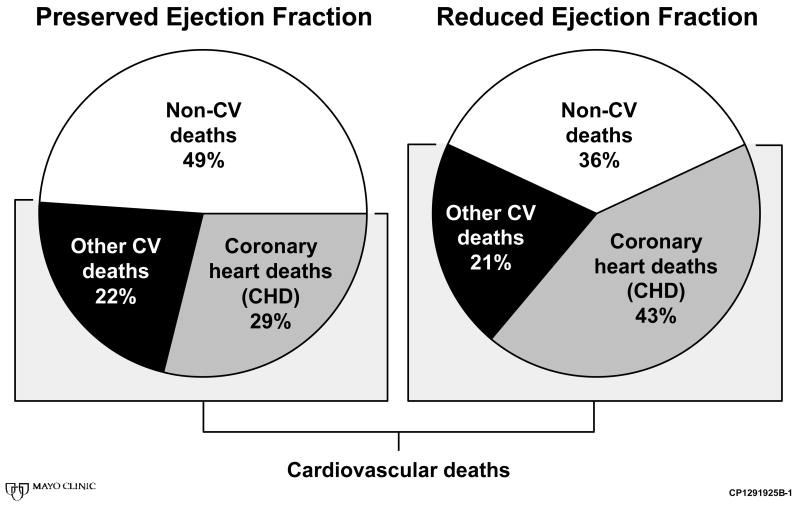
Method and results: Community subjects with HF were classified according to preserved (> or =50%) and reduced EF (<50%). Deaths were classified as coronary heart disease (CHD), other cardiovascular and non-cardiovascular. Among 1063 persons with HF, 45% had preserved EF with less cardiovascular risk factors and less coronary disease than those with reduced EF. At 5 years, survival was 45% (95% CI 43%-49%) and 43% of the deaths were non-cardiovascular. The leading cause of death in subjects with preserved EF was non-cardiovascular (49%) vs CHD (43%) for subjects with reduced EF. The proportion of cardiovascular deaths decreased from 69% in 1979-1984 to 40% in 1997-2002 (p=0.007) among subjects with preserved EF contrasting with a modest change among those with reduced EF (77% in to 64%, p=0.08). Advanced age, male sex, diabetes, smoking and kidney disease were associated with an increase risk of all cause and cardiovascular death. After adjustment, preserved EF was associated with a lower risk of cardiovascular death but not all cause death.
Conclusion: Community subjects with HF experience a persistently high mortality and a large proportion of deaths are non-cardiovascular. Subjects with preserved EF have less cardiovascular disease before death, are less likely to experience cardiovascular deaths than those with reduced EF and the proportion of cardiovascular deaths declined over time.
Keywords: HF; ejection fraction; epidemiology; mortality.
Conflict of interest statement
CONFLICT OF INTEREST
There is no conflict of interest.
Figures
Comment in
-
Does it matter why and how patients with heart failure die?: a debate that lives on.Circ Heart Fail. 2008 Jul;1(2):89-90. doi: 10.1161/CIRCHEARTFAILURE.108.796250. Circ Heart Fail. 2008. PMID: 19808278 No abstract available.
References
-
- Hunt SA. ACC/AHA 2005 guideline update for the diagnosis and management of chronic heart failure in the adult: a report of the American College of Cardiology/American Heart Association Task Force on Practice Guidelines (Writing Committee to Update the 2001 Guidelines for the Evaluation and Management of Heart Failure) J Am Coll Cardiol. 2005;46:e1–82. - PubMed
-
- Levy D, Kenchaiah S, Larson MG, Benjamin EJ, Kupka MJ, Ho KK, Murabito JM, Vasan RS. Long-term trends in the incidence of and survival with heart failure. N Engl J Med. 2002;347:1397–402. - PubMed
-
- Roger VL, Weston SA, Redfield MM, Hellermann-Homan JP, Killian J, Yawn BP, Jacobsen SJ. Trends in heart failure incidence and survival in a community-based population. Jama. 2004;292:344–50. - PubMed
-
- Brown AM, Cleland JG. Influence of concomitant disease on patterns of hospitalization in patients with heart failure discharged from Scottish hospitals in 1995. Eur Heart J. 1998;19:1063–9. - PubMed
Publication types
MeSH terms
Grants and funding
LinkOut - more resources
Full Text Sources
Medical
Research Materials
Miscellaneous
