


Continuous levodopa for advanced Parkinson's disease
- PMID: 19300565
- PMCID: PMC2654791
Continuous levodopa for advanced Parkinson's disease
Abstract
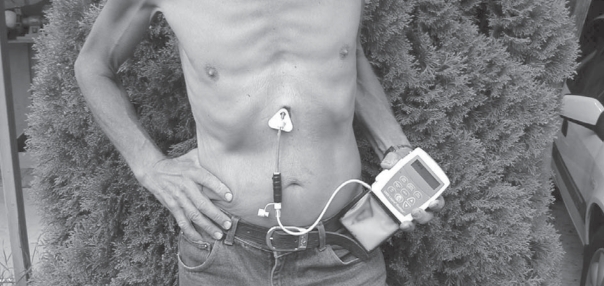
Parkinson's disease is characterized by the progression of the disease from the early stages where it still has little functional consequence for afflicted patients, to an advanced stage disease with large consequences in terms of function, quality of life and individual and societal costs. Motor fluctuations and symptoms of levodopa overdosage may occur in parallel with increasing Parkinsonian symptoms. This leads to a narrower therapeutic window which causes problems with traditional oral medication. Various ways of optimizing oral treatment should be tried but often have limited effects. In addition to the previous alternatives of neurosurgery (especially deep brain stimulation of the subthalamic nuclei) and continuous apomorphine treatment there is now also the alternative of continuous enteral levodopa administration via a trans-abdominal tube. The effect of the treatment may be tested individually via naso-duodenal administration before a decision is made whether to continue with permanent treatment. In the present article, the challenges to treatment of Parkinson's disease in these phases are described as well as the various treatment alternatives available. Focus is mainly on the clinical studies of continuous levodopa infusion therapies, especially enteral administration of levodopa/carbidopa gel. The place of enteral levodopa/carbidopa gel treatment among the other treatment methods is also discussed.
Keywords: Parkinson’s disease; carbidopa; levodopa; levodopa/carbidopa gel.
Figures
References
-
- Aarsland D, Larsen JP, Tandberg E, et al. Predictors of nursing home placement in Parkinsons disease: a population-based prospective study. J Am Geriatr Soc. 2000;48:938–42. - PubMed
-
- Benabid AL. Deep brain stimulation for Parkinson’s Disease. Curr Opin Neurobiol. 2003;13:696–706. - PubMed
-
- Bredberg E, Nilsson D, Johansson K, et al. Intraduodenal infusion of a water-based levodopa dispersion for optimisation of the therapeutic effect in severe Parkinson’s disease. Eur J Clin Pharmacol. 1993;45:117–22. - PubMed
-
- Burkhard PR, Vingerhoets FJG, Berney A, et al. Suicide after successful deep brain stimulation for movement disorders. Neurology. 2004;63:2170–2. - PubMed
-
- Cedarbaum JM, Silvestr M, Kutt H. Sustained enteral aministration of levodopa increases and interrupted infusion decreases levodopa dose requirements. Neurology. 1990;40:995–7. - PubMed
LinkOut - more resources
Full Text Sources
Other Literature Sources
