


ATP release from non-excitable cells
- PMID: 19301146
- PMCID: PMC2776134
- DOI: 10.1007/s11302-009-9146-2
ATP release from non-excitable cells
Abstract
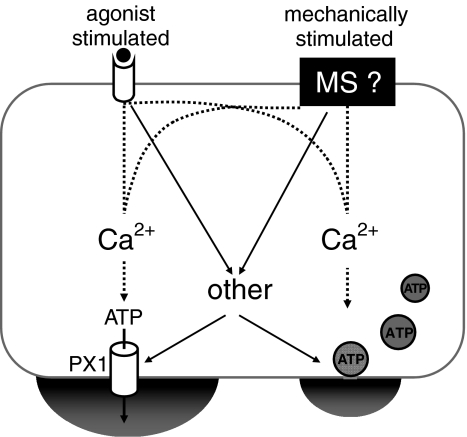
All cells release nucleotides and are in one way or another involved in local autocrine and paracrine regulation of organ function via stimulation of purinergic receptors. Significant technical advances have been made in recent years to quantify more precisely resting and stimulated adenosine triphosphate (ATP) concentrations in close proximity to the plasma membrane. These technical advances are reviewed here. However, the mechanisms by which cells release ATP continue to be enigmatic. The current state of knowledge on different suggested mechanisms is also reviewed. Current evidence suggests that two separate regulated modes of ATP release co-exist in non-excitable cells: (1) a conductive pore which in several systems has been found to be the channel pannexin 1 and (2) vesicular release. Modes of stimulation of ATP release are reviewed and indicate that both subtle mechanical stimulation and agonist-triggered release play pivotal roles. The mechano-sensor for ATP release is not yet defined.
Figures
References
-
- {'text': '', 'ref_index': 1, 'ids': [{'type': 'PubMed', 'value': '15109209', 'is_inner': True, 'url': 'https://pubmed.ncbi.nlm.nih.gov/15109209/'}]}
- Spyer KM, Dale N, Gourine AV (2004) ATP is a key mediator of central and peripheral chemosensory transduction. Exp Physiol 89:53–59 - PubMed
-
- {'text': '', 'ref_index': 1, 'ids': [{'type': 'PMC', 'value': 'PMC1665262', 'is_inner': False, 'url': 'https://pmc.ncbi.nlm.nih.gov/articles/PMC1665262/'}, {'type': 'PubMed', 'value': '15331685', 'is_inner': True, 'url': 'https://pubmed.ncbi.nlm.nih.gov/15331685/'}]}
- Fabbro A, Skorinkin A, Grandolfo M, Nistri A, Giniatullin R (2004) Quantal release of ATP from clusters of PC12 cells. J Physiol 560:505–517 - PMC - PubMed
-
- {'text': '', 'ref_index': 1, 'ids': [{'type': 'PubMed', 'value': '16322458', 'is_inner': True, 'url': 'https://pubmed.ncbi.nlm.nih.gov/16322458/'}]}
- Finger TE, Danilova V, Barrows J, Bartel DL, Vigers AJ, Stone L, Hellekant G, Kinnamon SC (2005) ATP signaling is crucial for communication from taste buds to gustatory nerves. Science 310:1495–1499 - PubMed
-
- {'text': '', 'ref_index': 1, 'ids': [{'type': 'PubMed', 'value': '16001070', 'is_inner': True, 'url': 'https://pubmed.ncbi.nlm.nih.gov/16001070/'}]}
- Gourine AV, Llaudet E, Dale N, Spyer KM (2005) ATP is a mediator of chemosensory transduction in the central nervous system. Nature 436:108–111 - PubMed
-
- {'text': '', 'ref_index': 1, 'ids': [{'type': 'PMC', 'value': 'PMC6725960', 'is_inner': False, 'url': 'https://pmc.ncbi.nlm.nih.gov/articles/PMC6725960/'}, {'type': 'PubMed', 'value': '15689558', 'is_inner': True, 'url': 'https://pubmed.ncbi.nlm.nih.gov/15689558/'}]}
- Gourine AV, Llaudet E, Dale N, Spyer KM (2005) Release of ATP in the ventral medulla during hypoxia in rats: role in hypoxic ventilatory response. J Neurosci 25:1211–1218 - PMC - PubMed
LinkOut - more resources
Full Text Sources
