. 2009 May 15;107(2):253-63.
doi: 10.1002/jcb.22121.

Identification of tubulins as substrates of serine protease HtrA1 by mixture-based oriented peptide library screening

Affiliations

Identification of tubulins as substrates of serine protease HtrA1 by mixture-based oriented peptide library screening

Jeremy Chien et al. J Cell Biochem. .

Abstract

Serine protease HtrA1 belongs to a family of chymotrypsin-like proteases that were first identified in bacteria and later in mammalian systems. These proteases were identified as components of protein quality control in prokaryotic systems and as regulators of diverse signaling pathways in mammalian systems. In particular, HtrA1 is implicated in trophoblast cell migration and invasion, tumor progression, chemotherapy-induced cytotoxicity, osteoarthritis, age-related macular degeneration, and pathogenesis of Alzheimer's disease. However, systematic analysis of its potential substrates in biological system is still lacking. Therefore, we performed a mixture-based oriented peptide library screening to identify putative substrates of HtrA1. We identified [AEGR]-[LAGR]-[IAMLR]-[TVIAL] as consensus residues for P1 to P4 sites. We identified several putative substrates of HtrA1 involved in the pathogenesis of various diseases. In this study, we report on the identification of tubulins as potential substrates of HtrA1, and validated tubulins as in vitro and intracellular substrates of HtrA1. These results provide initial insights into substrate identification and functional characterization of HtrA1 in pathogenesis of various diseases.


Figures

Fig. 1
Fig. 1
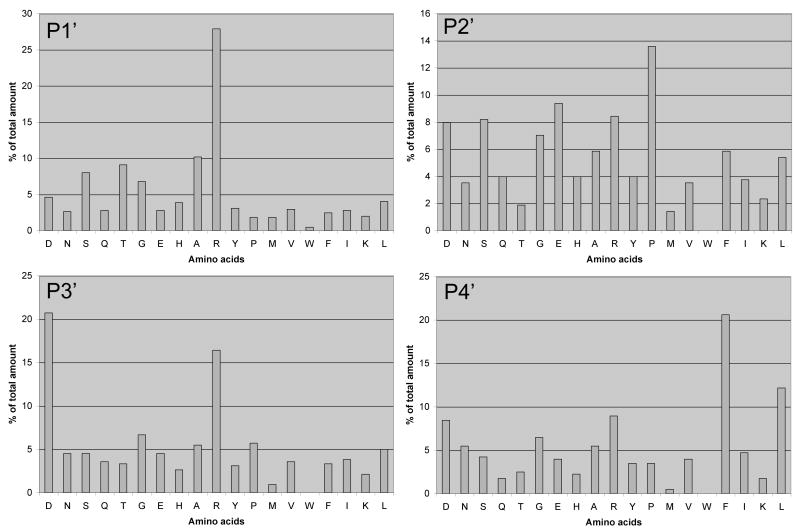
Identification of consensus HtrA1 cleavage motif for primed positions. 2 mg/ml of purified peptide library was digested with 2 μg of purified recombinant HtrA1 for 3 hours at 37°C and subjected to N-terminal sequencing. Since N-termini of all peptides in the library are blocked, only the cleaved peptides contribute to sequencing. Based on the molar proportion of each residue present within a given sequencing cycle, selectivity of amino acid for P1 to P4 relative to cleavage site is determined [Turk and Cantley, 2004; Turk et al., 2001].
Fig. 2
Fig. 2
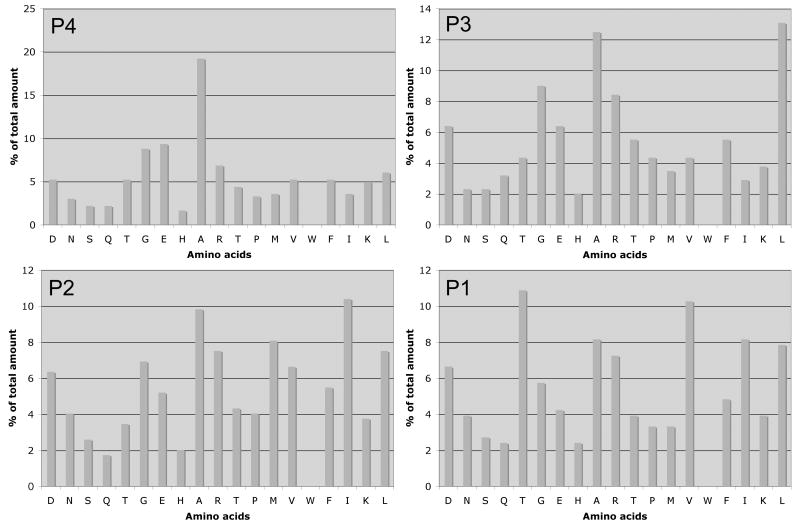
Identification of consensus HtrA1 cleavage motif for unprimed positions. 2 mg/ml of purified peptide library was digested with 2 μg of purified recombinant HtrA1 for 3 hours at 37°C and subjected to avidin affinity purification to remove un-reacted and C-terminal fragments of cleaved peptides as previously described [Turk and Cantley, 2004; Turk et al., 2001]. Unbound peptides were subjected to amino terminal sequencing to determine the selectivity of amino acids corresponding to P1-P4 of unprimed side as previously described [Turk and Cantley, 2004; Turk et al., 2001].
Fig. 3
Fig. 3
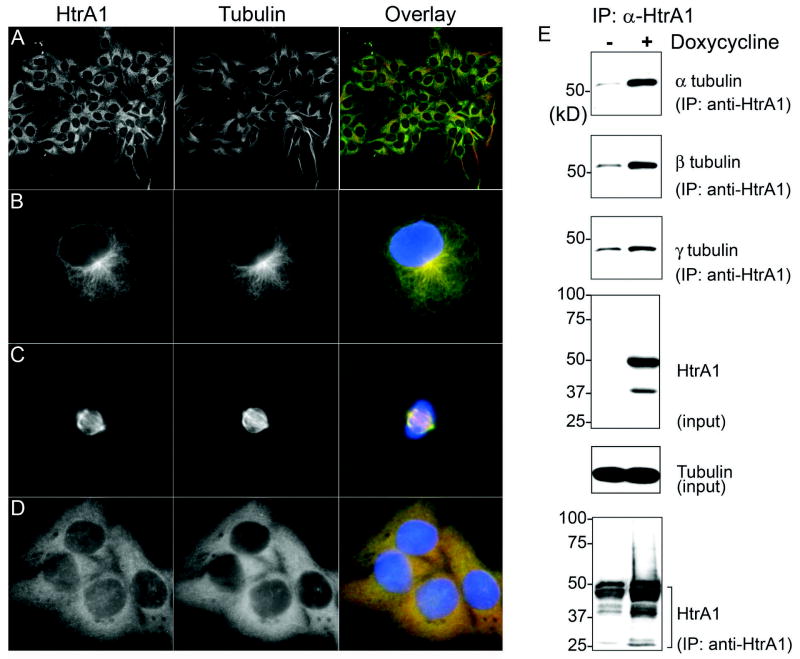
Localization of endogenous HtrA1 to microtubules. A. Endogenous expression of HtrA1 in SKOV3 cells (observed under 10x objective lens). B-C. Localization of HtrA1 to microtubules at interphase and mitotic cells. Overlay indicates merging of pseudocolors for HtrA1 (green), tubulin (yellow), and nuclear stain DAPI (blue). D. Tubular staining of HtrA1 was dependent on intact microtubules, and destabilization of microtubules by Nocodazole treatment resulted in diffuse staining of HtrA1. E. In 293T cells with inducible HtrA1 expression, immunoprecipitation of HtrA1 resulted in co-precipitation of α-, β-, and γ-tubulins.
Fig. 4
Fig. 4
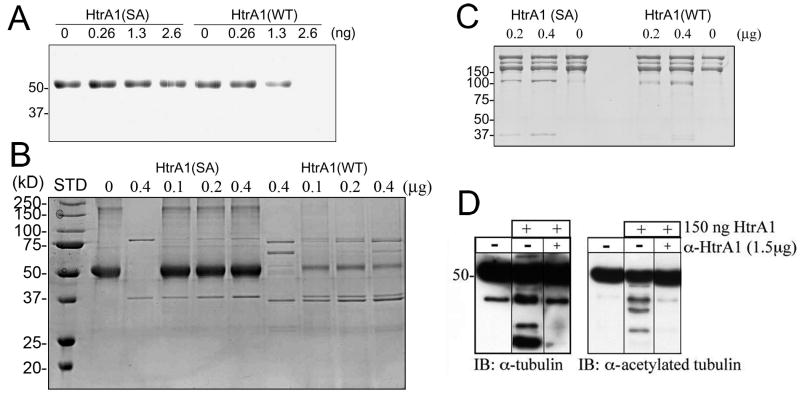
In vitro degradation of tubulins by HtrA1. A. Dose dependent degradation of tubulins by HtrA1. B. No partially digested tubulins were observed by Coomassie stain even when 10 μg of tubulin was used in the digestion reaction. C. No collagen degradation was observed when 2 μg of type I collagen was tested as a potential substrate. D. Partially degraded tubulins were observed only by immunoblotting, and could be blocked by a neutralizing antibody against HtrA1 (α-HtrA1).
Fig. 5
Fig. 5
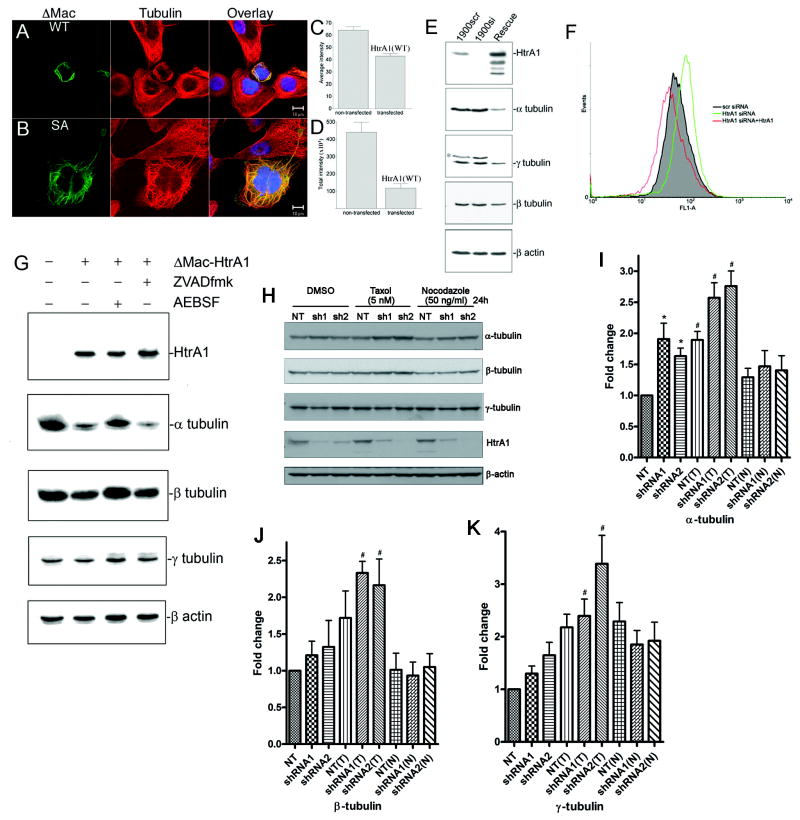
Degradation of intracellular tubulins by HtrA1 in intact cells. A. Exogenous expression of wild type HtrA1 (WT) in OV202 resulted in reduced tubulin immunofluorescence. B. Exogenous expression of protease mutant HtrA1 (SA) resulted in bundling of microtubules. C. Tubulin immunofluorescence intensity analysis indicates average intensity of tubulins within transfected cells decreased compared to non-transfected cells when adjusted for surface area of the cell. D. Overall intensity of tubulins, not adjusted for surface area, decreased markedly in transfected cells compared to non-transfected neighboring cells. E. In SKOV3 cells with endogenous HtrA1, down-regulation of HtrA1 by siRNA minimally increases endogenous tubulins, and rescue of HtrA1 expression in these cells markedly decreases endogenous tubulins. F. Flow cytometry analysis of α-tubulin expression in these cells shows a decrease in tubulin immunofluorescence following rescue of HtrA1 expression, whereas an increase in tubulin immunofluorescence is observed when endogenous HtrA1 is down-regulated by siRNA. G. Decreased in endogenous tubulins following HtrA1 expression is dependent on serine protease activities and could be inhibited by serine protease inhibitor, AEBSF, but not by broad caspase inhibitor ZVADfmk. H. Alpha tubulin levels are higher in SKOV3 cells with stable knockdown of HtrA1 by two different shRNAs (shRNA1 and shRNA2) than in cells with non-targeting shRNA (NT). Levels of α-, β-, and γ-tubulins are higher in SKOV3 cells treated for 24 hours with 5 nM paclitaxel (Taxol) than in cells treated with vehicle (DMSO) or with 50 ng/ml Nocodazole (top 3 panels). HtrA1 is efficiently knocked down in SKOV3 cells by shRNA1 and shRNA2 targeting HtrA1 (4th panel from top). β-actin immunoblot indicates controls for protein loading. I-K. Densitometry analysis of tubulin expression in SKOV3 cells with stable transfection of shRNA following 24 hours treatment with agents that altered microtubule stability or vehicle control. Expression values are normalized with β-actin expression and indicated as fold-change over control (DMSO-treated SKOV3 with stable transfection of non-targeting shRNA). (T) indicates Taxol treatment, and (N) indicates Nocodazole treatment. Bar graphs represent mean±sem; * p<0.05, with Newman-Keuls Multiple Comparison Test; # p<0.05 with Dunnett’s Multiple Comparison Test.

References

    1. Adrain C, Duriez PJ, Brumatti G, Delivani P, Martin SJ. The cytotoxic lymphocyte protease, granzyme B, targets the cytoskeleton and perturbs microtubule polymerization dynamics. J Biol Chem. 2006;281:8118–25. - PubMed
    1. Ajayi F, Kongoasa N, Gaffey T, Asmann YW, Watson W, Baldi A, Lala P, Shridhar V, Brost B, Chien J. Elevated expression of serine protease HtrA1 in preeclampsia and its role in trophoblast cell migration and invasion. American Journal of Obstetrics and Gynecology. 2008 Epub ahead of print. - PubMed
    1. Baldi A, De Luca A, Morini M, Battista T, Felsani A, Baldi F, Catricala C, Amantea A, Noonan DM, Albini A, Natali PG, Lombardi D, Paggi MG. The HtrA1 serine protease is down-regulated during human melanoma progression and represses growth of metastatic melanoma cells. Oncogene. 2002;21:6684–8. - PubMed
    1. Bovenschen N, de Koning PJ, Quadir R, Broekhuizen R, Damen JM, Froelich CJ, Slijper M, Kummer JA. NK cell protease granzyme M targets alpha-tubulin and disorganizes the microtubule network. J Immunol. 2008;180:8184–91. - PubMed
    1. Chien J, Aletti G, Baldi A, Catalano V, Muretto P, Keeney GL, Kalli KR, Staub J, Ehrmann M, Cliby WA, Lee YK, Bible KC, Hartmann LC, Kaufmann SH, Shridhar V. Serine protease HtrA1 modulates chemotherapy-induced cytotoxicity. J Clin Invest. 2006;116:1994–2004. - PMC - PubMed

Publication types

LinkOut - more resources