


Race/ethnicity and telomere length in the Multi-Ethnic Study of Atherosclerosis
- PMID: 19302371
- PMCID: PMC2713110
- DOI: 10.1111/j.1474-9726.2009.00470.x
Race/ethnicity and telomere length in the Multi-Ethnic Study of Atherosclerosis
Abstract
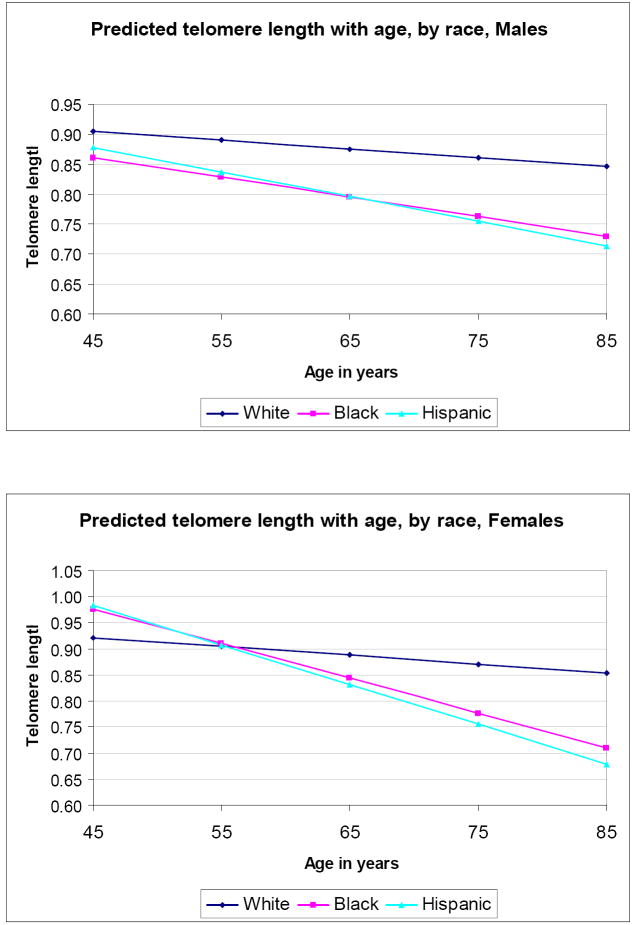
Telomere length has emerged as a marker of exposure to oxidative stress and aging. Race/ethnic differences in telomere length have been infrequently investigated. Leukocyte telomere length (LTL) was assessed 981 white, black and Hispanic men and women aged 45-84 years participating in the Multi-Ethnic Study of Atherosclerosis. Direct measurement and questionnaire were used to assess covariates. Linear regression was used to estimate associations of LTL with race/ethnicity and age after adjustment for sex, income, education, smoking, physical activity, diet and body mass index. On average blacks and Hispanics had shorter telomeres than whites [adjusted mean differences (standard error) in T/S ratio compared to whites: -0.041 (0.018) for blacks and -0.044 (0.018) for Hispanics]. Blacks and Hispanics showed greater differences in telomere length associated with age than whites (adjusted mean differences in T/S ratio per 1 year increase in age -0.0018, -0.0047 and -0.0055 in whites, blacks and Hispanics respectively). Differences in age associations were more pronounced and only statistically significant in women. Race/ethnic differences in LTL may reflect the cumulative burden of differential exposure to oxidative stress (and its predictors) over the lifecourse.
Figures
References
-
- Adams J, Martin-Ruiz C, Pearce MS, White M, Parker L, von Zglinicki T. No association between socio-economic status and white blood cell telomere length. Aging Cell. 2007;6:125–128. comment. - PubMed
-
- Bakaysa SL, Mucci LA, Slagboom PE, Boomsma DI, McClearn GE, Johansson B, Pedersen NL. Telomere length predicts survival independent of genetic influences. Aging Cell. 2007;6:769–774. - PubMed
-
- Benetos A, Okuda K, Lajemi M, Kimura M, Thomas F, Skurnick J, Labat C, Bean K, Aviv A. Telomere length as an indicator of biological aging: the gender effect and relation with pulse pressure and pulse wave velocity. Hypertension. 2001;37:381–385. - PubMed
-
- Bild D, Bluemke D, Burke G, Detrano R, Diez Roux A, Folsom A, Greenland P, Jacobs D, Kronma R, Liu L, et al. The Multi-Ethnic Study of Atherosclerosis (MESA): objectives and design. Am J Epidemiol. 2002;156:871–881. - PubMed
Publication types
MeSH terms
Grants and funding
- N01-HC-95162/HC/NHLBI NIH HHS/United States
- R01 HL76831/HL/NHLBI NIH HHS/United States
- N01 HC095169/HL/NHLBI NIH HHS/United States
- N01-HC-95163/HC/NHLBI NIH HHS/United States
- N01-HC-95165/HC/NHLBI NIH HHS/United States
- N01 HC095159/HL/NHLBI NIH HHS/United States
- N01-HC-95160/HC/NHLBI NIH HHS/United States
- N01-HC-95161/HC/NHLBI NIH HHS/United States
- N01 HC095165/HL/NHLBI NIH HHS/United States
- N01-HC-95159/HC/NHLBI NIH HHS/United States
- R01 HL076831/HL/NHLBI NIH HHS/United States
- N01-HC-95169/HC/NHLBI NIH HHS/United States
- N01-HC-95164/HC/NHLBI NIH HHS/United States
LinkOut - more resources
Full Text Sources
Medical
Molecular Biology Databases
