


Is brachial artery flow-mediated dilation associated with negative affect?
- PMID: 19306064
- PMCID: PMC2874418
- DOI: 10.1007/s12529-009-9038-4
Is brachial artery flow-mediated dilation associated with negative affect?
Abstract
Background: Trait negative affect has been implicated as a risk marker for cardiovascular disease, but the mechanisms underlying this association are uncertain.
Purpose: Our aim was to examine associations between trait measures of anger, hostility, depression, and anxiety with endothelial dysfunction via brachial artery flow-mediated dilation (FMD), an early indicator of cardiovascular disease.
Method: FMD was examined in 332 healthy older adults. Measures included Beck Anxiety and Depression Inventories, Cook-Medley Hostility Scale, and Spielberger State-Trait Anger Expression Inventory (Anger In, Anger Out, and Trait Anger).
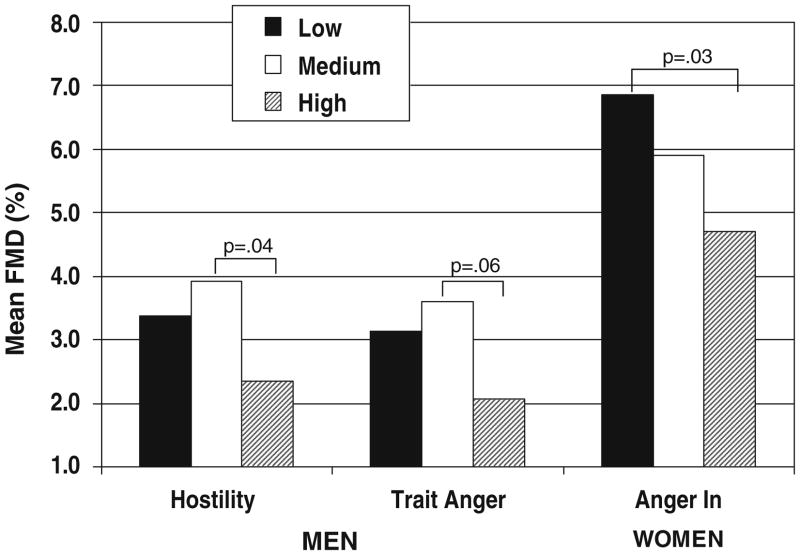
Results: Mean age was 60.5 +/- 4.8 years; 83% of participants were Caucasian and 49% were female. FMD was greater in women compared to men (6.17% vs. 4.07%, p < 0.001). Women reported significantly greater Anxiety (p < 0.001), and men reported greater Hostility (p = 0.004). In separate multivariable linear regression models controlling for cardiovascular risk factors, plus current hormone therapy for women, smaller FMD was associated with higher Anger In for women (beta = -0.222, p = 0.04) and showed a trend with higher Hostility for men (beta = -0.082, p = 0.09).
Conclusion: Endothelial dysfunction, as indicated by less vasodilatation of the brachial artery, is positively associated with measures of hostility and anger suppression in healthy older adults. Thus, associations between negative affect and cardiovascular health may be apparent early in the disease process.
Figures
References
-
- Everson-Rose SA, Lewis TT. Psychosocial factors and cardiovascular diseases. Annu Rev Public Health. 2005;26:469–500. - PubMed
-
- Smith TW, Ruiz JM. Psychosocial influences on the development and course of coronary heart disease: current status and implications for research and practice. J Consult Clin Psychol. 2002;70:548–68. - PubMed
-
- Matthews KA, Gump BB, Harris KF, Haney TL, Barefoot JC. Hostile behaviors predict cardiovascular mortality among men enrolled in the Multiple Risk Factor Intervention Trial. Circulation. 2004;109:66–70. - PubMed
-
- Williams JE, Nieto FJ, Sanford CP, Couper DJ, Tyroler HA. The association between trait anger and incident stroke risk: the Atherosclerosis Risk in Communities (ARIC) Study. Stroke. 2002;33:13–9. - PubMed
-
- Bleil ME, McCaffery JM, Muldoon MF, Sutton-Tyrrell K, Manuck SB. Anger-related personality traits and carotid artery atherosclerosis in untreated hypertensive men. Psychosom Med. 2004;66:633–9. - PubMed
Publication types
MeSH terms
Grants and funding
LinkOut - more resources
Full Text Sources
