Comment
. 2009 Mar;119(3):442-5.
doi: 10.1172/jci38619.

Protein degradation in Parkinson disease revisited: it's complex

Affiliations
Comment

Protein degradation in Parkinson disease revisited: it's complex

Han Li et al. J Clin Invest. 2009 Mar.

Abstract

Mutations in the genes PTEN-induced putative kinase 1 (PINK1), PARKIN,and DJ-1 cause autosomal recessive forms of Parkinson disease (PD), and the Pink1/Parkin pathway regulates mitochondrial integrity and function.An important question is whether the proteins encoded by these genes function to regulate activities of other cellular compartments. A study in mice,reported by Xiong et al. in this issue of the JCI, demonstrates that Pink1,Parkin, and DJ-1 can form a complex in the cytoplasm, with Pink1 and DJ-1 promoting the E3 ubiquitin ligase activity of Parkin to degrade substrates via the proteasome. This protein complex in the cytosol may or may not be related to the role of these proteins in regulating mitochondrial function or oxidative stress in vivo.


Figures
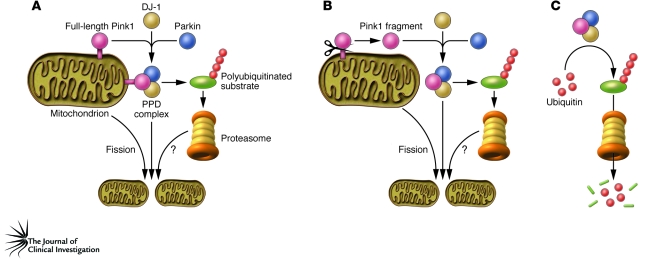
Figure 1
Figure 1. Three models for the role of the PPD complex.
In this issue of the JCI, Xiong et al. report that Pink1, Parkin, and DJ-1 bind to each other and form a PPD E3 ligase complex in which Pink1 and DJ-1 modulate Parkin-dependent ubiquitination and subsequent degradation of substrates via the proteasome (26). Previous work suggests that the Pink1/Parkin pathway regulates mitochondrial integrity and promotes mitochondrial fission in Drosophila (–14). (A) Parkin and DJ-1 may be recruited to the mitochondrial outer membrane during stress (30, 31) and interact with Pink1. These interactions may facilitate the ligase activity of Parkin, thereby facilitating the turnover of molecules that regulate mitochondrial dynamics and mitophagy. The PPD complex may have other roles in the cytosol that result in degradative ubiquitination (26) and/or relay information from mitochondria to other cellular compartments. (B) Alternatively, Pink1 may be released from mitochondria after cleavage to interact with DJ-1 and Parkin in the cytosol. A and B differ in the site of action of the PPD complex and the cleavage status of Pink1. The complex forms on the mitochondrial outer membrane potentially containing full-length Pink1 in A, and in the cytosol with cleaved Pink1 in B. The question marks indicate speculative connections. Note that lack of DJ-1 function results in phenotypes that are distinct from the mitochondrial phenotypes observed in null mutants of Pink1 or Parkin in Drosophila (9, 10, 12, 13, 34). Thus, although the PPD complex is illustrated here as regulating mitochondrial fission, the role of DJ-1 in vivo remains to be clarified. (C) It is also possible that the action occurs in the cytosol and is independent of the function of Pink1/Parkin in regulating mitochondrial integrity and function.

Comment on

References

    1. Dodson M.W., Guo M. Pink1, Parkin, DJ-1 and mitochondrial dysfunction in Parkinson’s disease. Curr. Opin. Neurobiol. 2007;17:331–337. doi: 10.1016/j.conb.2007.04.010. - DOI - PubMed
    1. Mukhopadhyay D., Riezman H. Proteasome-independent functions of ubiquitin in endocytosis and signaling. Science. 2007;315:201–215. doi: 10.1126/science.1127085. - DOI - PubMed
    1. Kahle P.J., Haass C. How does parkin ligate ubiquitin to Parkinson’s disease? EMBO Rep. 2004;5:681–685. doi: 10.1038/sj.embor.7400188. - DOI - PMC - PubMed
    1. Chung K.K., et al. Parkin ubiquitinates the alpha-synuclein-interacting protein, synphilin-1: implications for Lewy-body formation in Parkinson disease. Nat. Med. 2001;7:1144–1150. doi: 10.1038/nm1001-1144. - DOI - PubMed
    1. Ko H.S., et al. Accumulation of the authentic parkin substrate aminoacyl-tRNA synthetase cofactor, p38/JTV-1, leads to catecholaminergic cell death. J. Neurosci. 2005;25:7968–7978. doi: 10.1523/JNEUROSCI.2172-05.2005. - DOI - PMC - PubMed

Publication types

MeSH terms
