


Influence of timing of sexual debut and first marriage on sexual behaviour in later life: findings from four survey rounds in the Kisesa cohort in northern Tanzania
- PMID: 19307336
- PMCID: PMC2654117
- DOI: 10.1136/sti.2008.033704
Influence of timing of sexual debut and first marriage on sexual behaviour in later life: findings from four survey rounds in the Kisesa cohort in northern Tanzania
Abstract
Objectives: To evaluate quality of sexual debut and first marriage data, measure trends and study the association of risky sexual behaviour in youth with adult risk behaviour.
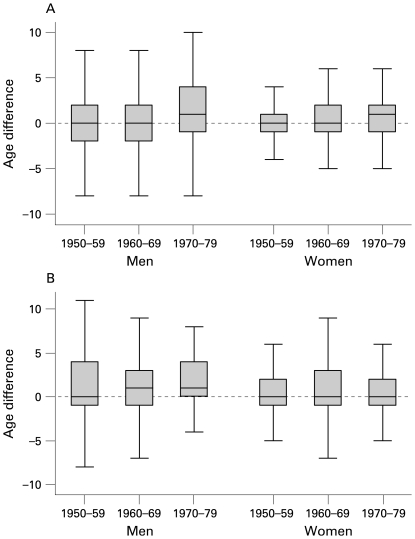
Methods: Reports on age at first sex (AFS) and age at first marriage (AFM) from the Kisesa cohort study, 1994-2004, were evaluated for consistency and used to describe trends in median age-at-event and time spent single but sexually active in different birth cohorts. The association of these variables with marital stability and numbers of partners at later ages was explored using statistical regression techniques.
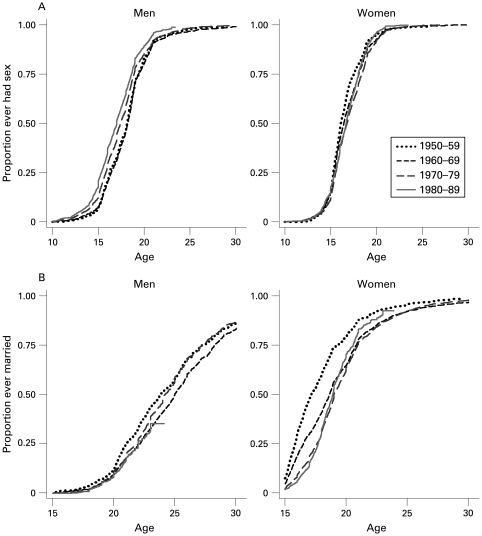
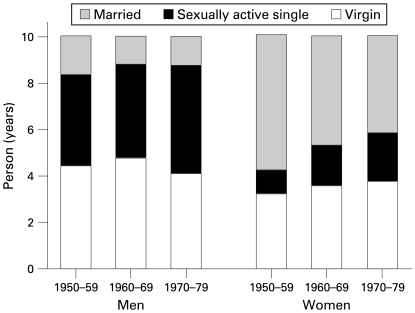
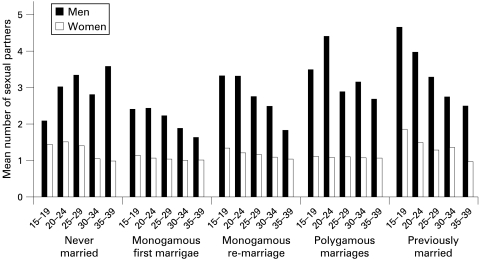
Results: AFS and AFM were inconsistently reported by 32% and 33% of respondents, respectively, but there was no general tendency to report lower or higher ages at a later report date. In 10-year birth cohorts born between 1950-9 and 1980-9, male median AFS declined from 18.1 to 17.0 years and female median AFM rose from 16.2 to 16.6 years. Young people of both sexes currently spend longer sexually active but unmarried than previously. Early marriage is statistically associated with remarriage and polygamy; longer time between sexual debut and marriage is associated with higher numbers of partners at later stages of life.
Conclusion: Inconsistent reporting of age-at-event introduces noise but does not bias estimates of population level indicators. Lengthening time spent single and sexually active suggests that men and women entering first marriage will have been exposed to increased numbers of non-marital partners. Successful youth interventions may also influence adult behaviour.
Conflict of interest statement
Figures
References
-
- Mann J, Tarantola D, Netter T, et al. Prevention. Mann J, Tarantola D, Netter T, ed. AIDS in the world Cambridge, MA: Harvard University Press, 1992:325–448
-
- Anon The ABC approach to HIV prevention: a policy analysis 2005.Selection of articles on A, B and C from the Guttmacher report on Public Policy, previously published as: (1) Cohen SA; Beyond slogans:lessons from Uganda’s experience with ABC and HIV/AIDS, 6(5), Dec 2003; (2) Dailard C.Understanding abstinence:implications for individuals, programs and policies 6(5), Dec 2003; (3) Cohen SA.Promoting the ‘B’ in ABC:its value and limitations in fostering reproductive health 7(4), Oct 2004; (4) Boonstra H.Public health advocates say campaign to disparage condoms threatens STD prevention efforts.6(1), Mar2003
-
- Gregson S, Garnett GP, Nyamukapa CA, et al. HIV decline associated with behavior change in eastern Zimbabwe. Science 2006;311:664–6 - PubMed
-
- Gouws E, Stanecki KA, Lyerla R, et al. The epidemiology of HIV infection among young people aged 15–24 years in southern Africa. AIDS 2008;22(Suppl 4):S5–16 - PubMed
Publication types
MeSH terms
Grants and funding
LinkOut - more resources
Full Text Sources
Miscellaneous
