


Sexual and marital trajectories and HIV infection among ever-married women in rural Malawi
- PMID: 19307337
- PMCID: PMC2654116
- DOI: 10.1136/sti.2008.033969
Sexual and marital trajectories and HIV infection among ever-married women in rural Malawi
Abstract
Objective: To explore how sexual and marital trajectories are associated with HIV infection among ever-married women in rural Malawi.
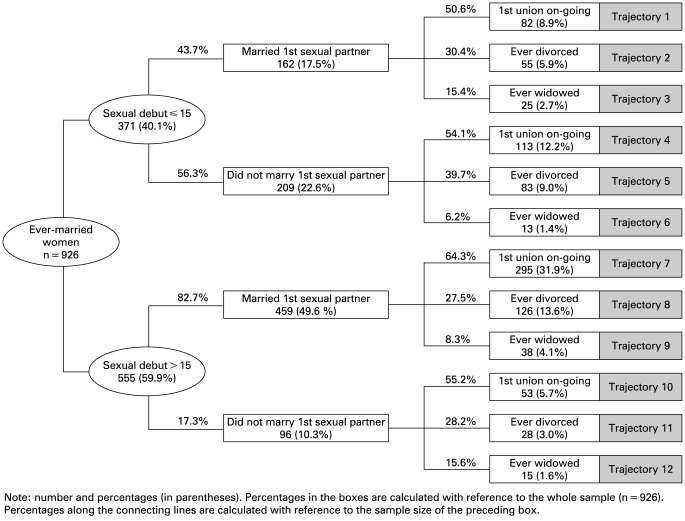
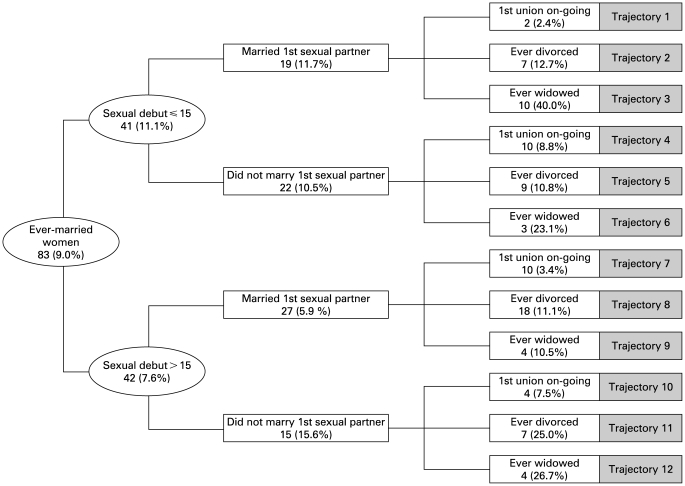
Methods: Retrospective survey data and HIV biomarker data for 926 ever-married women interviewed in the Malawi Diffusion and Ideational Change Project were used. The associations between HIV infection and four key life course transitions considered individually (age at sexual debut, premarital sexual activity, entry into marriage and marital disruption by divorce or death) were examined. These transitions were then sequenced to construct trajectories that represent the variety of patterns in the data. The association between different trajectories and HIV prevalence was examined, controlling for potentially confounding factors such as age and region.
Results: Although each life course transition taken in isolation may be associated with HIV infection, their combined effect appeared to be conditional on the sequence in which they occurred. Although early sexual debut, not marrying one's first sexual partner and having a disrupted marriage each increased the likelihood of HIV infection, their risk was not additive. Women who both delayed sexual debut and did not marry their first partner are, once married, more likely to experience marital disruption and to be HIV-positive. Women who marry their first partner but who have sex at a young age, however, are also at considerable risk.
Conclusions: These findings identify the potential of a life course perspective for understanding why some women become infected with HIV and others do not, as well as the differentials in HIV prevalence that originate from the sequence of sexual and marital transitions in one's life. The analysis suggests, however, the need for further data collection to permit a better examination of the mechanisms that account for variations in life course trajectories and thus in lifetime probabilities of HIV infection.
Conflict of interest statement
Figures
References
-
- Billari FC. Sequence analysis in demographic research. Can Stud Popul 2001;28(Special issue):439–58
-
- Finer LB, Darroch JE, Singh S. Sexual partnership patterns as a behavioral risk factor for sexually transmitted diseases. Fam Plann Perspect 1999;31:228–36 - PubMed
-
- Pettifor AE, van der Straten A, Dunbar MS, et al. Early age of first sex: a risk factor for HIV infection among women in Zimbabwe. AIDS 2004;18:1435–42 - PubMed
