


The medial prefrontal cortex exhibits money illusion
- PMID: 19307555
- PMCID: PMC2664018
- DOI: 10.1073/pnas.0901490106
The medial prefrontal cortex exhibits money illusion
Abstract
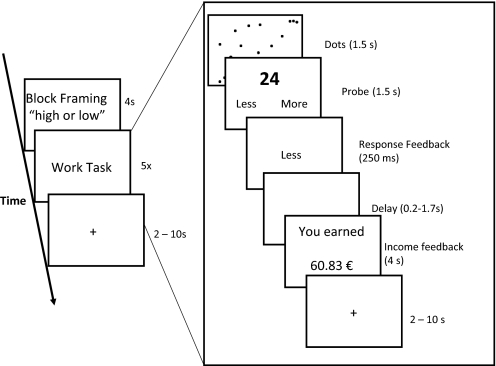
Behavioral economists have proposed that money illusion, which is a deviation from rationality in which individuals engage in nominal evaluation, can explain a wide range of important economic and social phenomena. This proposition stands in sharp contrast to the standard economic assumption of rationality that requires individuals to judge the value of money only on the basis of the bundle of goods that it can buy-its real value-and not on the basis of the actual amount of currency-its nominal value. We used fMRI to investigate whether the brain's reward circuitry exhibits money illusion. Subjects received prizes in 2 different experimental conditions that were identical in real economic terms, but differed in nominal terms. Thus, in the absence of money illusion there should be no differences in activation in reward-related brain areas. In contrast, we found that areas of the ventromedial prefrontal cortex (vmPFC), which have been previously associated with the processing of anticipatory and experienced rewards, and the valuation of goods, exhibited money illusion. We also found that the amount of money illusion exhibited by the vmPFC was correlated with the amount of money illusion exhibited in the evaluation of economic transactions.
Conflict of interest statement
The authors declare no conflict of interest.
Figures

References
-
- Tyran J-R. Money illusion and the market. Science. 2007;317:1042–1043. - PubMed
-
- Shafir E, Diamond P, Tversky A. Money illusion. Q J Econ. 1997;112:341–374.
-
- Tobin J. Inflation and unemployment. Am Econ Rev. 1972;62:1–18.
-
- Fehr E, Tyran J-R. Does money illusion matter? Am Econ Rev. 2001;91:1239–1262.
-
- Yellen JL, Akerlof GA. Stabilization policy: A reconsideration. Econ Inq. 2006;44:1–22.
Publication types
MeSH terms
LinkOut - more resources
Full Text Sources
