


The cultural and chronological context of early Holocene maize and squash domestication in the Central Balsas River Valley, Mexico
- PMID: 19307573
- PMCID: PMC2664064
- DOI: 10.1073/pnas.0812590106
The cultural and chronological context of early Holocene maize and squash domestication in the Central Balsas River Valley, Mexico
Abstract
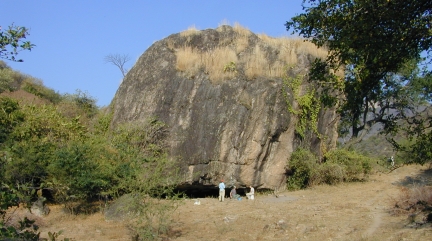
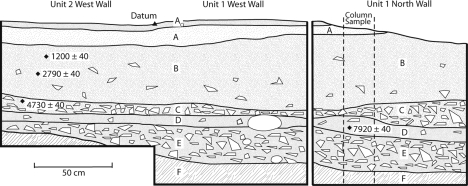
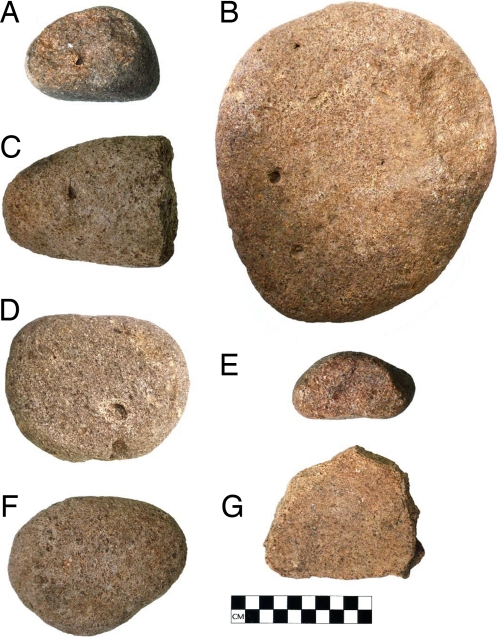
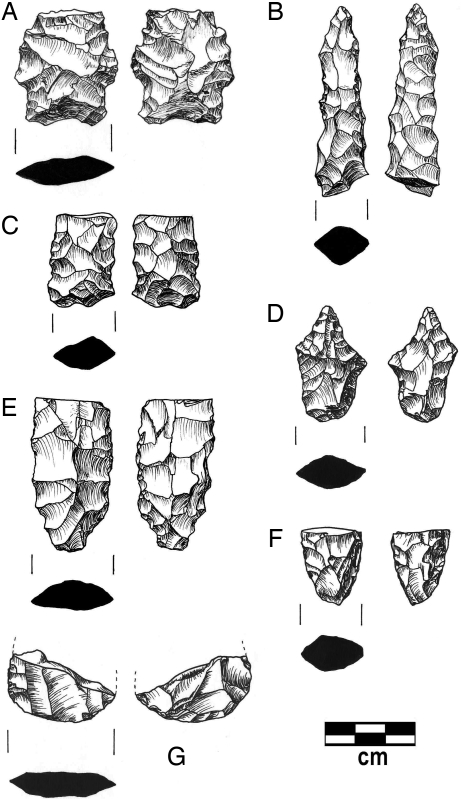
Molecular evidence indicates that the wild ancestor of maize is presently native to the seasonally dry tropical forest of the Central Balsas watershed in southwestern Mexico. We report here on archaeological investigations in a region of the Central Balsas located near the Iguala Valley in Guerrero state that show for the first time a long sequence of human occupation and plant exploitation reaching back to the early Holocene. One of the sites excavated, the Xihuatoxtla Shelter, contains well-stratified deposits and a stone tool assemblage of bifacially flaked points, simple flake tools, and numerous handstones and milling stone bases radiocarbon dated to at least 8700 calendrical years B.P. As reported in a companion paper (Piperno DR, et al., in this issue of PNAS), starch grain and phytolith residues from the ground and chipped stone tools, plus phytoliths from directly associated sediments, provide evidence for maize (Zea mays L.) and domesticated squash (Cucurbita spp.) in contexts contemporaneous with and stratigraphically below the 8700 calendrical years B.P. date. The radiocarbon determinations, stratigraphic integrity of Xihuatoxtla's deposits, and characteristics of the stone tool assemblages associated with the maize and squash remains all indicate that these plants were early Holocene domesticates. Early agriculture in this region of Mexico appears to have involved small groups of cultivators who were shifting their settlements seasonally and engaging in a variety of subsistence pursuits.
Conflict of interest statement
The authors declare no conflict of interest.
Figures

Comment in
-
Rio Balsas most likely region for maize domestication.Proc Natl Acad Sci U S A. 2009 Mar 31;106(13):4957-8. doi: 10.1073/pnas.0900935106. Epub 2009 Mar 25. Proc Natl Acad Sci U S A. 2009. PMID: 19321745 Free PMC article. No abstract available.
-
Typological labeling of early Holocene projectile points.Proc Natl Acad Sci U S A. 2009 Jul 7;106(27):E73; author reply E74. doi: 10.1073/pnas.0904234106. Epub 2009 Jun 29. Proc Natl Acad Sci U S A. 2009. PMID: 19564593 Free PMC article. No abstract available.
References
-
- Flannery K. Guilá Naquitz. Orlando: Academic; 1986.
-
- MacNeish RS. In: Environment and Subsistence, Vol 1: The Prehistory of the Tehuacan Valley. Byers D, editor. Austin: Univ Texas Press; 1967. pp. 290–309.
-
- Smith BD. The initial domestication of Cucurbita pepo in the Americas 10,000 years ago. Science. 1997;276:932–934.
-
- Beadle GW. In: Origins of Agriculture. Reed CE, editor. The Hague: Mouton; 1977. pp. 615–635.
-
- Iltis H. Homeotic sexual translocations and the origin of maize (Zea mays, Poaceae): A new look at an old problem. Econ Bot. 2000;54:7–42.
Publication types
MeSH terms
Substances
LinkOut - more resources
Full Text Sources
Research Materials
Miscellaneous
