


Larval dispersal connects fish populations in a network of marine protected areas
- PMID: 19307588
- PMCID: PMC2659712
- DOI: 10.1073/pnas.0808007106
Larval dispersal connects fish populations in a network of marine protected areas
Abstract
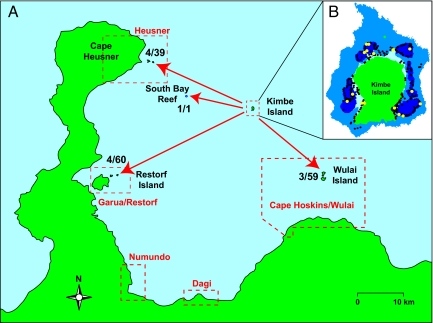
Networks of no-take marine protected areas (MPAs) have been widely advocated for the conservation of marine biodiversity. But for MPA networks to be successful in protecting marine populations, individual MPAs must be self-sustaining or adequately connected to other MPAs via dispersal. For marine species with a dispersive larval stage, populations within MPAs require either the return of settlement-stage larvae to their natal reserve or connectivity among reserves at the spatial scales at which MPA networks are implemented. To date, larvae have not been tracked when dispersing from one MPA to another, and the relative magnitude of local retention and connectivity among MPAs remains unknown. Here we use DNA parentage analysis to provide the first direct estimates of connectivity of a marine fish, the orange clownfish (Amphiprion percula), in a proposed network of marine reserves in Kimbe Bay, Papua New Guinea. Approximately 40% of A. percula larvae settling into anemones in an island MPA at 2 different times were derived from parents resident in the reserve. We also located juveniles spawned by Kimbe Island residents that had dispersed as far as 35 km to other proposed MPAs, the longest distance that marine larvae have been directly tracked. These dispersers accounted for up to 10% of the recruitment in the adjacent MPAs. Our findings suggest that MPA networks can function to sustain resident populations both by local replenishment and through larval dispersal from other reserves. More generally, DNA parentage analysis provides a direct method for measuring larval dispersal for other marine organisms.
Conflict of interest statement
The authors declare no conflict of interest.
Figures
References
-
- Agardy MT. Advances in marine conservation: The role of marine protected areas. Trends Ecol Evol. 1994;9:267–270. - PubMed
-
- Roberts CM. Connectivity and management of Caribbean coral reefs. Science. 1997;278:1454–1457. - PubMed
-
- Lubchenco J, Palumbi SR, Gaines SD, Andelman S. Plugging a hole in the ocean: The emerging science of marine reserves. Ecol Appl. 2003;13:S3–S7.
-
- Airame S, et al. Applying ecological criteria to marine reserve design: A case study from the California Channel Islands. Ecol Appl. 2003;13:S170–S184.
-
- Fernandes L, et al. Establishing representative no-take areas in the Great Barrier Reef: Large-scale implementation of theory on marine protected areas. Conserv Biol. 2005;19:1733–1744.
Publication types
MeSH terms
Substances
LinkOut - more resources
Full Text Sources
Other Literature Sources
