


Lrrk2 R1441G-related Parkinson's disease: evidence of a common founding event in the seventh century in Northern Spain
- PMID: 19308469
- PMCID: PMC2821036
- DOI: 10.1007/s10048-009-0187-z
Lrrk2 R1441G-related Parkinson's disease: evidence of a common founding event in the seventh century in Northern Spain
Abstract
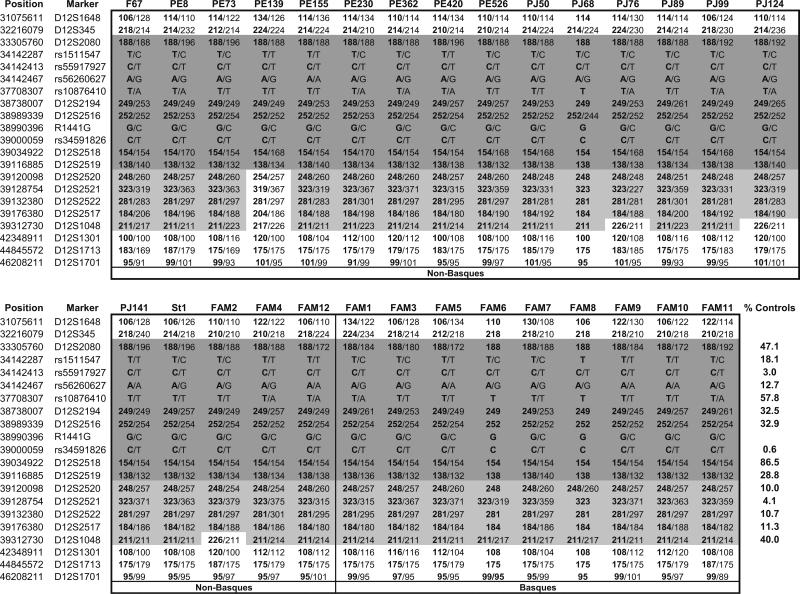
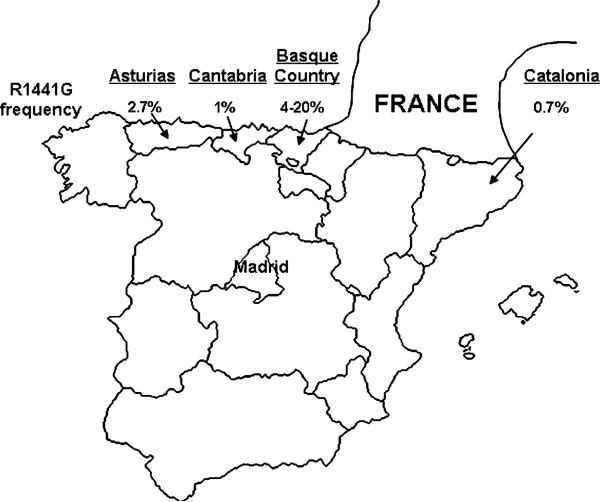
Mutations in the leucine-rich repeat kinase 2 (LRRK2) gene together represent the most common genetic determinant of Parkinson's disease (PD) identified to date. The vast majority of patients with LRRK2-related PD reported in the literature carry one of three pathogenic substitutions: G2019S, R1441C, or R1441G. While G2019S and R1441C are geographically widespread, R1441G is most prevalent in the Basque Country and is rare outside of Northern Spain. We sought to better understand the processes that have shaped the current distribution of R1441G. We performed a haplotype analysis of 29 unrelated PD patients heterozygous for R1441G and 85 wild-type controls using 20 markers that spanned 15.1 Mb across the LRRK2 region. Nine of the patients were of Basque origin and 20 were non-Basques. We inferred haplotypes using a Bayesian approach and utilized a maximum-likelihood method to estimate the age of the most recent common ancestor. Significant but incomplete allele sharing was observed over a distance of 6.0 Mb and a single, rare ten-marker haplotype 5.8 Mb in length was seen in all mutation carriers. We estimate that the most recent common ancestor lived 1,350 (95% CI, 1,020-1,740) years ago in approximately the seventh century. We hypothesize that R1441G originated in the Basque population and that dispersion of the mutation then occurred through short-range gene flow that was largely limited to nearby regions in Spain.
Figures
References
-
- Samii A, Nutt JG, Ransom BR. Parkinson's disease. Lancet. 2004;363:1783–1793. doi:10.1016/S0140-6736(04)16305-8. - PubMed
-
- Przedborski S, Tieu K, Perier C, Vila M. MPTP as a mitochondrial neurotoxic model of Parkinson's disease. J Bioenerg Biomembr. 2004;36:375–379. doi:10.1023/B:JOBB.0000041771.66775.d5. - PubMed
-
- Jankovic J. Parkinson's disease: clinical features and diagnosis. J Neurol Neurosurg Psychiatry. 2008;79:368–376. doi:10.1136/jnnp.2007.131045. - PubMed
-
- Payami H, Larsen K, Bernard S, Nutt J. Increased risk of Parkinson's disease in parents and siblings of patients. Ann Neurol. 1994;36:659–661. doi:10.1002/ana.410360417. - PubMed
-
- Bonifati V, Fabrizio E, Vanacore N, De Mari M, Meco G. Familial Parkinson's disease: a clinical genetic analysis. Can J Neurol Sci. 1995;22:272–279. - PubMed
Publication types
MeSH terms
Substances
Grants and funding
LinkOut - more resources
Full Text Sources
Medical
Miscellaneous
