


Association of Ilizarov's technique and intramedullary rodding in the treatment of congenital pseudarthrosis of the tibia
- PMID: 19308541
- PMCID: PMC2656871
- DOI: 10.1007/s11832-008-0139-4
Association of Ilizarov's technique and intramedullary rodding in the treatment of congenital pseudarthrosis of the tibia
Abstract
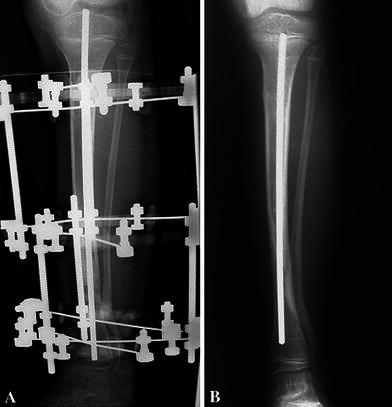
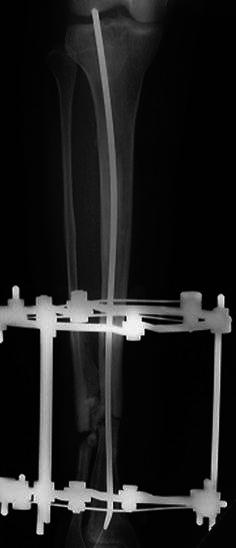
Purpose: Many surgical techniques have been published on how to treat congenital pseudoarthrosis of the tibia (CPT). We combined Ilizarov's fixator with intramedullary nailing of the tibia and developed a procedure which combines the advantages of both methods: Ilizarov's high fusion rate with alignment control and the protection against refracture provided by the intramedullary nail. The results of this approach are presented and discussed.
Material and methods: Seven boys and three girls aged 3-14 years (mean age 8 years 2 months) were treated using our combined technique. In six cases, the CPT was associated with neurofibromatosis. Two strategies were adopted: in six cases, a compression was applied on the bone defect, and in four cases, segmental bone transportation was performed before the compression procedure. The final follow-up (1.2-6.6 years) included a clinical and radiological examination.
Results: Tibial union was achieved in nine cases without bone grafting. In one case, tibial union still remains uncertain, despite intertibiofibular bone grafting and additional compression procedures. Thirteen overall complications were noted, including three valgus deformity of the ankle. Bone transportation failed to achieve complete limb lengthening in three cases. One deep infection occurred 4 years after removal of the external fixator. The treatment for this included nail removal and antibiotic therapy for 3 months. Despite a permanent protection of orthosis, a refracture occurred 2 years after nail removal, reverting to the initial level of pseudarthrosis. Another surgical attempt using the same method was then performed with a satisfactory result.
Conclusions: The association of Ilizarov's technique and intramedullary nailing achieved and maintained tibial union in nine of ten patients at final follow-up. It also allowed correction of axial deformities and prevented refracture. Despite the short duration of the follow-up and a high rate of complications in our series, this method can be useful in many cases of CPT in which healing has failed to occur despite many previous surgeries.
Figures




References
-
- Ilizarov GA, Gracheva VI. Bloodless treatment of congenital pseudarthrosis of the crus with simultaneous elimination of shortening using dosed distraction. Ortop Travmatol Protez. 1971;32:42–46. - PubMed
-
- Paley D, Catagni M, Argnani F, et al. Treatment of congenital pseudoarthrosis of the tibia using the Ilizarov technique. Clin Orthop Relat Res. 1992;280:81–93. - PubMed
-
- Plawecki S, Carpentier E, Lascombes P, Prevot J, Robb JE (1990) Treatment of congenital pseudarthrosis of the tibia by the Ilizarov method. J Pediatr Orthop 10:786–790 - PubMed
-
- Damsin JP, Ghanem I, Carlioz H. Contribution of Ilizarov’s equipment in the treatment of congenital pseudarthrosis of the lower limb. Rev Chir Orthop Reparatrice Appar Mot. 1996;82:34–41. - PubMed
LinkOut - more resources
Full Text Sources
Medical
Research Materials
