


New classification and score for tibial hemimelia
- PMID: 19308574
- PMCID: PMC2656800
- DOI: 10.1007/s11832-008-0081-5
New classification and score for tibial hemimelia
Abstract
Purpose: Previous classifications of tibial malformations are no longer sufficient and practical for clinics and treatment. They are not precisely defined, include incorrect pathological-anatomical definitions, are related to X-ray diagnosis only, miss complete formal types of malformation, or describe too complex concepts not useful for clinical applications (Jones et al., J Bone Joint Surg B 60:31-39, 1978; Kalamchi and Dawe, J Bone Joint Surg B 67:581-584, 1985; Henkel et al., Arch Orthop Trauma Surg 93:1-19, 1978). More precise preoperative diagnosis, including by sonography and MRI and experienced intraoperative analysis of anatomical structures ensure exact description of the pathological-anatomical situation which can be used because of new potential in therapy. Until now, no score was available for detection of additional limb malformations and, therefore, clinical and scientific comparison of the different tibial reduction deficiencies, especially in respect to the success of therapy, was not sufficiently realisable. A new classification and score is presented reflecting the improved therapy currently available.
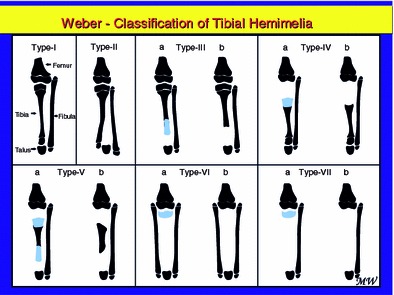
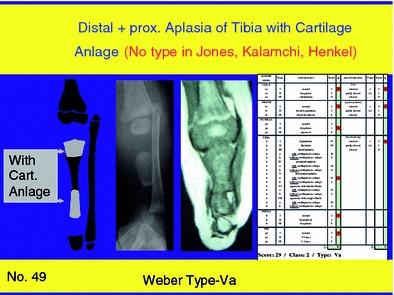
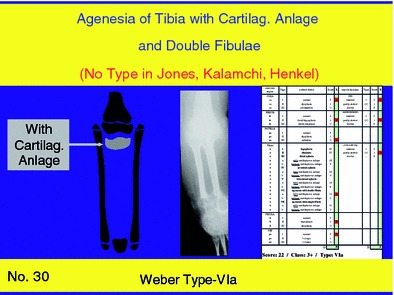
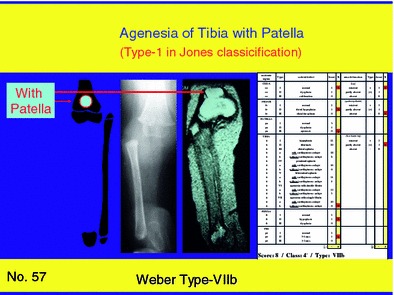
Methods: In this classification and score the main pathological findings of the complete leg are included (coxa-femur-patella-tibia-fibula-pes), with specific importance of the tibia. Tibial malformations are divided into seven main groups and five of them into two subgroups. The cartilaginous anlage of the tibia which has not yet received much attention in the literature plays an important role in this classification. Only seven main types of tibial defect have to be recognized and, if necessary, additional defects of the whole leg, including the function of the affected parts, can be summarized in a-five-class-system.
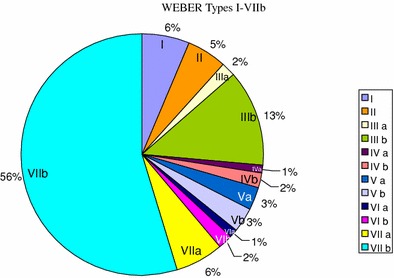
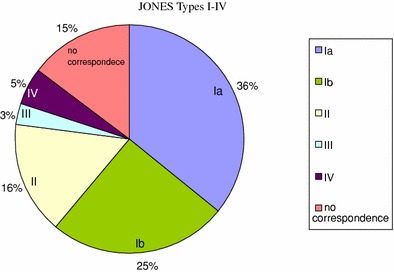
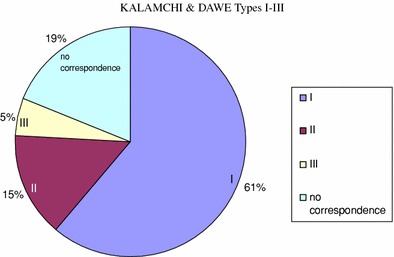
Results: With this classification and this score system which was evaluated on 95 affected limbs, with a sex ratio of 51%:49% (male:female), right:left affection, and unilateral:bilateral affection also, we found the sequence of the distribution of types as follows: 61% of cases with type-VII, 15% with type-III, 6% with type-I, 6% with type-V, 5% with type-II, 3% with type-IV, and 3% with type-VI. In comparison with the Jones et al. (J Bone Joint Surg B 60:31-39, 1978), Kalamchi and Dawe (J Bone Joint Surg B 67:581-584, 1985) and Henkel et al. (Arch Orthop Trauma Surg 93:1-19, 1978) classifications the tibial defects in the presented classification are detected more precisely, the pathological anatomical terms are correctly used, the whole leg and all main functions are included and, thus, reference to therapeutical possibilities is given.
Conclusions: The new classification and the score system allow simple, therapeutically relevant, and comprehensive classification and, additionally, scientific comparison of the different pattern of defects described by diverse authors. For daily clinical use the tibial classification only is preferred.
Figures
References
-
- Billroth T. Ueber einige durch Knochendefecte bedingte Krümmungen des Fusses. Arch Klin Chir. 1861;1:252–268.
-
- Dankmeijer J. Congenital absence of the tibia. Anat Rec. 1935;62:179–194. doi: 10.1002/ar.1090620205. - DOI
-
- Brown FW. The brown operation for total hemimelia tibia. In: Aitken GT, editor. Selected lower-limb anomalies. Washington: National Academy of Sciences; 1971. pp. 20–28.
-
- Jones D, Barnes J, Lloyd-Roberts GC. Congenital aplasia and dysplasia of the tibia with intact fibula: classification and management. J Bone Joint Surg B. 1978;60:31–39. - PubMed
LinkOut - more resources
Full Text Sources
