


Comment
doi: 10.1016/j.cub.2009.01.025.
Dyslexia: bridging the gap between hearing and reading
Affiliations
- PMID: 19321145
- PMCID: PMC4013749
- DOI: 10.1016/j.cub.2009.01.025
Item in Clipboard
Comment
Dyslexia: bridging the gap between hearing and reading
Curr Biol.
.
Abstract
Recent work with dyslexic subjects provides the first empirical evidence linking changes in the brain networks subserving phonological processing to deficits in the matching of speech sounds to their appropriate visual representations.
Figures
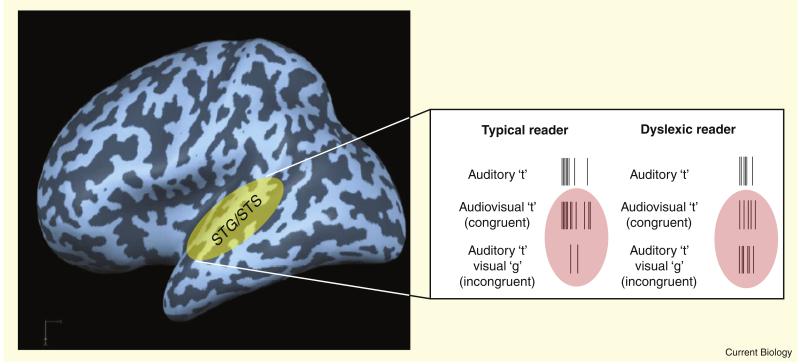
In the superior temporal gyrus and sulcus (STG/STS), the processing of the multisensory combination of auditory speech sounds and visual letters is different between typical and dyslexic readers. The brain template on the left shows the relative location of the STG/STS. The line drawing on the right shows the proposed neural processing differences between typical and dyslexic readers. The vertical lines are meant to represent the patterns of action potentials seen in a representative neuron in this brain region in response to an auditory speech sound alone (auditory ‘t’), the congruent presentation of an auditory speech sound and its visual correlate (audiovisual ‘t’) and an incongruent audiovisual pair (auditory ‘t’ + visual ‘g’). Note the slightly diminished response in the dyslexic readers compared with typical readers to the auditory speech sound alone, but more dramatically, the lack of the normal suppression seen in response to the incongruent audiovisual presentation (red shading).
Comment on
-
Reduced neural integration of letters and speech sounds links phonological and reading deficits in adult dyslexia.Curr Biol. 2009 Mar 24;19(6):503-8. doi: 10.1016/j.cub.2009.01.065. Epub 2009 Mar 12. Curr Biol. 2009. PMID: 19285401
References
-
- Habib M. The neurological basis of developmental dyslexia: an overview and working hypothesis. Brain. 2000;123:2373–2399. - PubMed
-
- Blau V, van Atteveldt N, Ekkebus M, Goebel R, Blomert L. Reduced neural integration of letters and speech sounds links phonological and reading deficits in adult dyslexia. Curr. Biol. 2009;19:503–508. - PubMed
-
- Paracchini S, Scerri T, Monaco AP. The genetic lexicon of dyslexia. Annu. Rev. Genomics Hum. Genet. 2007;8:57–79. - PubMed
-
- Tallal P. Auditory temporal perception, phonics, and reading disabilities in children. Brain Lang. 1980;9:182–198. - PubMed
-
- Tallal P, Miller S, Fitch RH. Neurobiological basis of speech: a case for the preeminence of temporal processing. Ann. NY Acad. Sci. 1993;682:27–47. - PubMed
Publication types
MeSH terms
Grants and funding
LinkOut - more resources
Full Text Sources
Miscellaneous
