Review
. 2009 Jun;15(6):321-33.
doi: 10.1093/molehr/gap025. Epub 2009 Mar 25.

Regulation of the steroidogenic acute regulatory protein gene expression: present and future perspectives

Affiliations
Review

Regulation of the steroidogenic acute regulatory protein gene expression: present and future perspectives

Pulak R Manna et al. Mol Hum Reprod. 2009 Jun.

Abstract

Steroid hormones are synthesized in the adrenal gland, gonads, placenta and brain and are critical for normal reproductive function and bodily homeostasis. The steroidogenic acute regulatory (StAR) protein regulates the rate-limiting step in steroid biosynthesis, i.e. the delivery of cholesterol from the outer to the inner mitochondrial membrane. The expression of the StAR protein is predominantly regulated by cAMP-dependent mechanisms in the adrenal and gonads. Whereas StAR plays an indispensable role in the regulation of steroid biosynthesis, a complete understanding of the regulation of its expression and function in steroidogenesis is not available. It has become clear that the regulation of StAR gene expression is a complex process that involves the interaction of a diversity of hormones and multiple signaling pathways that coordinate the cooperation and interaction of transcriptional machinery, as well as a number of post-transcriptional mechanisms that govern mRNA and protein expression. However, information is lacking on how the StAR gene is regulated in vivo such that it is expressed at appropriate times during development and is confined to the steroidogenic cells. Thus, it is not surprising that the precise mechanism involved in the regulation of StAR gene has not yet been established, which is the key to understanding the regulation of steroidogenesis in the context of both male and female development and function.


Figures
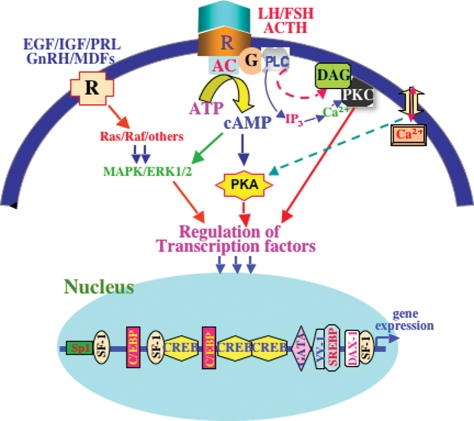
Figure 1
Figure 1
A schematic model illustrating multiple signaling pathways in regulating StAR gene transcription. The interaction of trophic hormones [luteinizing hormone(LH)/adrenocorticotropic hormone(ACTH)] with specific membrane receptors results in the activation of coupled G proteins (G), which in turn activates membrane-associated adenylyl cyclase (AC) that catalyzes cAMP formation from ATP. cAMP then activates protein kinase A (PKA), which results in the phosphorylation of a number of transcription factors. The concerted action of multiple transcription factors, and their interaction with most, if not all, of the cis-regulatory elements, appears to be involved in regulating StAR gene expression. cAMP-dependent mechanisms predominantly regulate StAR expression and steroidogenesis in steroidogenic tissue. The PKC pathway is involved in regulating transcription of the StAR gene. Ca2+ signaling has been shown to be effectively involved in modulating trophic hormone-stimulated steroidogenesis. Epidermal growth factor (EGF), insulin-like growth factor (IGF), prolactin (PRL), gonadotrophin-releasing hormone (GnRH) and macrophage-derived factors (MDFs) bind to specific membrane receptors (R), activate a cascade of protein kinases (Ras/Raf/others; MAPK/ERK) and have been demonstrated to function in the regulation of StAR expression and steroid biosynthesis.
Figure 2
Figure 2
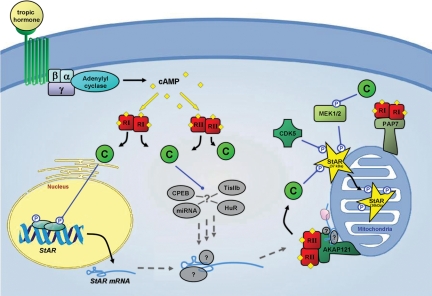
A model illustrating post-transcriptional and post-translational regulation of StAR. Tropic hormone activation initiates multiple signal transduction pathways known to induce StAR gene expression. Central to these pathways is the second messenger cAMP that binds to the regulatory subunits (RI and RII) of PKA resulting in the release of the active catalytic subunits (C). In addition to directing StAR gene transcription, it is predicted that PKA and other signaling events are likely to coordinate the post-transcriptional regulation of StAR mRNA, potentially through miRNAs and mRNA-binding proteins such as Tis11b, HuR and CPEB. The expression of StAR mRNA as a result of this process appears to be enhanced by A-kinase anchor protein (AKAP)121, which may recruit StAR mRNA, possibly in complex with other proteins, to the outer mitochondrial membrane, allowing it to be translated and activated on site. AKAP121 also tethers type II PKA to the mitochondria, which appears to serve a role in enhancing the activation of StAR at the outer mitochondrial membrane through the phosphorylation of Ser195 in StAR. Similarly, acyl-co-enzyme A-binding domain containing 3 (PAP7; also, ABCD3) has been demonstrated to bind type I PKA at the outer mitochondrial, also increasing steroidogenesis. The pool of AKAP-tethered PKA is likely to serve in activating mitochondrial kinase MEK1/2, which has recently been shown to activate StAR by phosphorylating Ser232. Furthermore, StAR activity in Leydig cells has been linked to its association with and phosphorylation by Cdk5; however, the specific target on StAR for this kinase remains unknown. These post-translational modifications to StAR may serve to enhance its stability or its ability to interact with other proteins necessary for cholesterol transport. Alternatively, these events may serve to prolong the duration it takes for StAR to be withdrawn into the mitochondria. The N-terminal region of full-length (37 kDa) StAR targets the protein for importation into the mitochondria and is proteolytically cleaved following StAR’s translocation. Thus, although the C-terminal domain (30 kDa) of StAR possesses the intrinsic capacity to promote cholesterol transfer, it is possible that the steroidogenic potential of StAR is maximized by events that cause it to dwell longer at the outer mitochondrial membrane in contact with other proteins known to promote steroidogenesis. (Figures and dashed arrows depicted in gray represent putative targets and interactions.)
Figure 3
Figure 3
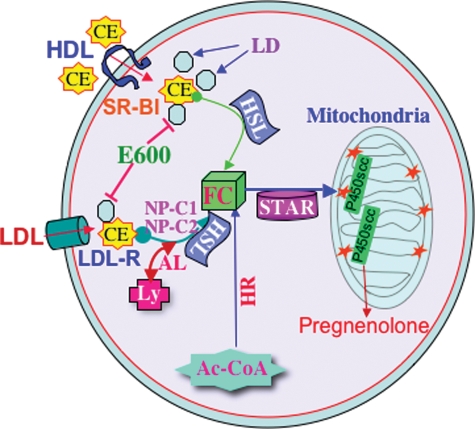
Metabolism of cholesteryl ester (CE) and role of hormone-sensitive lipase (HSL) in steroidogenesis. The hydrolysis of cholesteryl esters stored in lipid droplets is an important source of cholesterol for optimum steroid biosynthesis. HSL is a multifunctional enzyme that is responsible for neutral cholesteryl ester hydrolase activity. E600 blocks the release of cholesterol from lipid droplets (LD) and thus affects StAR expression and steroid synthesis. Circulating lipoproteins (HDL or LDL) bind to scavenger receptor class B, type 1 (SR-B1) and release cholesteryl esters into the cells. Free cholesterol (FC) for steroid production is mostly obtained in rodents via HDL-mediated cholesteryl ester internalization and followed by cleavage by HSL. However, receptor-mediated uptake of lipoprotein-derived cholesteryl esters is processed via the LDL receptor in the human systems. De novo synthesis of cholesterol from acetyl-co-enzyme A (AC-CoA) provides also FC for steroid synthesis. The StAR protein regulates steroidogenesis by controlling the transport of cholesterol from the outer to the inner mitochondrial membrane, the site of the cytochrome P450scc enzyme. Conversion of cholesterol is the first enzymatic step in steroid hormone biosynthesis. LD, lipid droplets; AL, acid lipase; NP-C1 and C2, Niemann–Pick C1 and C2; Ly, lysosome; HR, HMG-co-enzyme A reductase. HDL, high density lipoprotein; LDL, low density lipoprotein.

References

    1. Abate C, Baker SJ, Lees-Miller SP, Anderson CW, Marshak DR, Curran T. Dimerization and DNA binding alter phosphorylation of Fos and Jun. Proc Natl Acad Sci USA. 1993;90:6766–6770. - PMC - PubMed
    1. Affaitati A, Cardone L, de Cristofaro T, Carlucci A, Ginsberg MD, Varrone S, Gottesman ME, Avvedimento EV, Feliciello A. Essential role of A-kinase anchor protein 121 for cAMP signaling to mitochondria. J Biol Chem. 2003;278:4286–4294. - PubMed
    1. Alberta JA, Epstein LF, Pon LA, Orme-Johnson NR. Mitochondrial localization of a phosphoprotein that rapidly accumulates in adrenal cortex cells exposed to adrenocorticotropic hormone or to cAMP. J Biol Chem. 1989;264:2368–2372. - PubMed
    1. Alpy F, Tomasetto C. Give lipids a START: the StAR-related lipid transfer (START) domain in mammals. J Cell Sci. 2005;118:2791–2801. - PubMed
    1. Arakane F, Sugawara T, Nishino H, Liu Z, Holt JA, Pain D, Stocco DM, Miller WL, Strauss JF., III Steroidogenic acute regulatory protein (StAR) retains activity in the absence of its mitochondrial import sequence: implications for the mechanism of StAR action. Proc Natl Acad Sci USA. 1996;93:13731–13736. - PMC - PubMed

Publication types