. 2009 May;150(1):482-93.
doi: 10.1104/pp.108.134783. Epub 2009 Mar 25.

Strigolactone acts downstream of auxin to regulate bud outgrowth in pea and Arabidopsis

Affiliations

Strigolactone acts downstream of auxin to regulate bud outgrowth in pea and Arabidopsis

Philip B Brewer et al. Plant Physiol. 2009 May.

Abstract

During the last century, two key hypotheses have been proposed to explain apical dominance in plants: auxin promotes the production of a second messenger that moves up into buds to repress their outgrowth, and auxin saturation in the stem inhibits auxin transport from buds, thereby inhibiting bud outgrowth. The recent discovery of strigolactone as the novel shoot-branching inhibitor allowed us to test its mode of action in relation to these hypotheses. We found that exogenously applied strigolactone inhibited bud outgrowth in pea (Pisum sativum) even when auxin was depleted after decapitation. We also found that strigolactone application reduced branching in Arabidopsis (Arabidopsis thaliana) auxin response mutants, suggesting that auxin may act through strigolactones to facilitate apical dominance. Moreover, strigolactone application to tiny buds of mutant or decapitated pea plants rapidly stopped outgrowth, in contrast to applying N-1-naphthylphthalamic acid (NPA), an auxin transport inhibitor, which significantly slowed growth only after several days. Whereas strigolactone or NPA applied to growing buds reduced bud length, only NPA blocked auxin transport in the bud. Wild-type and strigolactone biosynthesis mutant pea and Arabidopsis shoots were capable of instantly transporting additional amounts of auxin in excess of endogenous levels, contrary to predictions of auxin transport models. These data suggest that strigolactone does not act primarily by affecting auxin transport from buds. Rather, the primary repressor of bud outgrowth appears to be the auxin-dependent production of strigolactones.


Figures
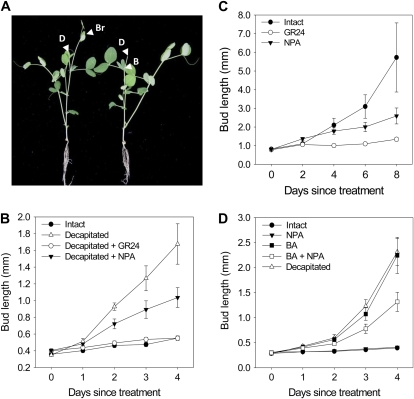
Figure 1.
Figure 1.
Effects of GR24 and NPA on initial bud outgrowth in pea. A, The axillary bud at node 5 of decapitated wild-type plants grows out when treated with 0 μm GR24 (left plant) but is inhibited when treated with 2 μm GR24 at daily intervals for 4 d (right plant), while untreated buds grow out as normal at lower nodes of both plants. Photograph was taken 9 d after decapitation. Abbreviations: B, Bud inhibited at node 5; Br, branch growing at node 5; D, decapitated stump. B, Bud length at node 5 of wild-type (Torsdag) plants that were left untreated (intact) or decapitated above node 5 and treated with 0 or 2 μm GR24 or 1 mm NPA at daily intervals for 3 d from 13 d old. Data are means ± se (n = 13–14). C, Bud length at node 2 of rms1-1 (ccd8) plants treated at 9 d old with either 0 or 2 μm GR24 or 3.4 mm NPA. Data are means ± se (n = 15–16). At day 0, corresponding wild-type buds at node 2 were 0.97 ± 0.07 mm in length. D, Bud length at node 5 of wild-type (Torsdag) plants that were treated at 12 d old with 0 or 1 mm NPA, 500 μm BA, or 1 mm NPA and 500 μm BA applied to the bud at node 5 or decapitated above node 5 with 0 mm NPA applied to the bud. Data are means ± se (n = 12). [See online article for color version of this figure.]
Figure 2.
Figure 2.
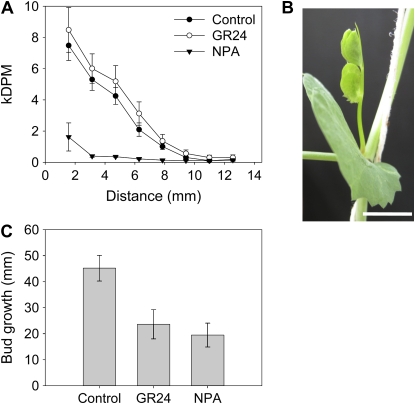
Effects of NPA and GR24 on auxin transport and bud growth. A, [3H]IAA transport in axillary buds of pea. Growing buds at node 4 of 20-d-old rms1-1 (ccd8) plants were treated with solution containing [3H]IAA and 0 or 10 μm GR24 or 1 mm NPA. Bud internode tissue below the shoot tip of the axillary bud and above the leaf axil was harvested into 1.57-mm segments and radioactivity was quantified. Data are means ± se (n = 8). B, Photograph of a treated growing axillary bud prior to harvest. Bar = 1 cm. C, Bud growth of axillary buds at node 4 of rms1-1 (ccd8) plants measured 3 d after treatment with solution containing 0 or 10 μm GR24 or 1 mm NPA. Data are means ± se (n = 13–15). [See online article for color version of this figure.]
Figure 3.
Figure 3.
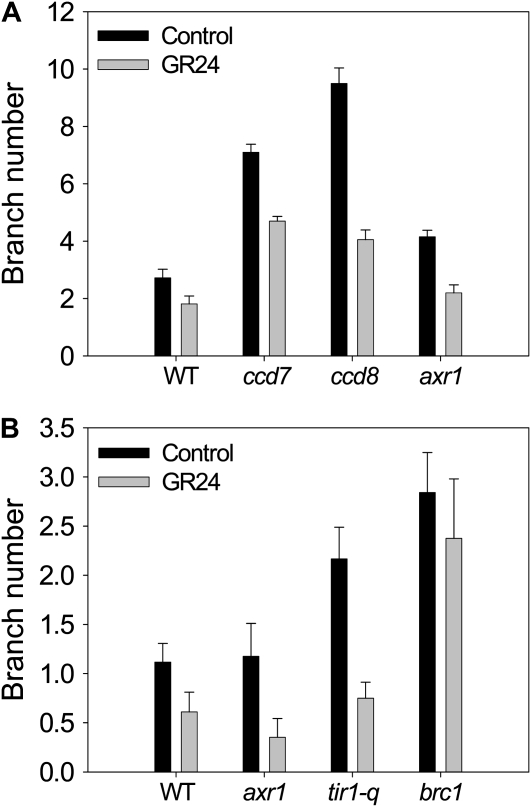
GR24 reduces bud outgrowth in increased branching auxin response mutants of Arabidopsis. A, Treatments of 0 or 5 μm GR24 were applied to the rosette axillary buds and leaf axils of wild-type (WT), max3-11 (ccd7), max4-1 (ccd8), and axr1-3 plants. Data are means ± se (n = 16–20). B, Wild-type, axr1-3, tir1-1 afb1-1 afb2-1 afb3-1 (tir1-q), and brc1-2/tbl1-1 (brc1 in figure; SALK 091920) plants were grown in Phytatrays with 0 or 5.8 μm GR24. Data are means ± se (n = 8–19).
Figure 4.
Figure 4.
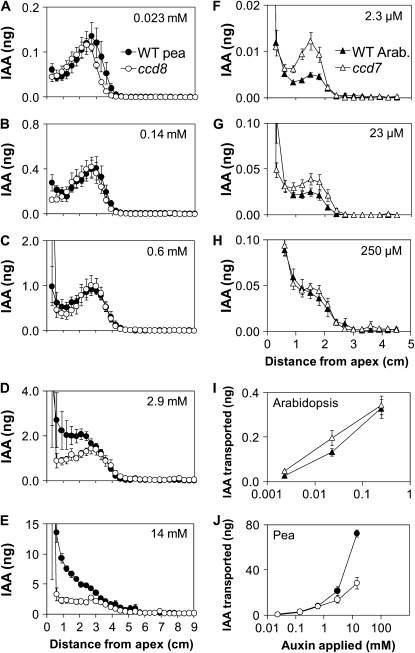
SMS mutants and wild-type plants have the capacity to transport high levels of IAA. A to E, IAA in segments of wild-type (WT) and rms1-1 (ccd8) pea plants 4 h after treatment with mixtures of IAA and [3H]IAA to a total of 0.023 mm (A), 0.14 mm (B), 0.6 mm (C), 2.9 mm (D), and 14 mm (E) IAA. F to H, IAA in segments of wild-type and max3-11 (ccd7) Arabidopsis plants 2.5 h after treatment with mixtures of IAA and [3H]IAA to a total of 2.3 μm (F), 23 μm (G), and 250 μm (H) IAA. I, Total auxin transported in wild-type and max3-11 (ccd7) Arabidopsis plants. J, Total auxin transported in wild-type and rms1 (ccd8) pea plants. Data are means ± se (n = 4 [A–E and J] and n = 5 [F–I]). The endogenous IAA in the stem of pea at about 3 cm from the shoot tip is about 0.4 ng per segment (Morris et al., 2005).
Figure 5.
Figure 5.
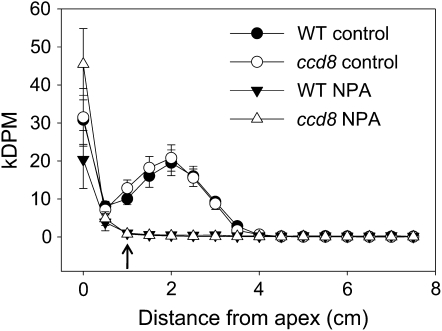
[3H]IAA transport is NPA sensitive in pea plants. Values shown are per segment of wild-type (WT) and rms1-1 (ccd8) pea stems treated with a lanolin ring containing either 0 (control) or 1 mg g−1 NPA and measured 4 h after treatment with [3H]IAA. The arrow indicates the position of the lanolin ring 10 mm below the oldest unexpanded leaf applied at 2 h before treatment with [3H]IAA.
Figure 6.
Figure 6.
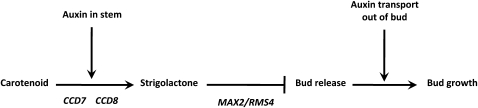
Pathway for auxin and strigolactone action in regulating axillary bud growth. Arrows represent promotion, while flat-ended lines represent inhibition. Auxin promotes strigolactone biosynthesis gene expression. The MAX2/RMS4 F-box protein is required for strigolactone inhibition of bud release. Auxin transport out of an axillary bud, which can be inhibited by NPA, is then required for a bud that has been released to proceed to sustained bud growth.

References

    1. Aguilar-Martínez JA, Poza-Carrión C, Cubas P (2008) Arabidopsis BRANCHED1 acts as an integrator of branching signals within axillary buds. Plant Cell 19 458–472 - PMC - PubMed
    1. Akiyama K, Matsuzaki K, Hayashi H (2005) Plant sesquiterpenes induce hyphal branching in arbuscular mycorrhizal fungi. Nature 435 824–827 - PubMed
    1. Ali A, Fletcher RA (1970) Xylem differentiation in inhibited cotyledonary buds of soybeans. Can J Bot 48 1139–1140
    1. Arite T, Iwata H, Ohshima K, Maekawa M, Nakajima M, Kojima M, Sakakibara H, Kyozuka J (2007) DWARF10, an RMS1/MAX4/DAD1 ortholog, controls lateral bud outgrowth in rice. Plant J 51 1019–1029 - PubMed
    1. Azpiroz R, Wu Y, LoCascio JC, Feldmann KA (1998) An Arabidopsis brassinosteroid-dependent mutant is blocked in cell elongation. Plant Cell 10 219–230 - PMC - PubMed

Publication types

MeSH terms

LinkOut - more resources