


Generating Cu(II)-oxyl/Cu(III)-oxo species from Cu(I)-alpha-ketocarboxylate complexes and O2: in silico studies on ligand effects and C-H-activation reactivity
- PMID: 19322769
- PMCID: PMC2878202
- DOI: 10.1002/chem.200802338
Generating Cu(II)-oxyl/Cu(III)-oxo species from Cu(I)-alpha-ketocarboxylate complexes and O2: in silico studies on ligand effects and C-H-activation reactivity
Abstract
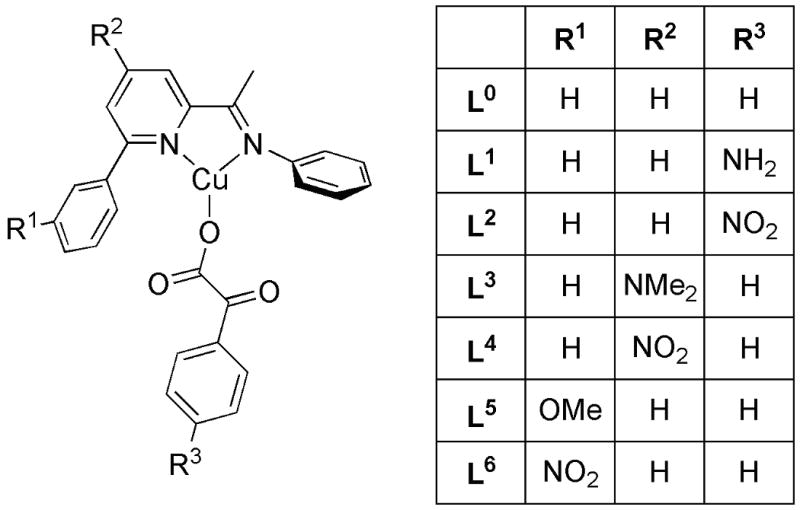
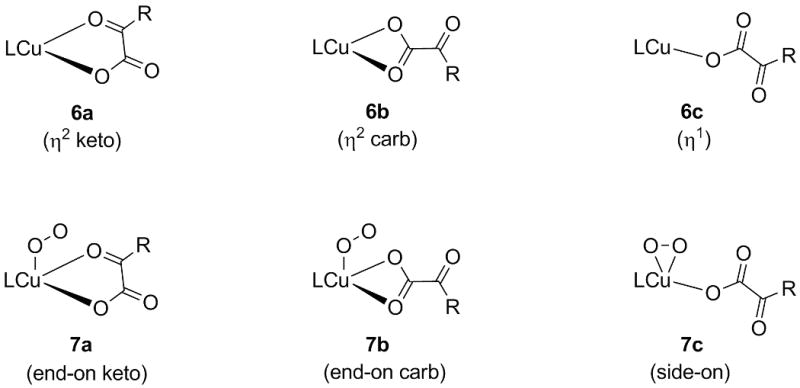
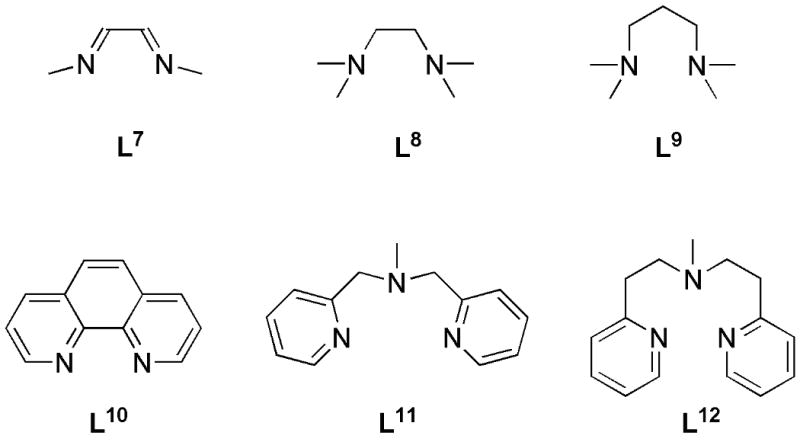
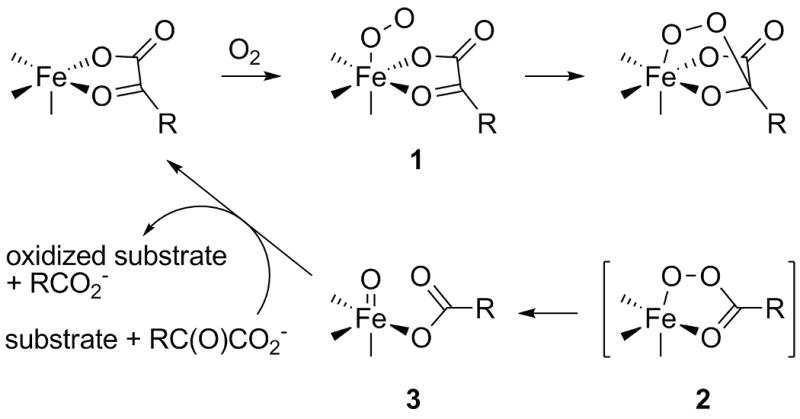
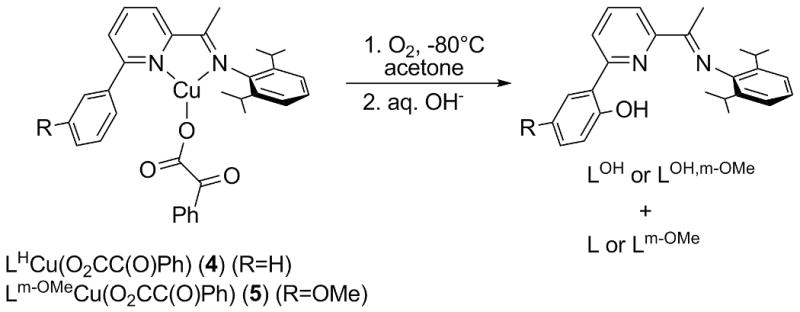
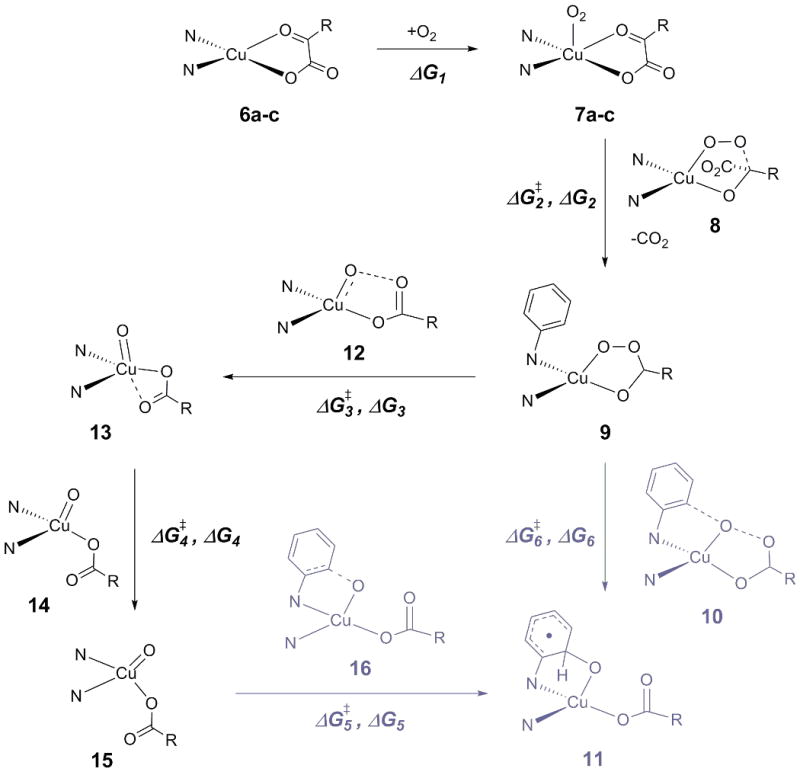
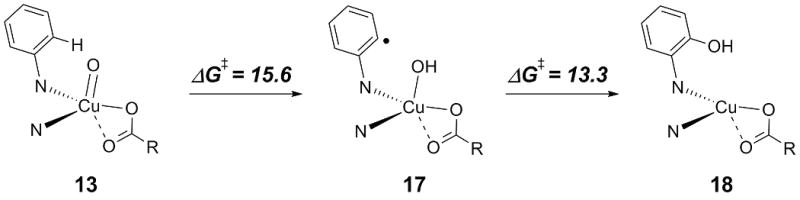
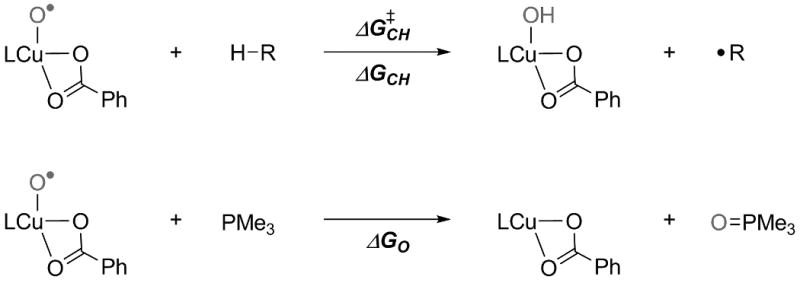
A mechanism for the oxygenation of Cu(I) complexes with alpha-ketocarboxylate ligands that is based on a combination of density functional theory and multireference second-order perturbation theory (CASSCF/CASPT2) calculations is elaborated. The reaction proceeds in a manner largely analogous to those of similar Fe(II)-alpha-ketocarboxylate systems, that is, by initial attack of a coordinated oxygen molecule on a ketocarboxylate ligand with concomitant decarboxylation. Subsequently, two reactive intermediates may be generated, a Cu-peracid structure and a [CuO](+) species, both of which are capable of oxidizing a phenyl ring component of the supporting ligand. Hydroxylation by the [CuO](+) species is predicted to proceed with a smaller activation free energy. The effects of electronic and steric variations on the oxygenation mechanisms were studied by introducing substituents at several positions of the ligand backbone and by investigating various N-donor ligands. In general, more electron donation by the N-donor ligand leads to increased stabilization of the more Cu(II)/Cu(III)-like intermediates (oxygen adducts and [CuO](+) species) relative to the more Cu(I)-like peracid intermediate. For all ligands investigated, the [CuO](+) intermediates are best described as Cu(II)-O(*-) species with triplet ground states. The reactivity of these compounds in C-H abstraction reactions decreases with more electron-donating N-donor ligands, which also increase the Cu-O bond strength, although the Cu-O bond is generally predicted to be rather weak (with a bond order of about 0.5). A comparison of several methods to obtain singlet energies for the reaction intermediates indicates that multireference second-order perturbation theory is likely more accurate for the initial oxygen adducts, but not necessarily for subsequent reaction intermediates.
Figures
References
-
- Solomon EI, Sundaram UM, Machonkin TE. Chem Rev. 1996;96:2563–2605. - PubMed
- Solomon EI, Chen P, Metz M, Lee SK, Palmer AE. Angew Chem Int Ed. 2001;40:4570–4590. - PubMed
- Klinman JP. Chem Rev. 1996;96:2541–2561. - PubMed
- Decker A, Solomon EI. Curr Opin Chem Biol. 2005;9:152–163. - PubMed
- Solomon EI, Sarangi R, Woertink J, Augustine A, Yoon J, Ghosh S. Acc Chem Res. 2007;40:581–591. - PMC - PubMed
-
-
Selected recent reviews: Mirica LM, Ottenwaelder X, Stack TDP. Chem Rev. 2004;104:1013–1045.Lewis EA, Tolman WB. Chem Rev. 2004;104:1047–1076.Hatcher L, Karlin KD. J Biol Inorg Chem. 2004;9:669–683.Itoh S. Curr Opin Chem Biol. 2006;10:115–122.Cramer CJ, Tolman WB. Acc Chem Res. 2007;40:601–608.Suzuki M. Acc Chem Res. 2007;40:609–617.Gherman BF, Cramer CJ. Coord Chem Rev. doi: 10.1016/j.ccr.2007.11.018. in press.
-
-
- Crespo A, Marti MA, Roitberg AE, Amzel LM, Estrin DA. J Am Chem Soc. 2006;128:12817–12828. - PubMed
- Kmachi T, Kihara N, Shiota Y, Yoshizawa K. Inorg Chem. 2005;44:4226–4236. - PubMed
- Yoshizawa K, Kihara N, Kamachi T, Shiota Y. Inorg Chem. 2006;45:3034–3041. - PubMed
- Evans JP, Ahn K, Klinman JP. J Biol Chem. 2003;278:49691–49698. - PubMed
- Chen P, Solomon EI. J Am Chem Soc. 2004;126:4991–5000. - PubMed
- Klinman JP. J Biol Chem. 2006;281:3013–3016. - PubMed
-
-
For examples, see: Kitajima N, Koda T, Iwata Y, Moro-oka Y. J Am Chem Soc. 1990;112:8833–8839.Capdevielle P, Sparfel D, Baranne-Lafont J, Cuong NK, Maumy M. J Chem Soc, Chem Commun. 1990:565–566.Reinaud O, Chapdevielle P, Maumy M. J Chem Soc, Chem Commun. 1990:566–568.Maiti D, Lucas HR, Sarjeant AAN, Karlin KD. J Am Chem Soc. 2007;129:6998–6999.Maiti D, Sarjeant AAN, Karlin KD. Inorg Chem. 2008;47:8736–8747.
-
-
- Schroeder D, Holtzhausen MC, Schwarz H. J Phys Chem B. 2004;108:14407–14416.
Publication types
MeSH terms
Substances
Grants and funding
LinkOut - more resources
Full Text Sources
