


Smaller organ mass with greater age, except for heart
- PMID: 19325028
- PMCID: PMC2692775
- DOI: 10.1152/japplphysiol.90454.2008
Smaller organ mass with greater age, except for heart
Abstract
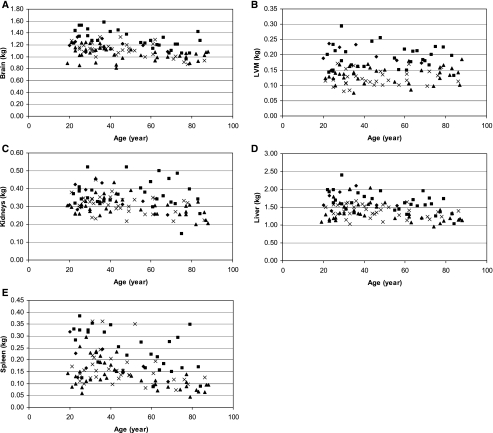
Autopsy/cadaver data indicate that many organs and tissues are smaller in the elderly compared with young adults; however, in vivo data are lacking. The aim of this study was to determine whether the mass of specific high-metabolic-rate organs is different with increasing age, using MRI. Seventy-five healthy women (41 African-Americans and 34 Caucasians, age range 19-88 yr) and 36 men (8 African-Americans and 28 Caucasians, age range 19-84 yr) were studied. MRI-derived in vivo measures of brain, heart, kidneys, liver, and spleen were acquired. Left ventricular mass (LVM) was measured by either echocardiography or cardiac gated MRI. Total body fat mass and fat-free mass (FFM) were measured with a whole body dual-energy X-ray absorptiometry (DXA) scanner. Multiple regression analysis was used to investigate the association between the organ mass and age after adjustment for weight and height (or DXA measures of FFM), race, sex, and interactions among these variable. No statistically significant interaction was found among age, sex, and race in any regression model. Significant negative relationships between organ mass and age were found for brain (P < 0.0001), kidneys (P = 0.01), liver (P = 0.001), and spleen (P < 0.0001). A positive relationship between LVM and age was found after adjustment for FFM (P = 0.037). These findings demonstrate that age has a significant effect on brain, kidneys, liver, spleen, and heart mass. The age effect was independent of race and sex.
Figures
Comment in
-
Organ-o-penia.J Appl Physiol (1985). 2009 Jun;106(6):1759-60. doi: 10.1152/japplphysiol.00315.2009. Epub 2009 Apr 9. J Appl Physiol (1985). 2009. PMID: 19359616 No abstract available.
References
-
- Bean BR Composite study of weight of vital organs in man. Am J Phys Anthropol 9: 293–317, 1926.
-
- Bosy-Westphal A, Eichhorn C, Kutzner D, Ner K 3rd, Heller M, Muller MJ. The age-related decline in resting energy expenditure in humans is due to the loss of fat-free mass and to alterations in its metabolically active components. J Nutr 133: 2356–2362, 2003. - PubMed
-
- Elia M Organ and tissue contribution to metabolic rate. In: Energy Metabolism. Tissue Determinants and Cellular Corollaries, edited by Kinney JM, Tucker HN. New York, Raven, p. 61–77, 1992.
-
- Gallagher D, Visser M, De Meersman RE, Sepúlveda D, Baumgartner RN, Pierson RN, Harris T, Heymsfield SB. Appendicular skeletal muscle mass: effects of age, gender, and ethnicity. J Appl Physiol 83: 229–239, 1997. - PubMed
-
- Gallagher D, Belmonte D, Deurenberg P, Wang Z, Krasnow N, Pi-Sunyer FX, Heymsfield SB. Organ-tissue mass measurement allows modeling of REE and metabolically active tissue mass. Am J Physiol Endocrinol Metab 275: E249–E258, 1998. - PubMed
Publication types
MeSH terms
Grants and funding
LinkOut - more resources
Full Text Sources
Medical
