. 2009;60(6):1783-97.
doi: 10.1093/jxb/erp048. Epub 2009 Mar 26.

Molecular and functional characterization of a novel chromoplast-specific lycopene beta-cyclase from Citrus and its relation to lycopene accumulation

Affiliations

Molecular and functional characterization of a novel chromoplast-specific lycopene beta-cyclase from Citrus and its relation to lycopene accumulation

Berta Alquézar et al. J Exp Bot. 2009.

Abstract

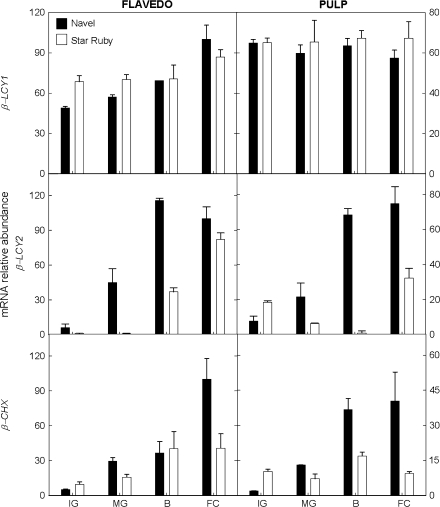
Carotenoids are the main pigments responsible of the colouration of Citrus fruits. The beta-cyclization of lycopene, catalysed by the lycopene beta-cyclases (beta-LCY), seems to be a key regulatory step of the carotenoid pathway. In the present study, two beta-LCYs from orange fruits (Citrus sinensis), named Csbeta-LCY1 and Csbeta-LCY2 have been isolated and the activity of the encoded proteins was demonstrated by functional analysis. Csbeta-LCY1 was expressed at low levels and remained relatively constant during fruit ripening while Csbeta-LCY2 showed a chromoplast-specific expression and a marked induction in both peel and pulp of orange fruits in parallel with the accumulation of beta,beta-xanthophylls. The potential involvement of Csbeta-LCY2 in the accumulation of lycopene, characteristic of some Citrus species such as red grapefruits, was investigated. Expression of Csbeta-LCY2 and another seven carotenoid biosynthetic genes were studied in the peel and pulp of the high lycopene-accumulating grapefruit, Star Ruby, and compared with those of ordinary Navel orange. In Star Ruby, the accumulation of lycopene during fruit maturation was associated with a substantial reduction in the expression of both beta-LCY2 and beta-CHX genes with respect to Navel orange. Moreover, two different alleles of beta-LCY2: beta-LCY2a and beta-LCY2b were isolated from both genotypes, and functional assays demonstrated that the lycopene beta-cyclase activity of the allele b was almost null. Interestingly, Star Ruby grapefruit predominantly expressed the unfunctional beta-LCY2b allele during fruit ripening whereas Navel oranges preferably expressed the functional allele. It is suggested that the presence of diverse alleles of the beta-LCY2 gene, encoding enzymes with altered activity, with different transcript accumulation may be an additional regulatory mechanism of carotenoid synthesis involved in the accumulation of lycopene in red grapefruits.


Figures
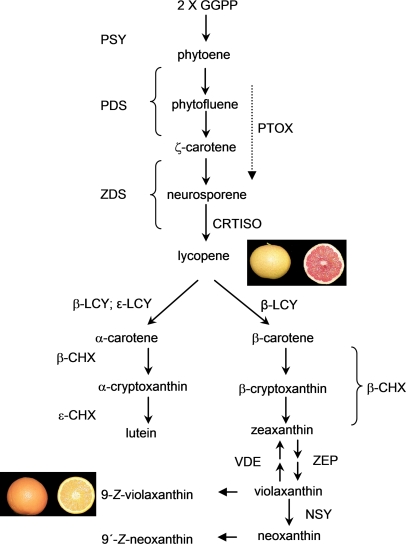
Fig. 1.
Fig. 1.
Schematic diagram of the carotenoid biosynthesis pathway in plants. GGPP, geranylgeranyl diphosphate; PSY, phytoene synthase; PDS, phytoene desaturase; ZDS, ζ-carotene desaturase; PTOX, plastid terminal oxidase; CRTISO, carotene isomerase; ε-LCY, lycopene ε-cyclase; β-LCY, lycopene β-cyclase; β-CHX, β-carotene hydroxylase; ε-CHX, ε-carotene hydroxylase; ZEP, zeaxanthin epoxidase; VDE, violaxanthin de-epoxidase; NSY, neoxanthin synthase. Internal and external aspect of mature Navel orange (Citrus sinensis) and Star Ruby grapefruit (Citrus paradisi) used in this study, are located in the pathway side to the major carotenoid accumulating in the pulp of full-coloured fruit. (This figure is available in colour at JXB online.)
Fig. 2.
Fig. 2.
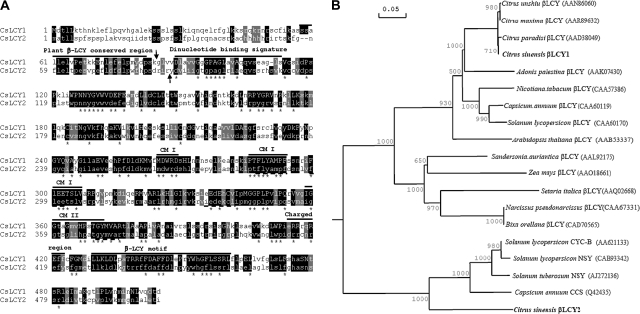
(A) Alignment of deduced amino acid sequences of Csβ-LCY1 and Csβ-LCY2. The alignment was created by using ClustalW program. Numbers on the left denote the number of amino acid residues. Residues identical for both sequences in a given position are in white text on a black background, those identical in all plant β-LCYs (including tomato CYC-B and pepper CCS) are in capital letters on the Csβ-LCY1 sequence, while those also conserved in ε-LCYs are marked with an asterisk (*). The most likely points for chloroplast precursor cleavage are indicated with arrows. Characteristic regions of plant LCYs are indicated on the Csβ-LCY1 sequence as plant β-LCY conserved region, di-nucleotide binding signature, cyclase motifs (CM) I and II, charged region, and β-LCY motif (Hugueney et al. 1995; Cunningham et al. 1996). Domains described as essential for β-LCY activity are underlined (Bouvier et al. 1997). (B) Phylogenetic tree generated based on alignment of deduced amino acid sequences of plant β-LCYs, NSYs, and CCS. The tree was constructed on the basis of the Neighbor–Joining method (Saitou and Nei, 1987). The bootstrap values on the nodes indicate the number of times that each group occurred with 1000 replicates. Only bootstrap values greater than 500 are shown. Accession numbers of protein sequences are in parenthesis.
Fig. 3.
Fig. 3.
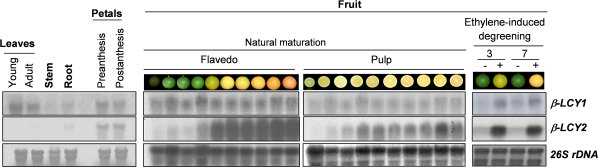
Accumulation of Csβ-LCY1 and Csβ-LCY2 transcripts in different orange (Citrus sinensis cv. Navel) tissues. In the degreening experiment total RNA from flavedo of control fruits (–) or ethylene treated (+) (10 μl l−1) after 3 d and 7 d of treatment was used for expression analysis. Each lane was loaded with 10 μg of total RNA. The RNA was fractionated on a 1% agarose-formaldehyde gel, blotted onto nylon membrane, and hybridized with the correspondent probe. Note that for thr Csβ-LCY1 probe, the exposure time was between 4–15 times higher than for the Csβ-LCY2 probe. Membrane staining with methylene blue shows the rRNA bands. Expression data are representative of at least two independent experiments.
Fig. 4.
Fig. 4.
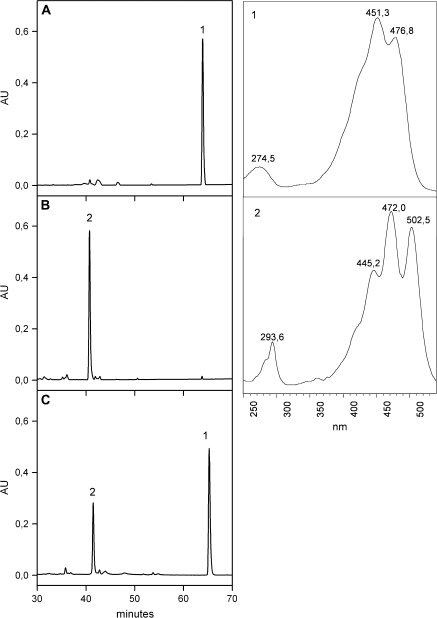
Analysis by HPLC-PDA of carotenoids in E. coli cells that accumulate lycopene and express β-LCY1 or β-LCY2 from Citrus sinensis. Carotenoids were extracted from suspension cultures of cells with plasmids pACCRT-EIB and pGEM (empty vector) (A), plasmids pACCRT-EIB and pGEM-Csβ-LCY1 (B), or plasmids pACCRT-EIB and pGEM-Csβ-LCY2 (C). Absorbance spectra of the peaks are showed in boxes: peak 1, lycopene; peak 2, β-carotene. (This figure is available in colour at JXB online.)
Fig. 5.
Fig. 5.
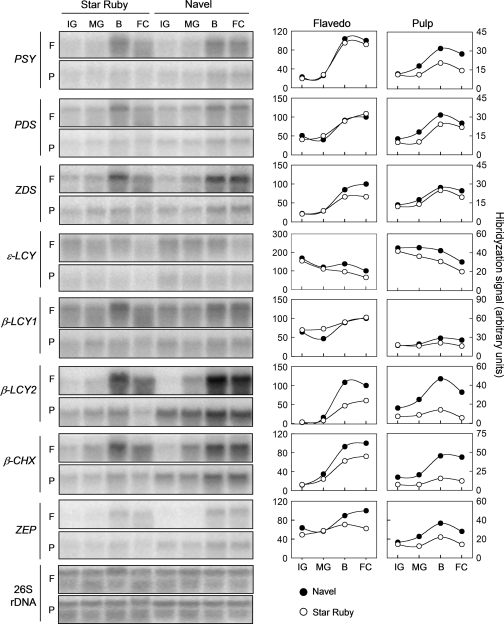
Accumulation of mRNAs from carotenoid biosynthetic genes in the flavedo and the pulp of Navel orange (C. sinensis) (black symbols) and Star Ruby grapefruit (C. paradisi) (white symbols) at the IG (immature green), MG (mature green), B (breaker), and FC (full-colour) stages. All transcripts values for individual genes were normalized with respect to the corresponding value of the 26s rDNA signal. Normalized values of mRNAs accumulation in arbitrary units are represented using the FC flavedo of Navel as a reference (100).
Fig. 6.
Fig. 6.
Quantitative RT-PCR analysis of the expression of β-LCY1, β-LCY2, and β-CHX genes in the flavedo and the pulp of Navel orange (C. sinensis) (black bars) and Star Ruby grapefruit (C. paradisi) (white bars) at the IG (immature green), MG (mature green), B (breaker), and FC (full-colour) stages. The levels of expression were normalized to the amount of RNA and the value of Navel flavedo at the FC stage was set to 100. The data are means ±SD of three experimental replicates.

References

    1. al Babili S, Hugueney P, Schledz M, Welsch R, Frohnmeyer H, Laule O, Beyer P. Identification of a novel gene coding for neoxanthin synthase from Solanum tuberosum. FEBS Letters. 2000;485:168–172. - PubMed
    1. Alos E, Cercos M, Rodrigo MJ, Zacarias L, Talon M. Regulation of color break in citrus fruits. Changes in pigment profiling and gene expression induced by gibberellins and nitrate, two ripening retardants. Journal of Agricultural and Food Chemistry. 2006;54:4888–4895. - PubMed
    1. Alquezar B, Rodrigo MJ, Zacarias L. Regulation of carotenoid biosynthesis during fruit maturation in the red-fleshed orange mutant Cara Cara. Phytochemistry. 2008;69:1997–2007. - PubMed
    1. Altschul SF, Gish W, Miller W, Myers EW, Lipman DJ. Basic Local Alignment Search Tool. Journal of Molecular Biology. 1990;215:403–410. - PubMed
    1. Ballester AR, Lafuente MT, Gonzalez-Candelas L. Spatial study of antioxidant enzymes, peroxidase and phenylalanine ammonia-lyase in the citrus fruit–Penicillium digitatum interaction. Postharvest Biology and Technology. 2006;39:115–124.

Publication types

MeSH terms