. 2009 Mar 27:8:18.
doi: 10.1186/1475-2840-8-18.

Blood pressure reduction, persistence and costs in the evaluation of antihypertensive drug treatment--a review

Affiliations

Blood pressure reduction, persistence and costs in the evaluation of antihypertensive drug treatment--a review

Peter Bramlage et al. Cardiovasc Diabetol. .

Abstract

Background: Blood pressure lowering drugs are usually evaluated in short term trials determining the absolute blood pressure reduction during trough and the duration of the antihypertensive effect after single or multiple dosing. A lack of persistence with treatment has however been shown to be linked to a worse cardiovascular prognosis. This review explores the blood pressure reduction and persistence with treatment of antihypertensive drugs and the cost consequences of poor persistence with pharmaceutical interventions in arterial hypertension.

Methods: We have searched the literature for data on blood pressure lowering effects of different antihypertensive drug classes and agents, on persistence with treatment, and on related costs. Persistence was measured as patients' medication possession rate. Results are presented in the form of a systematic review.

Results: Angiotensin II receptor blocker (ARBs) have a competitive blood pressure lowering efficacy compared with ACE-inhibitors (ACEi) and calcium channel blockers (CCBs), beta-blockers (BBs) and diuretics. 8 studies describing the persistence with treatment were identified. Patients were more persistent on ARBs than on ACEi and CCBs, BBs and diuretics. Thus the product of blood pressure lowering and persistence was higher on ARBs than on any other drug class. Although the price per tablet of more recently developed drugs (ACEi, ARBs) is higher than that of older ones (diuretics and BBs), the newer drugs result in a more favourable cost to effect ratio when direct drug costs and indirect costs are also considered.

Conclusion: To evaluate drugs for the treatment of hypertension several key variables including the blood pressure lowering effect, side effects, compliance/persistence with treatment, as well as drug costs and direct and indirect costs of medical care have to be considered. ARBs, while nominally more expensive when drug costs are considered only, provide substantial cost savings and may prevent cardiovascular morbidity and mortality based on the more complete antihypertensive coverage. This makes ARBs an attractive choice for long term treatment of hypertension.


Figures
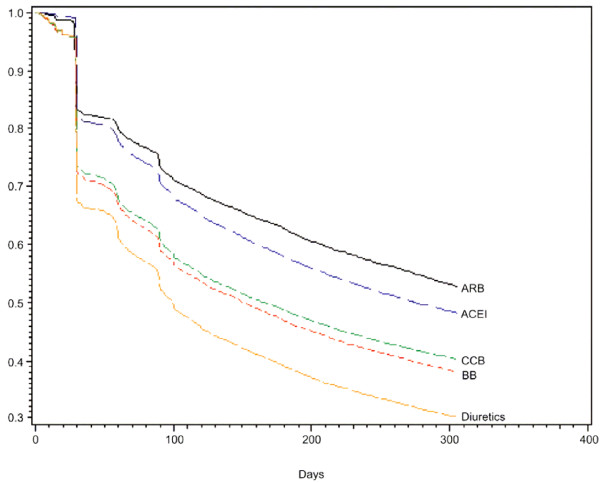
Figure 1
Figure 1
Time to therapy discontinuation of antihypertensive monotherapy [16]. This depicts the proportion of study patients by antihypertensive medication class who remained persistent with index therapy (y axis) during the year subsequent to the index study claim (days subsequent to index date depicted on x axis). ARB patients were most likely to remain on therapy, closely followed by ACEi patients. Diuretic patients were least likely to remain on the index monotherapy regimen.
Figure 2
Figure 2
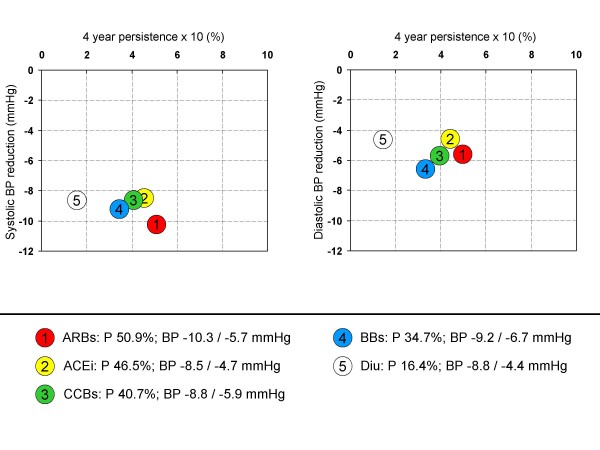
Blood pressure reduction vs. 4 year persistence with treatment. Mean systolic blood pressure reduction was taken from Law [9], 4 year persistence with monotherapy was taken from Conlin [18].
Figure 3
Figure 3
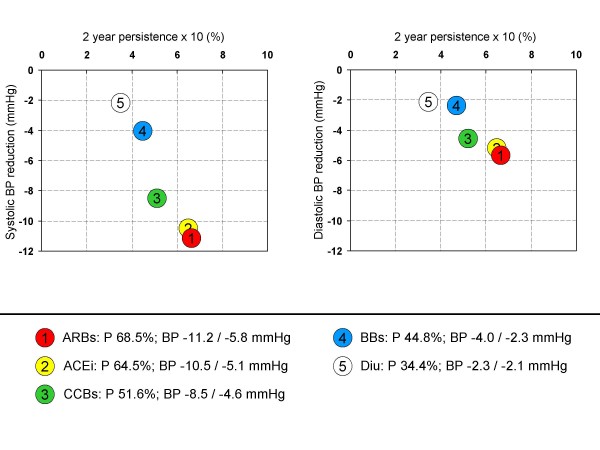
Blood pressure reduction vs. 2 year persistence with treatment. Mean blood pressure reduction and persistence with treatment over 2 years was taken from Veronesi [19].
Figure 4
Figure 4
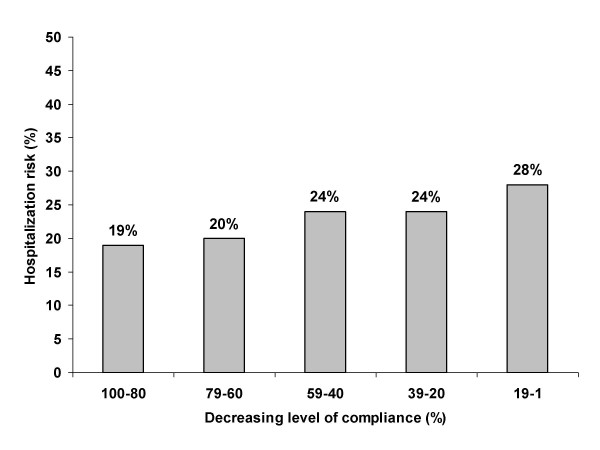
Risk of hospitalisation (%) in relation to the level of compliance for hypertension [24]. Level of compliance grouped into quintiles vs. risk of hospitalization. Patients with a high degree of compliance (of between 80 and 100%) have a 19% risk of hospitalization as compared to 28% in patients with a compliance between 1 and 19%.
Figure 5
Figure 5
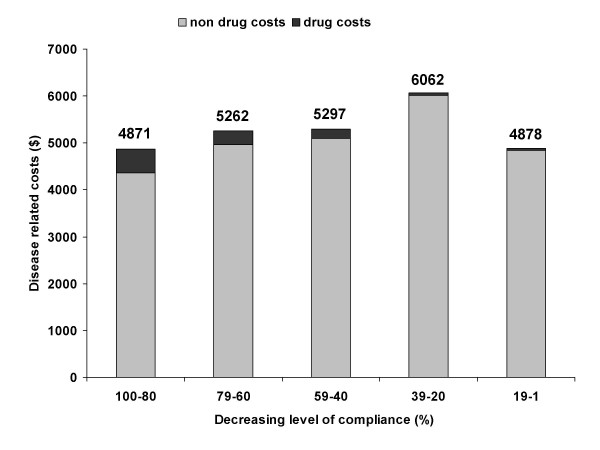
Disease-related healthcare costs in relation to the level of compliance for hypertension [24]. Costs are in $.
Figure 6
Figure 6
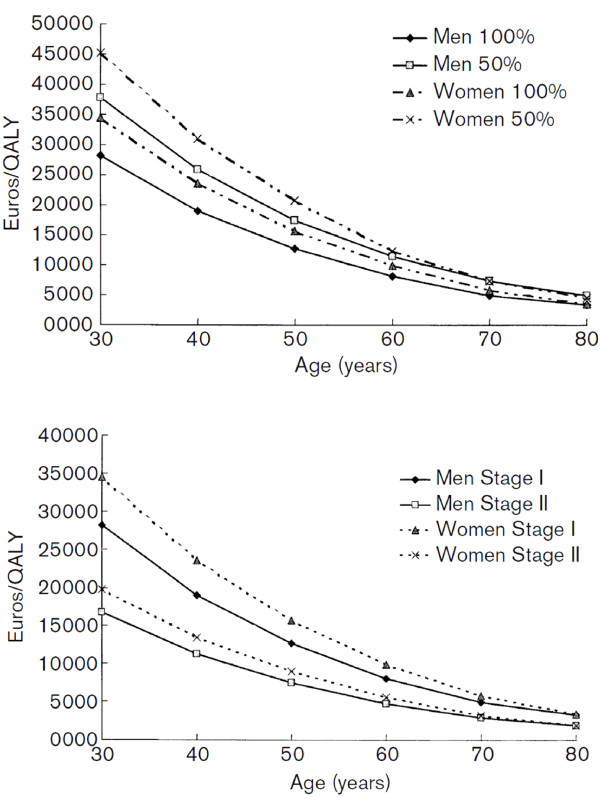
Cost-effectiveness ratios of treatment of hypertension, by hypertension stage, sex and age. QALY, quality adjusted life year [28]

References

    1. Halpern MT, Khan ZM, Schmier JK, Burnier M, Caro JJ, Cramer J, Daley WL, Gurwitz J, Hollenberg NK. Recommendations for evaluating compliance and persistence with hypertension therapy using retrospective data. Hypertension. 2006;47:1039–1048. doi: 10.1161/01.HYP.0000222373.59104.3d. - DOI - PubMed
    1. Simpson SH, Eurich DT, Majumdar SR, Padwal RS, Tsuyuki RT, Varney J, Johnson JA. A meta-analysis of the association between adherence to drug therapy and mortality. BMJ. 2006;333:15. doi: 10.1136/bmj.38875.675486.55. - DOI - PMC - PubMed
    1. Bramley TJ, Gerbino PP, Nightengale BS, Frech-Tamas F. Relationship of blood pressure control to adherence with antihypertensive monotherapy in 13 managed care organizations. J Manag Care Pharm. 2006;12:239–245. - PMC - PubMed
    1. Ambrosioni E. Pharmacoeconomics of hypertension management: the place of combination therapy. Pharmacoeconomics. 2001;19:337–347. doi: 10.2165/00019053-200119040-00002. - DOI - PubMed
    1. Hughes DA, Bagust A, Haycox A, Walley T. The impact of non-compliance on the cost-effectiveness of pharmaceuticals: a review of the literature. Health Econ. 2001;10:601–615. doi: 10.1002/hec.609. - DOI - PubMed

Publication types

Substances