. 2009 May 15;382(4):697-703.
doi: 10.1016/j.bbrc.2009.03.118. Epub 2009 Mar 25.

Cell stiffness, contractile stress and the role of extracellular matrix

Affiliations

Cell stiffness, contractile stress and the role of extracellular matrix

Steven S An et al. Biochem Biophys Res Commun. .

Abstract

Here we have assessed the effects of extracellular matrix (ECM) composition and rigidity on mechanical properties of the human airway smooth muscle (ASM) cell. Cell stiffness and contractile stress showed appreciable changes from the most relaxed state to the most contracted state: we refer to the maximal range of these changes as the cell contractile scope. The contractile scope was least when the cell was adherent upon collagen V, followed by collagen IV, laminin, and collagen I, and greatest for fibronectin. Regardless of ECM composition, upon adherence to increasingly rigid substrates, the ASM cell positively regulated expression of antioxidant genes in the glutathione pathway and heme oxygenase, and disruption of a redox-sensitive transcription factor, nuclear erythroid 2 p45-related factor (Nrf2), culminated in greater contractile scope. These findings provide biophysical evidence that ECM differentially modulates muscle contractility and, for the first time, demonstrate a link between muscle contractility and Nrf2-directed responses.


Figures
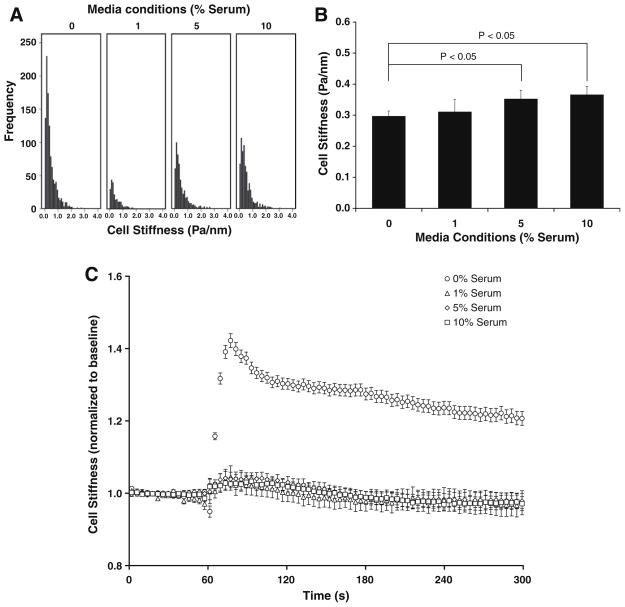
Fig. 1
Fig. 1
(A) The histogram of stiffness data prior to histamine challenge. (B) Baseline stiffness of cells treated with a range of serum. (C) Changes in cell stiffness to 10 μM histamine: for each cell, changes were normalized to its baseline stiffness. Data are reported by descriptive statistics in the form of geometric means, and error bars indicate 95% confidence intervals (n = 229–1068 cells).
Fig. 2
Fig. 2
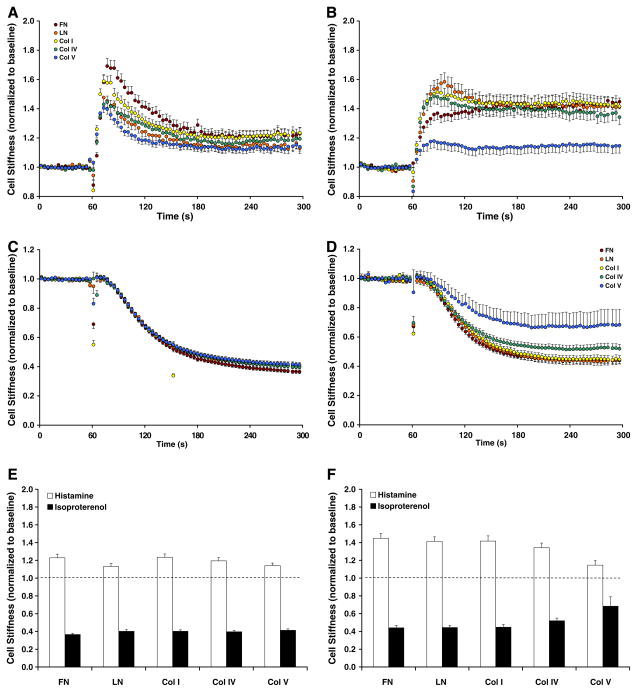
Stiffness of cells adherent upon various ECM protein substrates for 1 day, (A,C); for 5 days, (B,D) were measured in response to 10 μM histamine (A,B) or isoproterenol (C,D). The steady-state, maximal cell stiffness responses to histamine (open bars) or isoproterenol (closed bars), for day 1 (E) and for day 5 (F). The data are presented by geometric means, and error bars indicate 95% confidence interval (n = 66–626 cells).
Fig. 3
Fig. 3
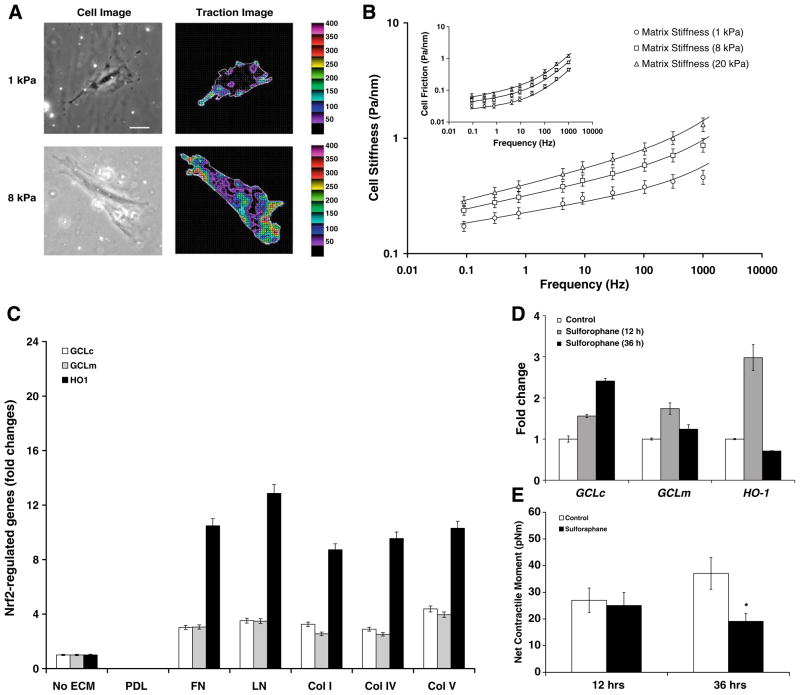
(A) A representative phase contrast and traction field images of the single ASM cell adherent upon an elastic gel block (Young’s modulus of 1 or 8 kPa with a Poisson’s ratio of 0.48). Colors show the magnitude of the tractions in Pa, and arrows show the direction and relative magnitude of those tractions. Scale bar, 50 μm. (B) Stiffness and frictional modulus of the adherent cell across a spectrum spanning five decades of frequency. The solid lines are the fit of experimental data with a two-term power-law model [25], G* = G0(if)x−1 + G1(if)¾, where the first term accounts for slow glassy dynamics [20] and the second term for semiflexible polymer fluctuations [25]. Data are presented by geometric means, and error bars indicate 95% confidence intervals (n = 341–372 cells). (C) The basal transcript levels of GCLc, GCLm, and HO-1: cells were adherent upon plastic substrates coated without or with PDL, FN, LN, Col I, Col IV or Col V. (D) Induction of GCLc, GCLm, and HO-1 by Sulforaphane (20 μM): cells were adherent upon elastic gel (8 kPa) substrate coated with Col I. Data are presented as Mean ± SE (n = 3 separate experiments). (E) Net contractile moment of cells treated without or with 20 μM Sulforaphane. Data are presented as Mean ± SE (n = 24–31 cells).
Fig. 4
Fig. 4
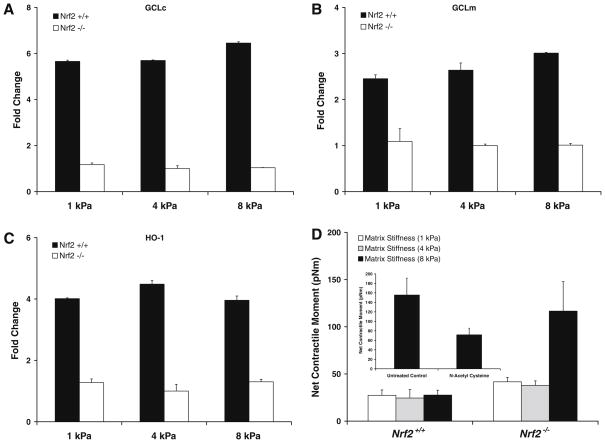
Transcript levels of GCLc (A), GCLm (B), and HO-1 (C) of ASM cells isolated from Nrf2+/+ and Nrf2−/− mice: cells were adherent upon elastic gel (1–8 kPa) substrates coated with Col I. Data are presented as Mean ± SE (n = 3 separate experiments). (D) Net contractile moment of cells isolated from Nrf2+/+ and Nrf2−/− mice. Data are presented as Mean ± SE (n = 9–14 cells). Inset: net contractile moment of Nrf2−/3−cells treated for 24 h without or with 10 mM NAC. Data are presented as Mean ± SE (n = 15–17 cells).

References

    1. Bousquet J, Jeffery PK, Busse WW, Johnson M, Vignola AM. Asthma: from bronchoconstriction to airways inflammation and remodeling. Am J Respir Crit Care Med. 2000;161:1720–1745. - PubMed
    1. Woolcock AJ, Peat JK. Epidemiology of bronchial hyperresponsiveness. Clin Rev Allergy Immunol. 1989;7:245–256. - PubMed
    1. Wilson JW, Li X. The measurement of reticular basement membrane and submucosal collagen in the asthmatic airway. Clin Expr Allergy. 1997;27:363–371. - PubMed
    1. Bosse Y, Pare PD, Seow CY. Airway wall remodeling in asthma: from the epithelial layer to the adventitia. Curr Allergy Asthma Reports. 2008;8:357–366. - PubMed
    1. Bai TR, Cooper J, Koelmeyer T, Pare PD, Weir TD. The effect of age and duration of disease on airway structure in fatal asthma. Am J Respir Crit Care Med. 2000;162:663–669. - PubMed

Publication types

Substances

LinkOut - more resources