Review
. 2009 Apr;19(2):145-55.
doi: 10.1016/j.sbi.2009.02.005. Epub 2009 Mar 25.

Protein structure prediction: when is it useful?

Affiliations
Review

Protein structure prediction: when is it useful?

Yang Zhang. Curr Opin Struct Biol. 2009 Apr.

Abstract

Computationally predicted three-dimensional structure of protein molecules has demonstrated the usefulness in many areas of biomedicine, ranging from approximate family assignments to precise drug screening. For nearly 40 years, however, the accuracy of the predicted models has been dictated by the availability of close structural templates. Progress has recently been achieved in refining low-resolution models closer to the native ones; this has been made possible by combining knowledge-based information from multiple sources of structural templates as well as by improving the energy funnel of physics-based force fields. Unfortunately, there has been no essential progress in the development of techniques for detecting remotely homologous templates and for predicting novel protein structures.


Figures
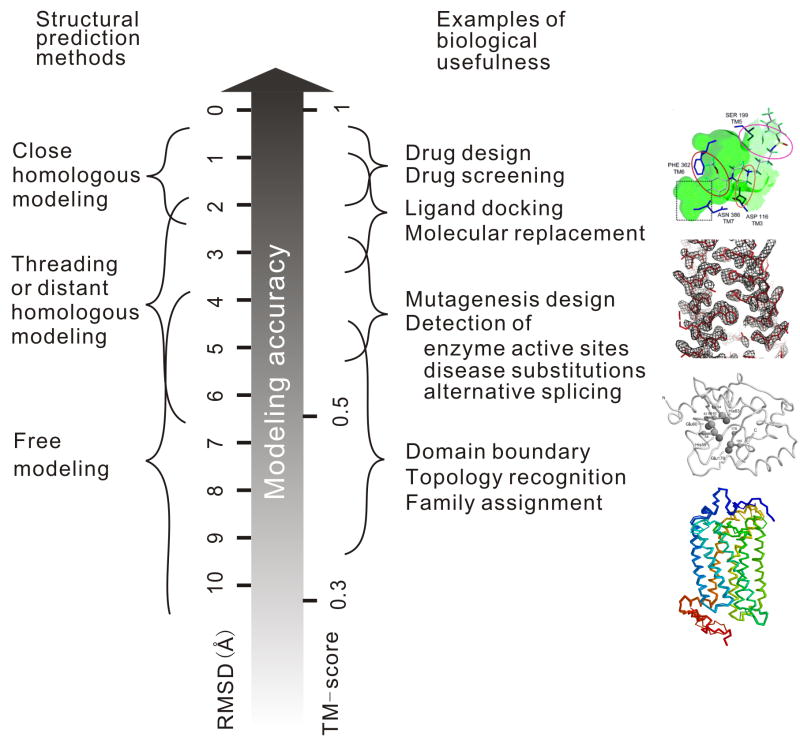
Figure 1
Figure 1
Approximate correspondence of the algorithms, accuracy, and the biological usefulness of protein structure predictions. The pictures in the right panel are representative examples where models of different resolutions are used for different purposes: The first picture shows the 3D model of the lead compound arylpiperazinylsulfonamide docked to the predicted structure of the serotonin receptor. The squared region highlights the interactions specified for serotonin which were exploited to design new compounds with improved selectivity over the adrenergic receptors [10]. The second picture shows the electron density map of Rv2844, a CM target in CASP7, determined from molecular replacement using ROSETTA refined models, with the sticks representing the backbone of the X-ray structure [14]. The third picture is the TASSER model for the YfcM protein from E. coli, with its active sites highlighted, which structurally match with the AFT descriptor associated with EC 3.4.24.69 (metalloendopeptidase); this functional annotation could not be obtained from homology [15]. The fourth picture is the structural superposition of the TASSER models for the orphan RDC1 receptor (thick backbone) and the chemokine CXCR1 receptor (thin backbone) [24••]; the RDC1 receptor was later deorphanized as a chemokine receptor that binds the chemokines CXCL11 and CXCL12 [26].
Figure 2
Figure 2
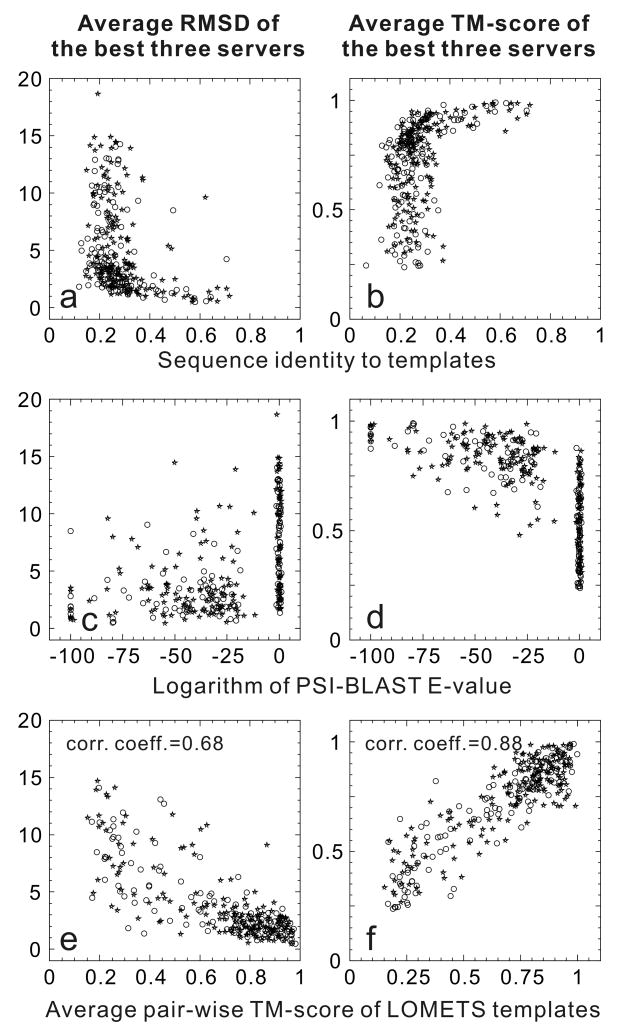
Correlation of accuracy of state-of-the-art structure predictions with different pre-modeling parameters. (a, b) the sequence identity of targets to templates; (c, d) E-value of PSI-BLAST search; (e, f) structural consensus of the templates by LOMETS [29]. The data come from 293 targets in the CASP7 and CASP8 experiments with open circles indicating the CASP7 targets and stars the CASP8 targets. The RMSD and TM-score were calculated from the average of the best three groups for each target. Sequence identity is from the pairwise sequence alignment by BLAST. BLAST, PSI-BLAST and LOMETS were run on a target-specific template library which excludes structures published after the target was released in CASP. The left panel shows RMSD and the right panel shows TM-score as measures of model accuracy
Figure 3
Figure 3
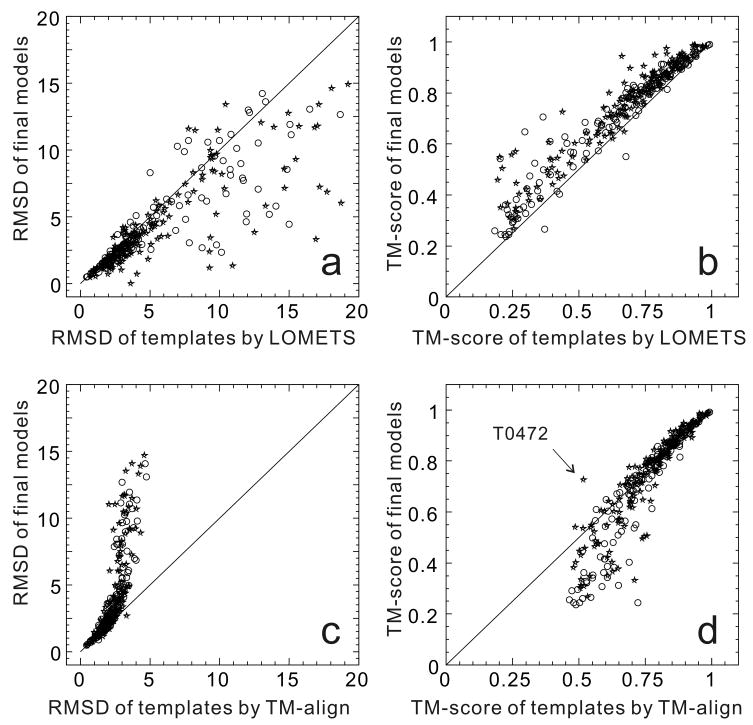
Comparison of final models with templates. (a, b) templates are from meta-server threading; (c, d) templates are from structural alignment. The data is taken from 293 targets in CASP7 and CASP8 experiments with open circles indicating the CASP7 targets and stars the CASP8 targets. RMSD and TM-score of final models were calculated from the average of the best three groups for each target. RMSD was calculated based on the same aligned regions as the template alignments while TM-score was calculated along the whole chain for the final models. LOMETS and TM-align were run using template libraries excluding structures published after each target was released in CASP. The labeled point in (d) is T0472 which has a duplicated β3α two-domain structure, with the closest structural template from a domain-swapped dimer of 3bid. TM-align matches one chain of 3bid to half of the target structure while the top predictors exploit the whole dimer as a template to model the target which results in a significantly higher TM-score than that by TM-align.

References

    1. Bairoch A, Bougueleret L, Altairac S, Amendolia V, Auchincloss A, Puy GA, Axelsen K, Baratin D, Blatter M, Boeckmann B, et al. The universal protein resource (UniProt) Nucleic Acids Res. 2008;36:D190–195. - PMC - PubMed
    1. Berman HM, Westbrook J, Feng Z, Gilliland G, Bhat TN, Weissig H, Shindyalov IN, Bourne PE. The Protein Data Bank. Nucleic Acids Res. 2000;28:235–242. - PMC - PubMed
    1. Zhang Y. Progress and challenges in protein structure prediction. Curr Opin Struct Biol. 2008;18:342–348. - PMC - PubMed
    1. Read RJ, Chavali G. Assessment of CASP7 predictions in the high accuracy template-based modeling category. Proteins. 2007;69:27–37. - PubMed
    1. Jauch R, Yeo HC, Kolatkar PR, Clarke ND. Assessment of CASP7 structure predictions for template free targets. Proteins. 2007;69:57–67. - PubMed

Publication types

LinkOut - more resources