. 2009 Jun;75(11):3826-33.
doi: 10.1128/AEM.02542-08. Epub 2009 Mar 27.

Hollow-fiber membrane chamber as a device for in situ environmental cultivation

Affiliations

Hollow-fiber membrane chamber as a device for in situ environmental cultivation

Yoshiteru Aoi et al. Appl Environ Microbiol. 2009 Jun.

Abstract

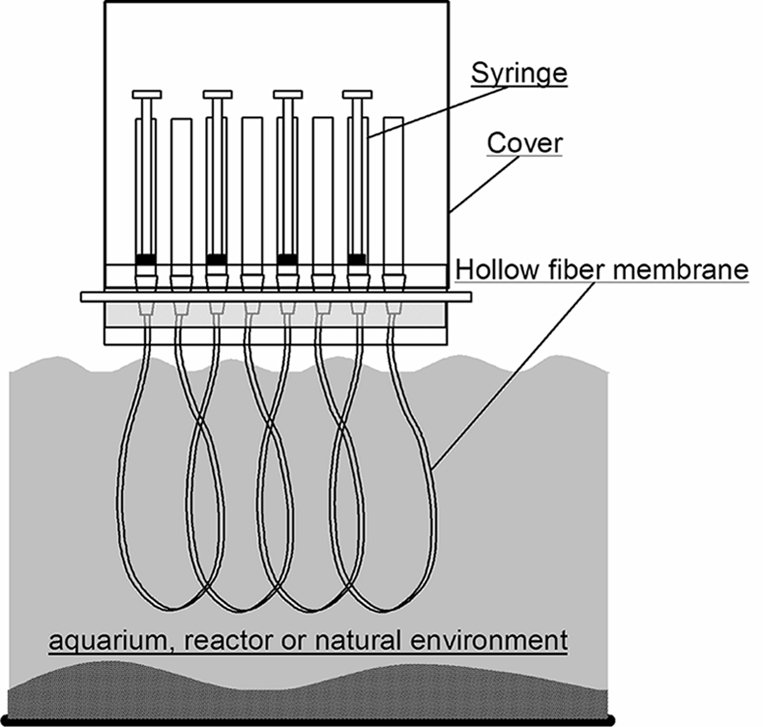
A hollow-fiber membrane chamber (HFMC) was developed as an in situ cultivation device for environmental microorganisms. The HFMC system consists of 48 to 96 pieces of porous hollow-fiber membrane connected with injectors. The system allows rapid exchange of chemical compounds, thereby simulating a natural environment. Comparative analysis through the cultivation of three types of environmental samples was performed using this newly designed device and a conventional agar-based petri dish. The results show that the ratios of novel phylotypes in isolates, species-level diversities, and cultivabilities in HFMC-based cultivation are higher than those in an agar-based petri dish for all three samples, suggesting that the new in situ cultivation device is effective for cultivation of various environmental microorganisms.


Figures
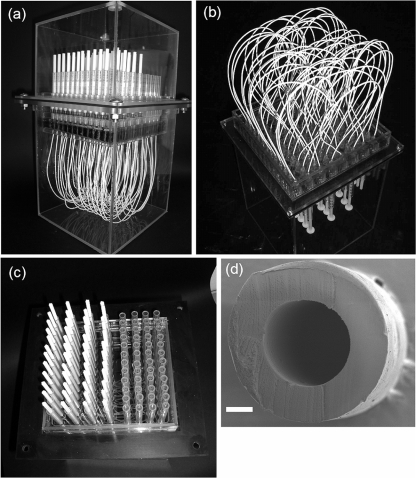
FIG. 1.
FIG. 1.
Photographs of the 48-well type of HFMC showing the overall system (a), membrane part (b), and injection part (c) and a cross-sectional scanning electron microscope image of a hollow-fiber membrane (d). The size bar represents 200 μm.
FIG. 2.
FIG. 2.
Schematic diagram of cultivation of environmental microorganisms using the HFMC under environmental conditions.
FIG. 3.
FIG. 3.
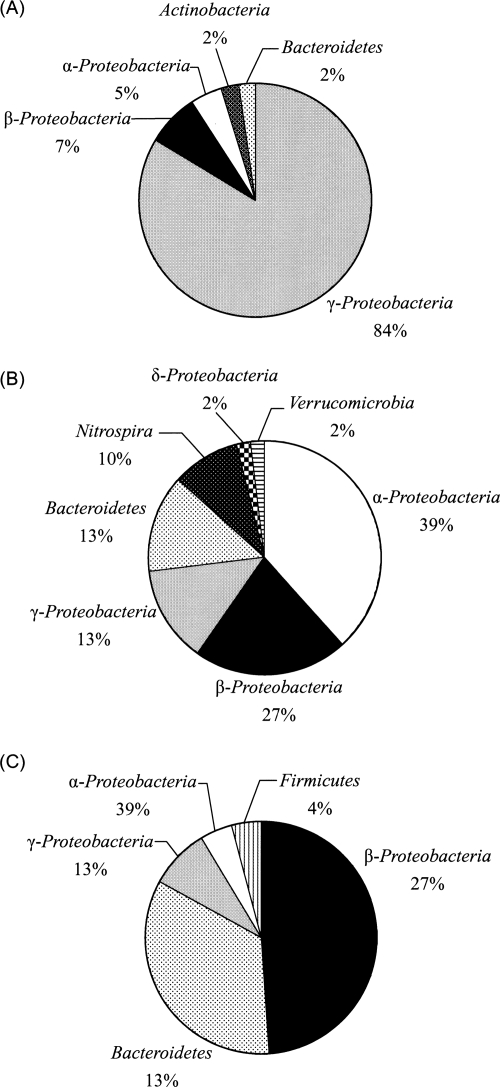
Bacterial phylogenetic distributions of 16S rRNA gene clones from tidal flat (A), SWTP (B), and EBPR (C) samples.

References

    1. Amann, R. I., W. Ludwig, and K.-H. Schleifer. 1995. Phylogenetic identification and in situ detection of individual microbial cells without cultivation. Microbiol. Rev. 59:143-169. - PMC - PubMed
    1. Bollmann, A., K. Lewis, and S. S. Epstein. 2007. Incubation of environmental samples in a diffusion chamber increases the diversity of recovered isolates. Appl. Environ. Microbiol. 73:6386-6390. - PMC - PubMed
    1. Bruns, A., H. Cypionka, and J. Overmann. 2002. Cyclic AMP and acyl homoserine lactones increase the cultivation efficiency of heterotrophic bacteria from the central Baltic Sea. Appl. Environ. Microbiol. 68:3978-3987. - PMC - PubMed
    1. Bruns, A., U. Nübel, H. Cypionka, and J. Overmann. 2003. Effect of signal compounds and incubation conditions on the culturability of freshwater bacterioplankton. Appl. Environ. Microbiol. 69:1980-1989. - PMC - PubMed
    1. Button, D. K., F. Schut, P. Quang, R. Martin, and B. R. Robertson. 1993. Viability and isolation of marine bacteria by dilution culture: theory, procedures, and initial results. Appl. Environ. Microbiol. 59:881-891. - PMC - PubMed

Publication types

LinkOut - more resources