


doi: 10.1038/nn.2296.
Epub 2009 Mar 29.
Enhancing the contrast sensitivity function through action video game training
Affiliations
- PMID: 19330003
- PMCID: PMC2921999
- DOI: 10.1038/nn.2296
Item in Clipboard
Enhancing the contrast sensitivity function through action video game training
Nat Neurosci.
2009 May.
Abstract
The contrast sensitivity function (CSF) is routinely assessed in clinical evaluation of vision and is the primary limiting factor in how well one sees. CSF improvements are typically brought about by correction of the optics of the eye with eyeglasses, contact lenses or surgery. We found that the very act of action video game playing also enhanced contrast sensitivity, providing a complementary route to eyesight improvement.
Figures
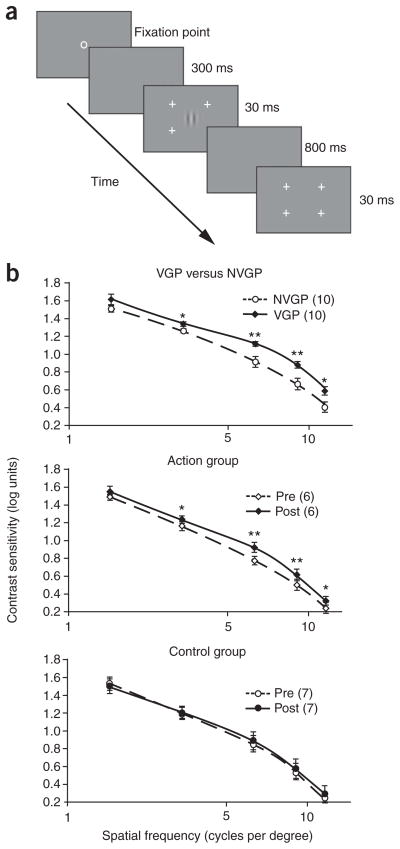
Improved CSF as a result of action video game experience. (a) The CSF was assessed at five different spatial frequencies (1.5, 3, 6, 9 and 12 cycles per degree) by using a two-interval forced-choice procedure in which subjects had to decide which of two intervals, each marked by the presence of four peripheral cross-hairs, contained a Gabor patch. Unlike in the typical clinical procedure, the size of the Gabor patch was scaled with frequency so that the space constant of the Gabor was equal to one period of the grating at all frequencies. A trial consisted of a 30-ms Gabor signal and a 30-ms blank screen, separated by an 800-ms interval. Participants were asked to indicate which 30-ms interval marked by the cross-hairs contained the Gabor signal. Contrast of the Gabor was modulated in 0.1-log-unit steps following a 3-up–1-down staircase to find the 79% threshold. (b) Contrast sensitivity as a function of spatial frequency in VGPs (n = 10) versus NVGPs (n = 10) and in the action-trained (n = 6) and control-trained groups (n = 7) pre- and post-training. VGPs showed higher contrast sensitivity (plotted in log units) than NVGPs (group effect: F1,18 = 9.37, P = 0.007, partial eta squared (ηp2) = 0.34). This group difference was greater at intermediate and higher spatial frequencies (F4,72 = 2.48, P = 0.05, ηp2 = 0.12). In the training experiment, the action-trained group showed a significant improvement in contrast sensitivity as a result of training, whereas no such change was noted in the control-trained group (pre/post × group interaction: F1,11 = 5.65, P = 0.04, ηp2 = 0.34). Curves were obtained by smoothed interpolation between data points. Error brackets are s.e.m. * P < 0.05, ** P < 0.01.
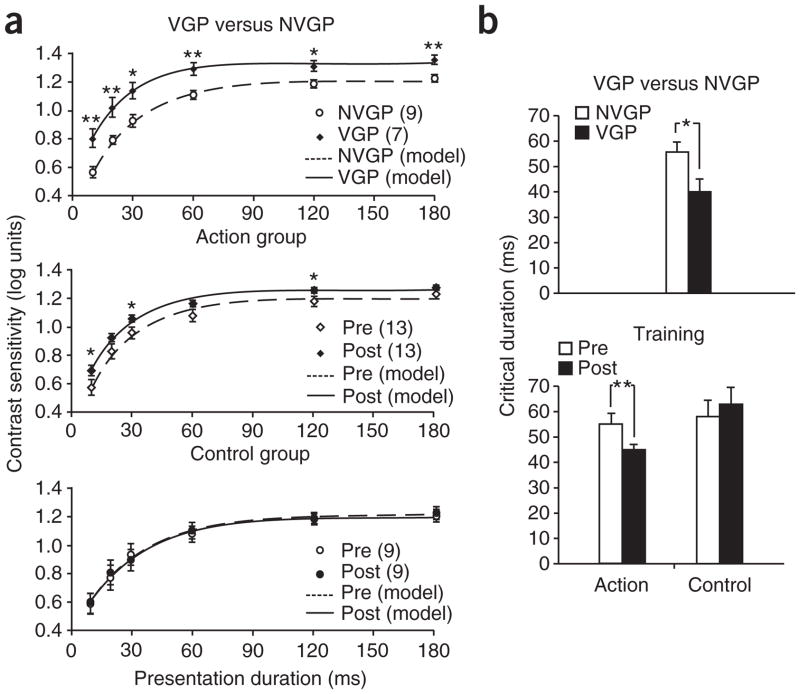
Improved critical duration as a result of action video game experience. (a) Contrast sensitivity (plotted in log units) at 6 cycles per degree as a function of display duration (10, 20, 30, 60, 120 and 180 ms) for VGPs (n = 7) versus NVGPs (n = 9), and the action-trained (n = 13) and control-trained groups (n = 9) pre- and post-training. Curves are maximum-likelihood fits of the exponential saturation function log(CS) = log(CSmax) − ae−t/τ, where t is the time in milliseconds, CSmax is the asymptote, a is the amplitude and τ is the time constant. Exponential fits to the individual data were good (VGP, r2 = 0.99; NVGP, r2 = 0.98). (b) Critical duration was shorter in VGPs than NVGPs (group effect: F1,14 = 6.60, P = 0.02, ηp2 = 0.30); in the training study, the action-trained group showed reduced critical duration post-training, whereas the control-trained group did not (pre/post × group interaction: F1,20 = 6.35, P = 0.02, ηp2 = 0.24). Error brackets are s.e.m. * P < 0.05, ** P < 0.01.
Comment in
-
Carrot sticks or joysticks: video games improve vision.Nat Neurosci. 2009 May;12(5):527-8. doi: 10.1038/nn0509-527. Nat Neurosci. 2009. PMID: 19396229 Free PMC article. No abstract available.
References
-
- Campbell FW. Behav Brain Res. 1983;10:87–97. - PubMed
-
- Sekuler R, Sekuler AB. Visual perception and cognition. In: Evans JG, Williams TF, Beattie BL, Michel J-P, Wilcock GK, editors. Oxford Textbook of Geriatric Medicine. Oxford University Press; New York: 2000. pp. 874–880.
-
- Weale RA. The Senescence of Human Vision. Oxford University Press; Oxford: 1992.
-
- Fahle M, Poggio T. Perceptual Learning. MIT Press; Cambridge, Massachusetts, USA: 2002.
-
- Yu C, Klein SA, Levi DM. J Vis. 2004;4:169–182. - PubMed
Publication types
MeSH terms
Grants and funding
LinkOut - more resources
Full Text Sources
Other Literature Sources
Medical
