


A central role for Foxp3+ regulatory T cells in K-Ras-driven lung tumorigenesis
- PMID: 19330036
- PMCID: PMC2659439
- DOI: 10.1371/journal.pone.0005061
A central role for Foxp3+ regulatory T cells in K-Ras-driven lung tumorigenesis
Abstract
Background: K-Ras mutations are characteristic of human lung adenocarcinomas and occur almost exclusively in smokers. In preclinical models, K-Ras mutations are necessary for tobacco carcinogen-driven lung tumorigenesis and are sufficient to cause lung adenocarcinomas in transgenic mice. Because these mutations confer resistance to commonly used cytotoxic chemotherapies and targeted agents, effective therapies that target K-Ras are needed. Inhibitors of mTOR such as rapamycin can prevent K-Ras-driven lung tumorigenesis and alter the proportion of cytotoxic and Foxp3+ regulatory T cells, suggesting that lung-associated T cells might be important for tumorigenesis.
Methods: Lung tumorigenesis was studied in three murine models that depend on mutant K-Ras; a tobacco carcinogen-driven model, a syngeneic inoculation model, and a transgenic model. Splenic and lung-associated T cells were studied using flow cytometry and immunohistochemistry. Foxp3+ cells were depleted using rapamycin, an antibody, or genetic ablation.
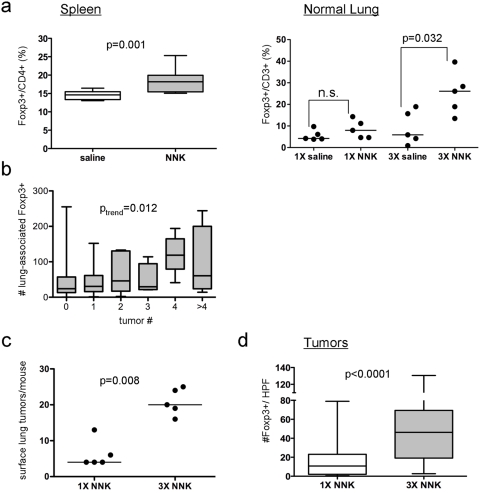
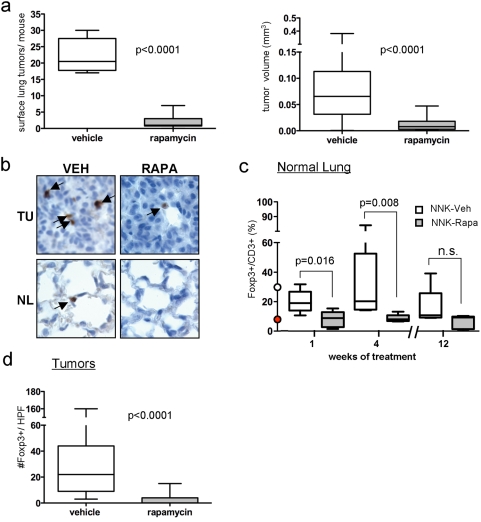
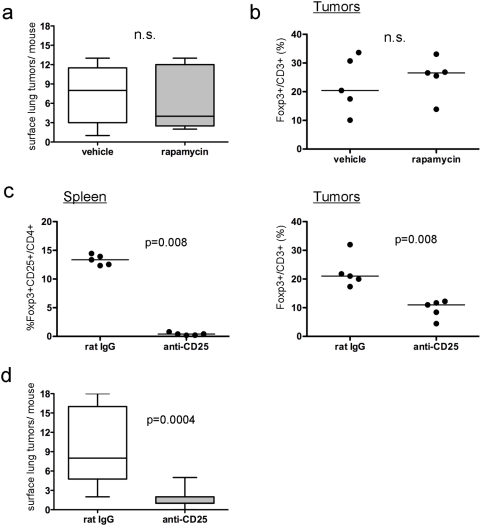
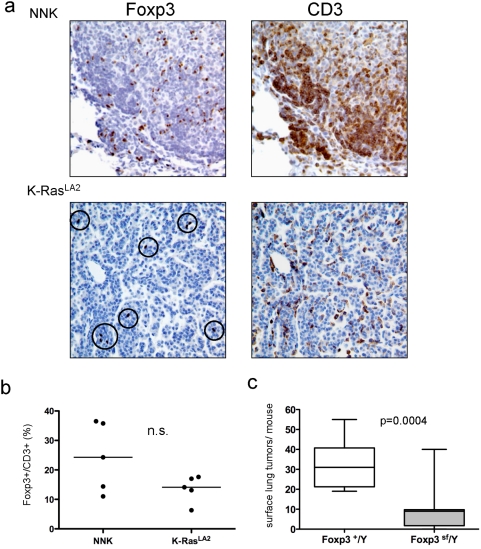
Results: Exposure of A/J mice to a tobacco carcinogen tripled lung-associated Foxp3+ cells prior to tumor development. At clinically relevant concentrations, rapamycin prevented this induction and reduced lung tumors by 90%. In A/J mice inoculated with lung adenocarcinoma cells resistant to rapamycin, antibody-mediated depletion of Foxp3+ cells reduced lung tumorigenesis by 80%. Likewise, mutant K-Ras transgenic mice lacking Foxp3+ cells developed 75% fewer lung tumors than littermates with Foxp3+ cells.
Conclusions: Foxp3+ regulatory T cells are required for K-Ras-mediated lung tumorigenesis in mice. These studies support clinical testing of rapamycin or other agents that target Treg in K-Ras driven human lung cancer.
Conflict of interest statement
Figures
References
-
- Jemal A, Siegel R, Ward E, Hao Y, Xu J, et al. Cancer statistics, 2008. CA Cancer J Clin. 2008;58:71–96. - PubMed
-
- Westra WH, Slebos RJ, Offerhaus GJ, Goodman SN, Evers SG, et al. K-ras oncogene activation in lung adenocarcinomas from former smokers. Evidence that K-ras mutations are an early and irreversible event in the development of adenocarcinoma of the lung. Cancer. 1993;72:432–438. - PubMed
-
- Westra WH, Baas IO, Hruban RH, Askin FB, Wilson K, et al. K-ras oncogene activation in atypical alveolar hyperplasias of the human lung. Cancer Res. 1996;56:2224–2228. - PubMed
-
- Mills NE, Fishman CL, Rom WN, Dubin N, Jacobson DR. Increased prevalence of K-ras oncogene mutations in lung adenocarcinoma. Cancer Res. 1995;55:1444–1447. - PubMed
Publication types
MeSH terms
Substances
Grants and funding
LinkOut - more resources
Full Text Sources
Medical
Molecular Biology Databases
Miscellaneous
