. 2009 Jun;53(6):2605-9.
doi: 10.1128/AAC.01533-08. Epub 2009 Mar 30.

Galleria mellonella as a model system to study Acinetobacter baumannii pathogenesis and therapeutics

Affiliations

Galleria mellonella as a model system to study Acinetobacter baumannii pathogenesis and therapeutics

Anton Y Peleg et al. Antimicrob Agents Chemother. 2009 Jun.

Abstract

Nonmammalian model systems of infection such as Galleria mellonella (caterpillars of the greater wax moth) have significant logistical and ethical advantages over mammalian models. In this study, we utilize G. mellonella caterpillars to study host-pathogen interactions with the gram-negative organism Acinetobacter baumannii and determine the utility of this infection model to study antibacterial efficacy. After infecting G. mellonella caterpillars with a reference A. baumannii strain, we observed that the rate of G. mellonella killing was dependent on the infection inoculum and the incubation temperature postinfection, with greater killing at 37 degrees C than at 30 degrees C (P = 0.01). A. baumannii strains caused greater killing than the less-pathogenic species Acinetobacter baylyi and Acinetobacter lwoffii (P < 0.001). Community-acquired A. baumannii caused greater killing than a reference hospital-acquired strain (P < 0.01). Reduced levels of production of the quorum-sensing molecule 3-hydroxy-C(12)-homoserine lactone caused no change in A. baumannii virulence against G. mellonella. Treatment of a lethal A. baumannii infection with antibiotics that had in vitro activity against the infecting A. baumannii strain significantly prolonged the survival of G. mellonella caterpillars compared with treatment with antibiotics to which the bacteria were resistant. G. mellonella is a relatively simple, nonmammalian model system that can be used to facilitate the in vivo study of host-pathogen interactions in A. baumannii and the efficacy of antibacterial agents.


Figures

FIG. 1.
FIG. 1.
G. mellonella killing by A. baumannii is dependent on the inoculum and the incubation temperature postinfection. Killing was more pronounced at 37°C (A) than at 30°C (B) (P = 0.01 for comparison of an inoculum of 105 CFU/larva at 37°C and 30°C).
FIG. 2.
FIG. 2.
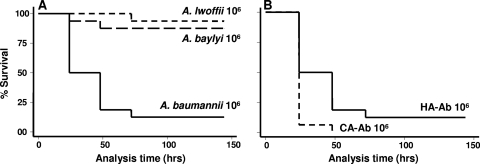
Acinetobacter is important for pathogenesis to G. mellonella (A), whereby the most important human pathogen, A. baumannii, killed significantly (P < 0.001) more than the less-common human pathogens A. baylyi and A. lwoffii. (B) Furthermore, the highly virulent community-acquired A. baumannii (CA-Ab) strain was more pathogenic than the reference hospital strain (HA-Ab) (ATCC 17978) (P = 0.005).
FIG. 3.
FIG. 3.
A. baumannii is engulfed by G. mellonella hemocytes after infection. Light and fluorescent microscopy images are shown of GFP-A. baumannii (A and B) and the non-GFP parent strain (ATCC 19606) (C and D). Increased green fluorescence of hemocytes is seen with GFP-A. baumannii. Low-level autofluorescence is seen in D.
FIG. 4.
FIG. 4.
Melanization of G. mellonella is part of the infection process with A. baumannii. The image was taken 24 h after infection with 1.6 × 10⁶ CFU/larva of A. baumannii ATCC 17978. Two dead caterpillars were removed prior to photograph.
FIG. 5.
FIG. 5.
Antibacterials that are active against A. baumannii (Ab) can prolong the survival of A. baumannii-infected G. mellonella caterpillars. After infection with a lethal dose of A. baumannii strain A9844 (5 × 10⁵ CFU/larva), meropenem (MER) and gentamicin (Gm), to which the strain was susceptible, significantly prolonged the survival of G. mellonella caterpillars (P < 0.001 for comparison with no antibiotics). However, cefotaxime (CTX) and tetracycline (TET), to which the strain was resistant, caused no difference in killing compared with no antibiotic treatment (P = 0.41). A. baumannii (Ab) with no antibiotic designation was the untreated control.

References

    1. Anstey, N. M., B. J. Currie, and K. M. Withnall. 1992. Community-acquired Acinetobacter pneumonia in the Northern Territory of Australia. Clin. Infect. Dis. 14:83-91. - PubMed
    1. Aperis, G., B. B. Fuchs, C. A. Anderson, J. E. Warner, S. B. Calderwood, and E. Mylonakis. 2007. Galleria mellonella as a model host to study infection by the Francisella tularensis live vaccine strain. Microbes Infect. 9:729-734. - PMC - PubMed
    1. Chen, T. L., L. K. Siu, Y. T. Lee, C. P. Chen, L. Y. Huang, R. C. Wu, W. L. Cho, and C. P. Fung. 2008. Acinetobacter baylyi as a pathogen for opportunistic infection. J. Clin. Microbiol. 46:2938-2944. - PMC - PubMed
    1. Cheng, H. P., and G. C. Walker. 1998. Succinoglycan is required for initiation and elongation of infection threads during nodulation of alfalfa by Rhizobium meliloti. J. Bacteriol. 180:5183-5191. - PMC - PubMed
    1. Clinical and Laboratory Standards Institute. 2007. Dilution antimicrobial susceptibility tests for bacteria that grow aerobically. M7-A7. CLSI, Wayne, PA.

Publication types

LinkOut - more resources