


Newer antidepressants and gabapentin for hot flashes: an individual patient pooled analysis
- PMID: 19332723
- PMCID: PMC2698018
- DOI: 10.1200/JCO.2008.19.6253
Newer antidepressants and gabapentin for hot flashes: an individual patient pooled analysis
Abstract
Purpose: Nonhormonal treatment options have been investigated as treatments for hot flashes, a major clinical problem in many women. Starting in 2000, a series of 10 individual double-blind placebo-controlled studies has evaluated newer antidepressants and gabapentin for treating hot flashes. This current project was developed to conduct an individual patient pooled analysis of the data from these published clinical trials.
Patients and methods: Individual patient data were collected from the various study investigators who published their study results between 2000 and 2007. Between-study heterogeneity for study characteristics and patient populations was tested via chi2 tests before a pooled analysis. The primary end point, the change in hot flash activity from baseline to week 4, for each agent was calculated via both weighted and unweighted approaches, using the size of the study as the weight. Basic summary statistics were produced for hot flash score and frequency using the following three statistics: raw change, percent reduction, and whether or not a 50% reduction was achieved.
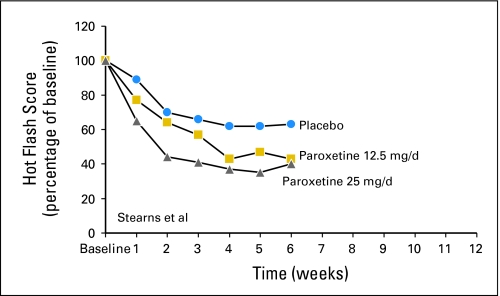
Results: This study included seven trials of newer antidepressants and three trials of gabapentin. The optimal doses (defined by individual study results) of the newer antidepressants paroxetine, venlafaxine, fluoxetine, and sertraline decreased hot flash scores by 41%, 33%, 13%, and 3% to 18% compared with the corresponding placebo arms, respectively. The three gabapentin trials decreased hot flashes by 35% to 38% compared with the corresponding placebo arms.
Conclusion: Some newer antidepressants and gabapentin, within 4 weeks of therapy initiation, decrease hot flashes more than placebo.
Conflict of interest statement
Authors' disclosures of potential conflicts of interest and author contributions are found at the end of this article.
Figures


References
-
- Rossouw JE, Anderson GL, Prentice RL, et al. Risks and benefits of estrogen plus progestin in healthy postmenopausal women: Principal results from the Women's Health Initiative randomized controlled trial. JAMA. 2002;288:321–333. - PubMed
-
- Loprinzi CL, Pisansky TM, Fonseca R, et al. Pilot evaluation of venlafaxine hydrochloride for the therapy of hot flashes in cancer survivors. J Clin Oncol. 1998;16:2377–2381. - PubMed
-
- Loprinzi CL, Kugler JW, Sloan JA, et al. Venlafaxine in management of hot flashes in survivors of breast cancer: A randomised controlled trial. Lancet. 2000;356:2059–2063. - PubMed
-
- Loprinzi CL, Sloan JA, Perez EA, et al. Phase III evaluation of fluoxetine for treatment of hot flashes. J Clin Oncol. 2002;20:1578–1583. - PubMed
Publication types
MeSH terms
Substances
Grants and funding
LinkOut - more resources
Full Text Sources
Medical
