Comment
doi: 10.1148/radiol.2511080671.
The linear no-threshold relationship is inconsistent with radiation biologic and experimental data
Affiliations
- PMID: 19332842
- PMCID: PMC2663584
- DOI: 10.1148/radiol.2511080671
Item in Clipboard
Comment
The linear no-threshold relationship is inconsistent with radiation biologic and experimental data
Radiology.
2009 Apr.
No abstract available
Figures
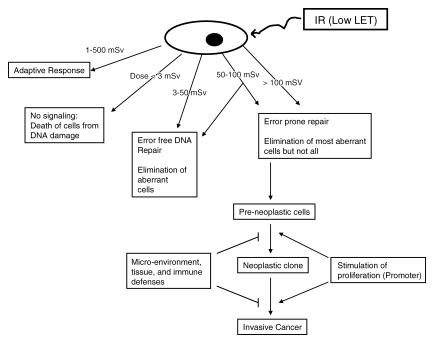
Diagram shows that effects of low linear energy transfer (LET) ionizing radiation (IR) on mammalian cells are dose dependent. With doses of less than 3 mSv at high or low dose rates, no signaling occurs, and mitotic cell death ensues. A dose of 3–50 mSv results in primarily error-free DNA repair, along with elimination of aberrant cells through apoptosis or other types of mitotic death. At doses between 50 and 100 mSv, dose rate and cell type play a role in whether a cell undergoes error-free repair or substantial levels of DNA misrepair. With doses greater than 100 mSv, error-prone DNA repair is substantial. Fortunately, the majority of aberrant cells are eliminated through cellular death pathways. Most of the preneoplastic cells are eliminated by immune defenses, inhibited by the microenvironment (and tissue), or become senescent. Cancer promoters may transform a preneoplastic clone to a neoplastic clone to eventual invasive cancer. Again, immune mechanisms and the microenvironment (and tissue) may eliminate and/or suppress the neoplastic cells. Furthermore, after irradiation (1–500 mSv), cells develop adaptive responses that counteract, in hit and non-hit cells, insults from endogenous toxins (eg, reactive oxygen species produced from aerobic metabolism) or exogenous oxidative stresses (eg, renewed irradiation, chemicals). The LNT hypothesis or slight modifications of it with the dose and dose rate effectiveness factor (DDREF) is not compatible with the scientific evidence. The concept of a practical threshold for carcinogenesis is plausible.
Comment in
-
Nuclear energy saves lives.Nature. 2019 Jun;570(7759):36. doi: 10.1038/d41586-019-01749-8. Nature. 2019. PMID: 31164764 No abstract available.
Comment on
-
Risks associated with low doses and low dose rates of ionizing radiation: why linearity may be (almost) the best we can do.Radiology. 2009 Apr;251(1):6-12. doi: 10.1148/radiol.2511081686. Radiology. 2009. PMID: 19332841 Free PMC article. No abstract available.
References
Publication types
MeSH terms
LinkOut - more resources
Full Text Sources
Other Literature Sources