. 2009 Apr 6;185(1):35-42.
doi: 10.1083/jcb.200811106. Epub 2009 Mar 30.

Angiogenin cleaves tRNA and promotes stress-induced translational repression

Affiliations

Angiogenin cleaves tRNA and promotes stress-induced translational repression

Satoshi Yamasaki et al. J Cell Biol. .

Abstract

Stress-induced phosphorylation of eIF2alpha inhibits global protein synthesis to conserve energy for repair of stress-induced damage. Stress-induced translational arrest is observed in cells expressing a nonphosphorylatable eIF2alpha mutant (S51A), which indicates the existence of an alternative pathway of translational control. In this paper, we show that arsenite, heat shock, or ultraviolet irradiation promotes transfer RNA (tRNA) cleavage and accumulation of tRNA-derived, stress-induced small RNAs (tiRNAs). We show that angiogenin, a secreted ribonuclease, is required for stress-induced production of tiRNAs. Knockdown of angiogenin, but not related ribonucleases, inhibits arsenite-induced tiRNA production and translational arrest. In contrast, knockdown of the angiogenin inhibitor RNH1 enhances tiRNA production and promotes arsenite-induced translational arrest. Moreover, recombinant angiogenin, but not RNase 4 or RNase A, induces tiRNA production and inhibits protein synthesis in the absence of exogenous stress. Finally, transfection of angiogenin-induced tiRNAs promotes phospho-eIF2alpha-independent translational arrest. Our results introduce angiogenin and tiRNAs as components of a phospho-eIF2alpha-independent stress response program.


Figures
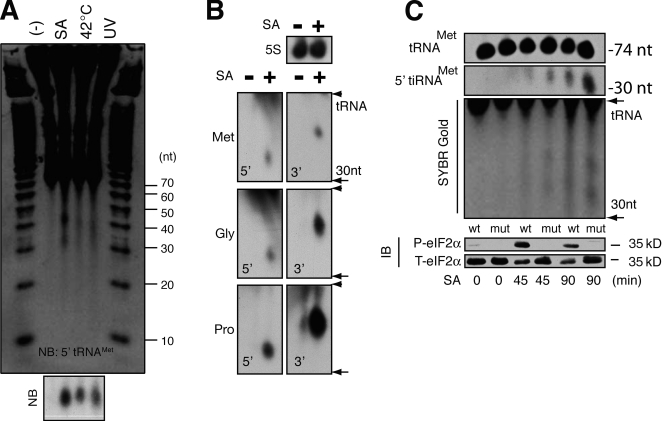
Figure 1.
Figure 1.
Stress-induced production of tiRNA. (A) U2OS cells treated with sodium arsenite (SA; 500 µM, 2 h), heat (42°C, 2 h), or UV irradiation (200 J/m2, 12 h) were extracted with Trizol, and total RNA (10 µg) was separated on a 15% TBE-urea gel before processing with SYBR gold. The gel was also transferred to membrane and hybridized to a biotin probe complementary to the 5′ end of tRNAMet (NB). (B) Northern blotting analysis of RNA extracted from U2OS cells cultured in the absence (−) or presence (+) of sodium arsenite (500 µM, 2 h). Blots were hybridized to cDNAs complementary to the 5′ or 3′ fragments of the indicated tRNAs (bottom) or 5S RNA as a loading control (top). (C) MEFs derived from wild type (wt) or eIF2α (S51A) mutant (mut) mice were cultured in the absence (−) or presence (SA) of sodium arsenite (500 µM) for the indicated times before Trizol extraction. tRNA and 5′ tRNA fragments were quantified by Northern blotting (top) and SYBR gold staining (middle). Phospho- and total eIF2α was quantified by immunoblotting (IB; bottom).
Figure 2.
Figure 2.
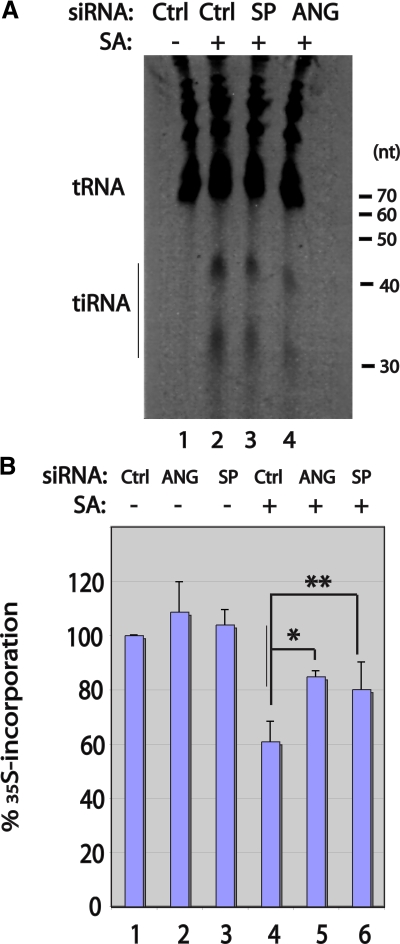
Effect of endogenous angiogenin on tiRNA production and protein synthesis. (A) U2OS cells were transfected with control (D0, lanes 1 and 2), angiogenin-specific SMART pool (SP; lane 3), or angiogenin-specific individual (ANG; lane 4) siRNAs, then cultured in the absence (−; lane 1) or presence (+; lanes 2–4) of sodium arsenite (SA; 250 µM) for 1 h before Trizol extraction, separation on a 15% TBE-urea gel, and CYBR gold staining. The positions of tRNAs and tiRNAs are indicated in this representative gel. Densitometric scanning was used to quantify the relative expression of tiRNAs in three independent experiments. (B) U2OS cells were transfected with the indicated siRNAs, cultured in the absence (−; lanes 1–3) or presence (+; lanes 4–6) of sodium arsenite (100 µM, 1 h), and pulsed with [35S]methionine-containing medium for 60 min before protein extraction. [35S]methionine incorporation (mean ± SD, n = 3–5) is normalized to that observed in cells treated with control siRNA (designated 100%). *, P = 0.02 (n = 3); **, P = 0.04 (n = 5).
Figure 3.
Figure 3.
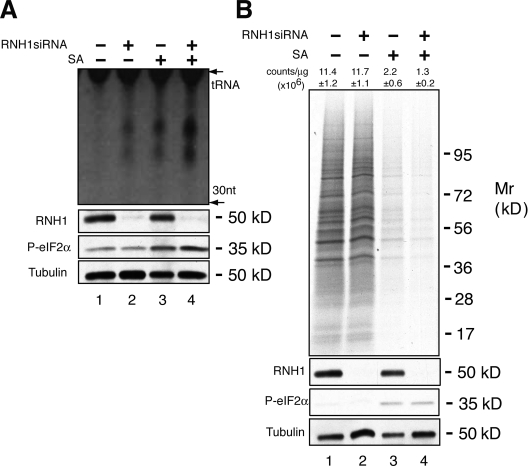
Effect of RNH1 on tiRNA production. (A) U2OS cells were treated with siRNA targeting RNH1 (lanes 2 and 4) 48 h before culturing cells in the absence (lanes 1 and 2) or presence (lanes 3 and 4) of sodium arsenite (SA, 200 µM) for 2 h. Cells were extracted with Trizol, and RNA was separated by 15% PAGE and stained with SYBR gold. The location of tRNAs is indicated. tiRNAs migrate as small RNAs centered around 30 and 40 nucleotides. The expression of RNH1, phospho-eIF2α, and tubulin were quantified by Western blotting analysis (bottom). (B) U2OS cells were treated with siRNAs targeting RNH1 (lanes 2 and 4), then cultured in the absence (lanes 1 and 2) or presence (lanes 3 and 4) of sodium arsenite (SA, 500 µM) for 1 h. Cells were then processed for gel electrophoresis and autoradiography (top) or TCA precipitation and scintillation counting (mean counts per microgram ± SD, n = 3, are shown over each lane). The expression of RNH1, phospho-eIF2α, and tubulin were quantified by Western blotting analysis (bottom).
Figure 4.
Figure 4.
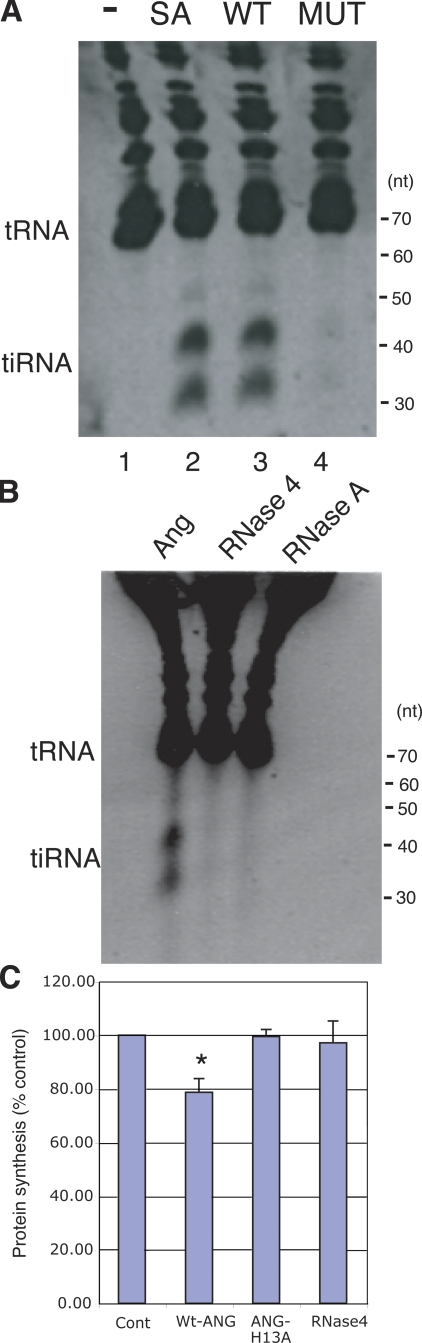
Effect of recombinant angiogenin on tiRNA production and protein synthesis. (A) U2OS cells were cultured in the absence (−; lane 1) or presence of sodium arsenite (SA; lane 2; 500 µM, 1 h), recombinant wild-type angiogenin (WT; 1 µg/ml, lane 3), or recombinant mutant angiogenin (MUT, 1 µg/ml, lane 4) for 1 h before Trizol extraction, separation by 15% TBE-urea gel, and CYBR gold staining. The positions of tRNAs and tiRNAs are indicated on the left. (B) U2OS cells were treated with the indicated ribonucleases (1 µg/ml) for 1 h before processing as described in A. (C) U2OS cells were treated with the indicated ribonucleases (1 µg/ml) for 30 min in the presence of [35S]methionine-containing medium before protein extraction. 35S counts in cells cultured in media alone (Cont) were normalized to 100%. Results are the means ± SD (n = 3). *, P = 0.02.
Figure 5.
Figure 5.
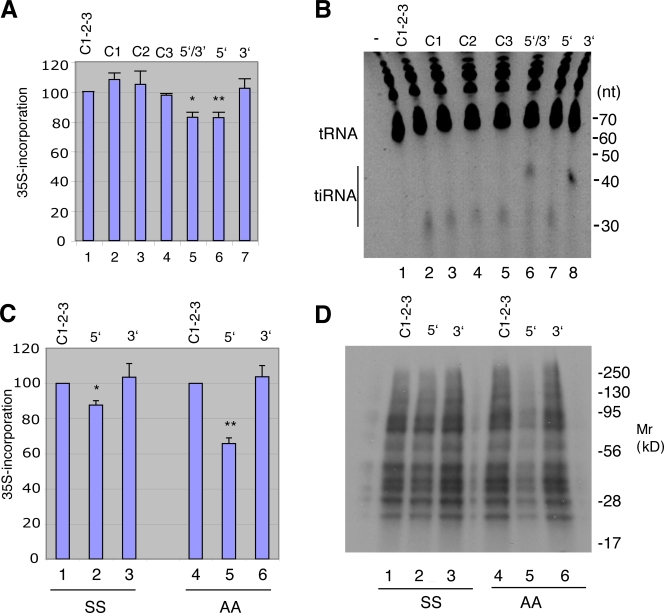
Effect of endogenous tiRNAs on protein synthesis. (A) Endogenous 5′ and 3′ (lane 5), 5′ (lane 6), or 3′ (lane 7) tiRNAs extracted from angiogenin-treated U2OS cells were transfected into U2OS cells using lipofectamine. After 6 h, cells were pulsed with [35S]methionine-containing medium for 30 min before protein extraction. Total counts per minute (cpm) per microgram of protein was normalized to cells treated with a combination of three PIWI-associated control RNAs (Control 1-2-3, lane 1; Control-1, lane 2; Control 3, lane 3) and expressed as a mean ± SD (n = 3). *, P = 0.01; **, P = 0.01. (B) U2OS cells were transfected with the indicated control RNAs (lanes 1–5) or endogenous 5′ (lane 7), 3′ (lane 8), or 5′ and 3′ (lane 6) tiRNAs. After 6 h, cells were washed, and Trizol extracts were separated on a 15% TBD-urea gel and stained with CYBR gold. (C) Wild-type (SS) and S51A mutant (AA) MEFs were transfected with control RNAs (lanes 1 and 4) or endogenous 5′ (lanes 2 and 5) or 3′ (lanes 3 and 6) tiRNAs, pulsed with [35S]methionine-containing medium, and extracted. Total cpm per microgram of protein was normalized to that of cells treated with control RNA and expressed as means ± SD (n = 3). *, P = 0.01; **, P = 0.003. (D) Samples from C were separated by 15% SDS-PAGE, transferred to nitrocellulose, and exposed for autoradiography. Migration of molecular size markers is shown at the right.

References

    1. Anderson P., Kedersha N. 2008. Stress granules: the Tao of RNA triage.Trends Biochem. Sci. 33:141–150 - PubMed
    1. Ardelt W., Mikulski S.M., Shogen K. 1991. Amino acid sequence of an anti-tumor protein from Rana pipiens oocytes and early embryos. Homology to pancreatic ribonucleases.J. Biol. Chem. 266:245–251 - PubMed
    1. Brennecke J., Aravin A.A., Stark A., Dus M., Kellis M., Sachidanandam R., Hannon G.J. 2007. Discrete small RNA-generating loci as master regulators of transposon activity in Drosophila.Cell. 128:1089–1103 - PubMed
    1. Dyer K.D., Rosenberg H.F. 2005. The mouse RNase 4 and RNase 5/ang 1 locus utilizes dual promoters for tissue-specific expression.Nucleic Acids Res. 33:1077–1086 - PMC - PubMed
    1. Fett J.W., Strydom D.J., Lobb R.R., Alderman E.M., Bethune J.L., Riordan J.F., Vallee B.L. 1985. Isolation and characterization of angiogenin, an angiogenic protein from human carcinoma cells.Biochemistry. 24:5480–5486 - PubMed

Publication types

MeSH terms