The costs and cost-effectiveness of mass treatment for intestinal nematode worm infections using different treatment thresholds
- PMID: 19333371
- PMCID: PMC2657832
- DOI: 10.1371/journal.pntd.0000402
The costs and cost-effectiveness of mass treatment for intestinal nematode worm infections using different treatment thresholds
Abstract
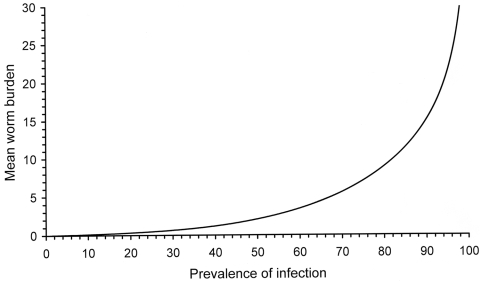
Background: It is estimated that almost a half of all of people living in developing countries today are infected with roundworms, hookworms, or whipworms or combinations of these types of intestinal nematode worms. They can all be treated using safe, effective, and inexpensive single-dose generic drugs costing as little as USD 0.03 per person treated when bought in bulk. The disease caused by intestinal nematodes is strongly related to the number of worms in the gut, and it is typical to find that worms tend to be aggregated or clumped in their distribution so that <20% of people may harbour >80% of all worms. This clumping of worms is greatest when the prevalence is low. When the prevalence rises above 50%, the mean worm burden increases exponentially, worms are less clumped, and more people are likely to have moderate to heavy infections and may be diseased. Children are most at risk. For these reasons, the World Health Organization (WHO) currently recommends mass treatment of children > or =1 year old without prior diagnosis when the prevalence is > or =20% and treatment twice a year when the prevalence is > or =50%.
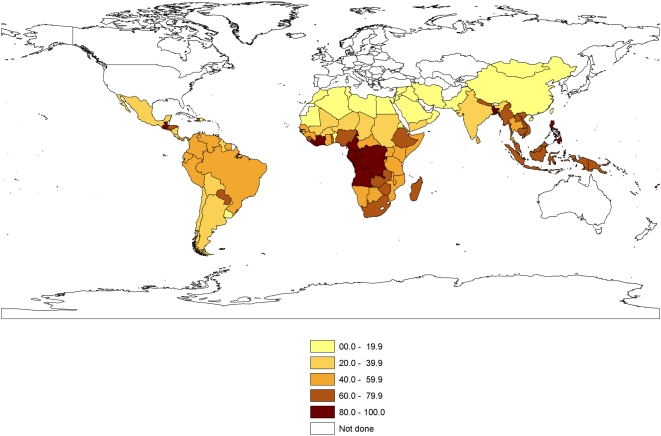
Methods and findings: The risk of moderate to heavy infections with intestinal nematodes was estimated by applying the negative binomial probability distribution, then the drug cost of treating diseased individuals was calculated based on different threshold numbers of worms. Based on this cost analysis, a new three-tier treatment regime is proposed: if the combined prevalence is >40%, treat all children once a year; >60% treat twice a year; and >80% treat three times a year. Using average data on drug and delivery costs of USD 0.15 to treat a school-age child and USD 0.25 to treat a pre-school child (with provisos) the cost of treating children aged 2-14 years was calculated for 105 low- and low-middle-income countries and for constituent regions of India and China based on estimates of the combined prevalence of intestinal nematode worms therein. The annual cost of the three-tier threshold was estimated to be USD 224 million compared with USD 276 million when the current WHO recommendations for mass treatment were applied.
Conclusion: The three-tier treatment thresholds were less expensive and more effective as they allocated a greater proportion of expenditures to treating infected individuals when compared with the WHO thresholds (73% compared with 61%) and treated a larger proportion of individuals with moderate to heavy worm burdens, arbitrarily defined as more than 10 worms per person (31% compared with 21%).
Conflict of interest statement
NdS is currently Chair of the Mebendazole Advisory Committee, an independent body of experts that advises Children Without Worms, which oversees Johnson & Johnson's donation of mebendazole to eight national de-worming programmes around the world. In 1990 AH was funded by SmithKlineBeecham to do a study of albendazole as a treatment for infections with
Figures
References
-
- Copenhagen Consensus. Copenhagen Consensus 2008 - Results. 2008. Available at: http://www.copenhagenconsensus.com/Default.aspx?ID953 Last accessed: November 2008.
-
- de Silva NR, Brooker S, Hotez PJ, Montresor A, Engels D, et al. Soil-transmitted helminth infections: updating the global picture. Trends Parasitol. 2003;19:547–551. - PubMed
-
- WHO. Basic Laboratory Methods in Medical Parasitology. Geneva: World Health Organization; 1991.
-
- Anderson RM, May RM. Infectious Diseases of Humans. Dynamics and Control. Oxford: Oxford University Press; 1991. p. 757.
Publication types
MeSH terms
Substances
LinkOut - more resources
Full Text Sources