


Recombinant human relaxin in the treatment of systemic sclerosis with diffuse cutaneous involvement: a randomized, double-blind, placebo-controlled trial
- PMID: 19333948
- PMCID: PMC3711466
- DOI: 10.1002/art.24380
Recombinant human relaxin in the treatment of systemic sclerosis with diffuse cutaneous involvement: a randomized, double-blind, placebo-controlled trial
Abstract
Objective: A phase II randomized controlled trial of recombinant human relaxin suggested that a dosage of 25 microg/kg/day was safe and clinically effective in improving skin disease and reducing functional disability in scleroderma (systemic sclerosis; SSc). We undertook a large randomized, double-blind, placebo-controlled clinical trial to compare placebo with 10 microg/kg/day and 25 microg/kg/day recombinant human relaxin, given for 24 weeks in patients with stable, diffuse, moderate-to-severe SSc.
Methods: Men and women ages 18-70 years with diffuse cutaneous SSc (dcSSc) were administered recombinant human relaxin (10 microg/kg/day or 25 microg/kg/day) or placebo for 24 weeks as a continuous subcutaneous infusion. There was a followup safety visit at week 28.
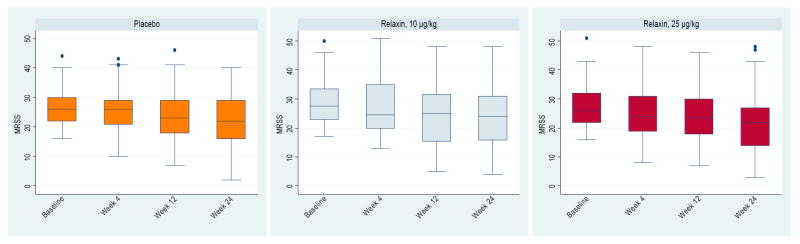
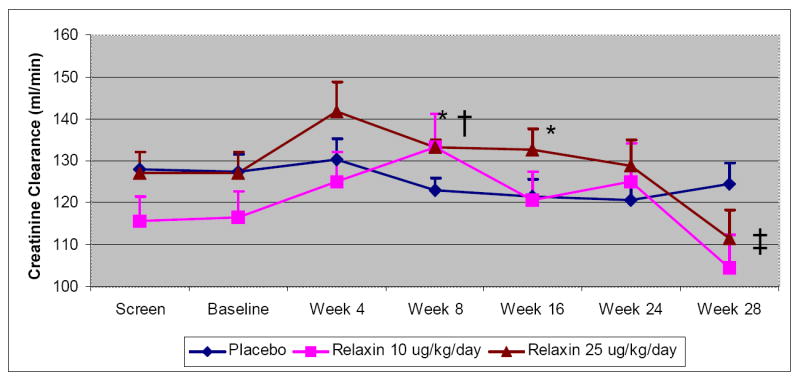
Results: The primary outcome measure, the modified Rodnan skin thickness score, was similar among the 3 groups at baseline and at weeks 4, 12, and 24. Secondary outcomes such as functional disability were similar in all 3 groups, while the forced vital capacity decreased significantly in the relaxin groups. The discontinuation of both doses of relaxin at week 24 led to statistically significant declines in creatinine clearance and serious renal adverse events (defined as doubling of serum creatinine, renal crisis, or grade 3 or 4 essential hypertension) in 7 patients who had received relaxin therapy but in none who had received placebo.
Conclusion: Recombinant relaxin was not significantly better than placebo in improving the total skin score or pulmonary function or in reducing functional disability in patients with dcSSc. In addition, relaxin was associated with serious renal adverse events, the majority of which occurred after stopping the infusion. If relaxin is used therapeutically for any conditions other than scleroderma, close monitoring of blood pressure and renal function must be performed.
Figures
References
-
- Samuel CS, Hewitson TD. Relaxin in cardiovascular and renal disease. Kidney Int. 2006;69(9):1498–502. - PubMed
-
- Unemori EN, Amento EP. Relaxin modulates synthesis and secretion of procollagenase and collagen by human dermal fibroblasts. J Biol Chem. 1990;265(18):10681–5. - PubMed
-
- Unemori EN, Bauer EA, Amento EP. Relaxin alone and in conjunction with interferon-gamma decreases collagen synthesis by cultured human scleroderma fibroblasts. J Invest Dermatol. 1992;99(3):337–42. - PubMed
-
- Unemori EN, Beck LS, Lee WP, Xu Y, Siegel M, Keller G, et al. Human relaxin decreases collagen accumulation in vivo in two rodent models of fibrosis. J Invest Dermatol. 1993;101(3):280–5. - PubMed
-
- Seibold JR, Korn JH, Simms R, Clements PJ, Moreland LW, Mayes MD, et al. Recombinant human relaxin in the treatment of scleroderma. A randomized, double-blind, placebo-controlled trial. Ann Intern Med. 2000;132(11):871–9. - PubMed
Publication types
MeSH terms
Substances
Grants and funding
LinkOut - more resources
Full Text Sources
Other Literature Sources
Medical
