Serum retinol and prostate cancer risk: a nested case-control study in the prostate, lung, colorectal, and ovarian cancer screening trial
- PMID: 19336558
- PMCID: PMC2717001
- DOI: 10.1158/1055-9965.EPI-08-0984
Serum retinol and prostate cancer risk: a nested case-control study in the prostate, lung, colorectal, and ovarian cancer screening trial
Abstract
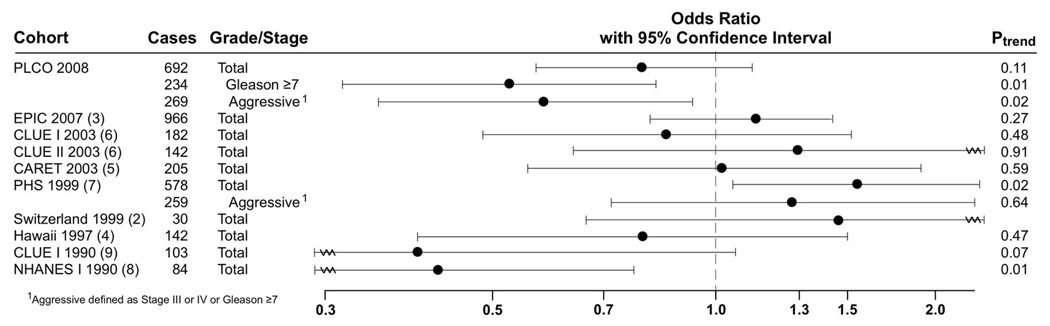
Vitamin A (retinol) plays a key role in the regulation of cell growth and differentiation, and has been studied as a potential chemopreventive agent for prostate cancer. However, findings from epidemiologic studies on the association between circulating retinol concentrations and the risk of prostate cancer are inconsistent. We examined whether serum concentrations of retinol were associated with the risk of prostate cancer in a nested case-control study using 692 prostate cancer cases and 844 matched controls from the Prostate, Lung, Colorectal, and Ovarian Cancer Screening Trial. We estimated the risk of prostate cancer using multivariate, conditional logistic regression to calculate odds ratios and 95% confidence intervals for overall prostate cancer and aggressive disease (stage III or IV or Gleason >7; n = 269). Serum retinol concentrations were not associated with overall prostate cancer risk; however, the highest versus lowest concentrations of serum retinol were associated with a 42% reduction in aggressive prostate cancer risk (P(trend) = 0.02), with the strongest inverse association for high-grade disease (Gleason sum >7; odds ratio, 0.52; 95% confidence interval, 0.32-0.84; P(trend) = 0.01). Our results suggest that higher circulating concentrations of retinol are associated with a decreased risk of aggressive prostate cancer. Further research is needed to better understand the significance of elevations in serum retinol concentrations and the possible biological mechanisms through which retinol affects prostate cancer.
Figures
References
-
- Dietary Reference Intakes for Vitamin A, Vitamin K, Arsenic, Boron, Chromium, Copper, Iodine, Iron, Manganese, Molybdenum, Nickel, Silicon, Vanadium, and Zinc. Washington D.C.: National Academy Press; 2001. - PubMed
-
- Eichholzer M, Stahelin HB, Ludin E, Bernasconi F. Smoking, plasma vitamins D, E, retinol, and carotene, and fatal prostate cancer: seventeen-year follow-up of the prospective Basel study. Prostate. 1999;38:189–98. - PubMed
-
- Key TJ, Appleby PN, Allen NE, et al. Plasma carotenoids, retinol, and tocopherols and the risk of prostate cancer in the European Prospective Investigation into Cancer and Nutrition study. Am J Clin Nutr. 2007;86:672–81. - PubMed
-
- Nomura AM, Stemmermann GN, Lee J, Craft NE. Serum micronutrients and prostate cancer in Japanese Americans in Hawaii. Cancer Epidemiol Biomarkers Prev. 1997;6:487–91. - PubMed
-
- Goodman GE, Schaffer S, Omenn GS, Chen C, King I. The association between lung and prostate cancer risk, and serum micronutrients: results and lessons learned from β-carotene and Retinol Efficacy Trial. Cancer Epidemiol Biomarkers Prev. 2003;12:518–26. - PubMed
Publication types
MeSH terms
Substances
Grants and funding
LinkOut - more resources
Full Text Sources
Medical