Twenty-four hour blood pressure pattern in patients with normal tension glaucoma in the habitual position
- PMID: 19337477
- PMCID: PMC2655738
- DOI: 10.3341/kjo.2009.23.1.32
Twenty-four hour blood pressure pattern in patients with normal tension glaucoma in the habitual position
Abstract
Purpose: To investigate the relationship between blood pressure (BP) parameters in the habitual position and glaucomatous damage at initial presentation in patients with untreated normal tension glaucoma (NTG).
Methods: Fifty-four eyes from 54 subjects diagnosed with NTG were consecutively enrolled. BP was measured with an automated ambulatory monitoring device in the habitual position during 24-hour in-hospitalization. Patients were classified into three groups: non-dippers, dippers, and over-dippers. corresponded to the degree of reduction in their nocturnal mean arterial pressure (MAP) compared with their diurnal MAP. Regression models were used to evaluate potential risk factors, including: age, pre-admission office intraocular pressure (IOP), central corneal thickness (CCT), and BP parameters. Functional outcome variables for glaucomatous damage included mean deviation (MD) and pattern standard deviation (PSD) on a Humphrey field analyzer (HFA). Anatomic outcome variables were TSNIT score (temporal, superior, nasal, inferior, and temporal) average, superior average, inferior average, and nerve fiber indicator (NFI) score on scanning laser polarimetry with variable corneal compensation (SLP-VCC; GDx-VCC).
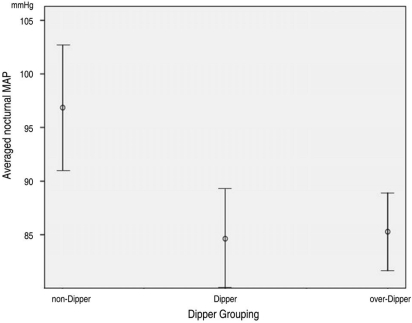
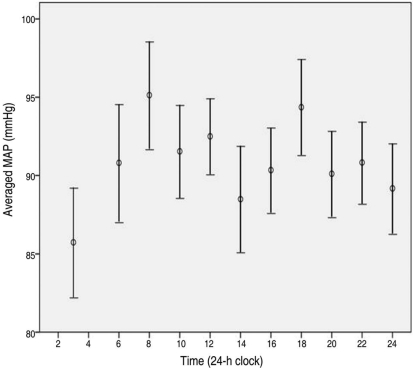
Results: Marked systolic blood pressure (SBP), diastolic blood pressure (DBP), and MAP fluctuation were noted in the over-dipper group (p<0.05). A linear regression analysis model revealed that nocturnal trough DBP and MAP, average nocturnal SBP, and MAP were all significantly associated with a decreased average TSNIT score and an increased NFI score.
Conclusions: Nocturnal BP reduction estimated in the habitual position was associated with structural damage in eyes with NTG. This finding may suggest systemic vascular etiology of NTG development associated with nocturnal BP reduction.
Keywords: 24-hour; Blood pressure; Habitual position; Normal tension glaucoma.
Figures
References
-
- Hayeh SS. The optic nerve circulation in health and disease. Exp Eye Res. 1995;61:259–272. - PubMed
-
- Flammer J, Orgul S. Optic nerve blood-flow abnormalities in glaucoma. Prog Retin Eye Res. 1998;17:267–289. - PubMed
-
- Bresson-Dumont H, Bechetoille A. [Role of arterial blood pressure in the development of glaucomatous lesions] J Fr Ophtalmol. 1996;19:435–442. - PubMed
-
- Cioffi GA, Sullivan P. The effect of chronic ischemia on the primate optic nerve. Eur J Ophthalmol. 1999;9(suppl 1):S34–S36. - PubMed
-
- Costa VP, Harris A, Stefansson E, et al. The effects of antiglaucoma and systemic medications on ocular blood flow. Prog Retin Eye Res. 2003;22:769–805. - PubMed
Publication types
MeSH terms
LinkOut - more resources
Full Text Sources
Medical