


Methylmercury exposure and adverse cardiovascular effects in Faroese whaling men
- PMID: 19337510
- PMCID: PMC2661905
- DOI: 10.1289/ehp.11608
Methylmercury exposure and adverse cardiovascular effects in Faroese whaling men
Abstract
Background: Methylmercury (MeHg), a worldwide contaminant found in fish and seafood, has been linked to an increased risk of cardiovascular mortality.
Objective: We examined 42 Faroese whaling men (30-70 years of age) to assess possible adverse effects within a wide range of MeHg exposures from consumption of pilot whale meat.
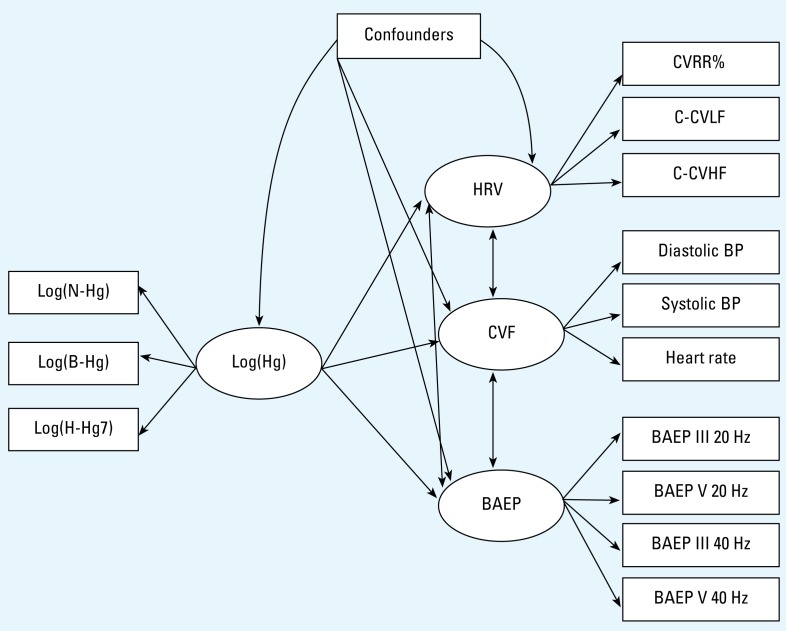
Methods: We assessed exposure levels from mercury analysis of toenails and whole blood (obtained at the time of clinical examination), and a hair sample collected 7 years previously. Outcome measures included heart rate variability (HRV), blood pressure (BP), common carotid intima-media thickness (IMT), and brainstem auditory evoked potentials (BAEP). We carried out multiple regression and structural equation model (SEM) analyses to determine the confounder-adjusted effect of mercury exposure. Taking into account correlations among related measures, we categorized exposure and outcomes in groups to derive latent exposure and response variables in SEMs. We used multiple regression analysis to compare the predictive validity of individual exposure biomarkers and the latent exposure variable on individual and latent outcomes.
Results: The toenail mercury concentrations varied widely and had a geometric mean of 2.0 microg/g; hair concentrations averaged about 3-fold higher. Mercury exposure was significantly associated with increased BP and IMT. This effect was reflected by SEMs, but mercury in toenails tended to be the best effect predictor.
Conclusions: The results support the notion that increased MeHg exposure promotes the development of cardiovascular disease.
Keywords: cardiovascular physiology; evoked potentials; food contamination; methylmercury; neurotoxicity; pilot whale; seafood.
Figures
References
-
- Akselrod S. Spectral analysis of fluctuations in heart rate and other cardiovascular parameters as a tool for the assessment of autonomic control. In: Korczyn AD, editor. Handbook of Autonomic Nervous System Dysfunction. New York: Marcel Dekker; 1995. pp. 469–493.
-
- Araki S, Murata K. Determination of evoked potentials in occupational and environmental medicine: a review. Environ Res. 1993;63:133–147. - PubMed
-
- Bollen KA. Structural Equations with Latent Variables. New York: John Wiley; 1989.
-
- Budtz-Jørgensen E, Grandjean P, Jørgensen PJ, Weihe P, Keiding N. Association between mercury concentrations in blood and hair in methylmercury- exposed subjects at different ages. Environ Res. 2004;95:385–393. - PubMed
Publication types
MeSH terms
Substances
Grants and funding
LinkOut - more resources
Full Text Sources
Medical