


Exposure to mouse allergen in U.S. homes associated with asthma symptoms
- PMID: 19337513
- PMCID: PMC2661908
- DOI: 10.1289/ehp.11847
Exposure to mouse allergen in U.S. homes associated with asthma symptoms
Abstract
Background: Most studies investigating the role of residential mouse allergen exposures in asthma have focused on inner-city populations.
Objective: We examined whether elevated mouse allergen levels were associated with occupants' asthma status in a nationally representative sample of U.S. households.
Methods: Data for this study were collected as part of the National Survey of Lead and Allergens in Housing. This cross-sectional study surveyed 831 housing units inhabited by 2,456 individuals in 75 different locations throughout the United States. The survey obtained information on demographics, household characteristics, and occupants' health status by questionnaire and environmental observations. We used a polyclonal immunoassay to assess concentrations of mouse urinary protein (MUP) in vacuumed dust collected from various indoor sites.
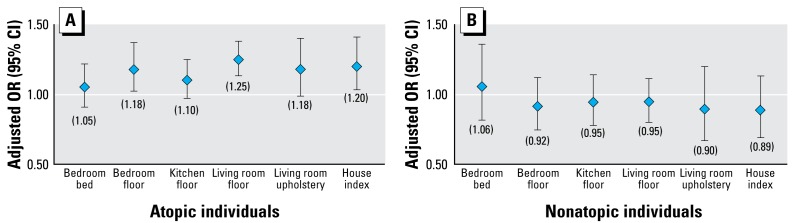
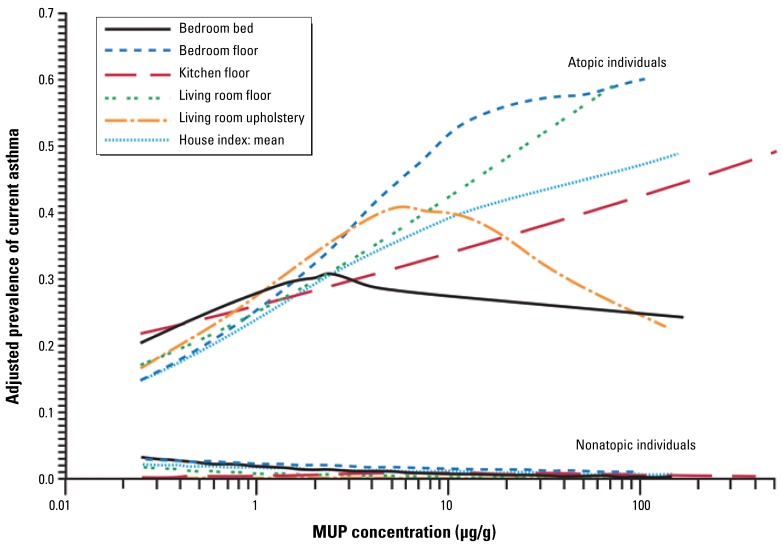
Results: Of the surveyed homes, 82% had detectable levels of MUP, and in 35% of the homes, MUP concentrations exceeded 1.6 microg/g, a level that has been associated with increased mouse allergen sensitization rates. Current asthma, defined as having doctor-diagnosed asthma and asthma symptoms in the preceding 12 months, was positively associated with increased MUP levels. The observed association was modified by atopic status; in allergic individuals, elevated MUP levels (>1.6 microg/g) increased the odds of having asthma symptoms [adjusted OR=1.93; 95% confidence interval (CI), 1.14-3.27], but we found no association in those who did not report allergies (adjusted OR=0.69; 95% CI, 0.33-1.44).
Conclusions: In allergic asthma, residential mouse allergen exposure is an important risk factor for asthma morbidity.
Keywords: allergy; asthma; exposure; indoor; mouse allergen.
Figures
Comment in
-
There's a mouse in the house.Curr Allergy Asthma Rep. 2010 Sep;10(5):306-7. doi: 10.1007/s11882-010-0124-0. Curr Allergy Asthma Rep. 2010. PMID: 20585905 No abstract available.
References
-
- Arbes SJ, Jr, Gergen PJ, Elliott L, Zeldin DC. Prevalences of positive skin test responses to 10 common allergens in the US population: results from the third National Health and Nutrition Examination Survey. J Allergy Clin Immunol. 2005;116(2):377–383. - PubMed
-
- Arif AA, Delclos GL, Lee ES, Tortolero SR, Whitehead LW. Prevalence and risk factors of asthma and wheezing among US adults: an analysis of the NHANES III data. Eur Respir J. 2003;21(5):827–833. - PubMed
-
- Bush RK, Stave GM. Laboratory animal allergy: an update. Ilar J. 2003;44(1):28–51. - PubMed
-
- Centers for Disease Control and Prevention. Asthma: National Health Interview Survey (NHIS) Data. 2006. [[accessed 31 March 2008]]. Available: http://www.cdc.gov/asthma/nhis/default.htm.
-
- Chew GL, Carlton EJ, Kass D, Hernandez M, Clarke B, Tiven J, et al. Determinants of cockroach and mouse exposure and associations with asthma in families and elderly individuals living in New York City public housing. Ann Allergy Asthma Immunol. 2006;97(4):502–513. - PubMed
Publication types
MeSH terms
Substances
Grants and funding
LinkOut - more resources
Full Text Sources
Medical